Monday, April 15, 2024


Largest Prison in The World

Israeli authorities claim “broad powers and discretion to decide who may enter its territory” and that “a foreigner has no legal right to enter the State’s sovereign territory, including for transit into the West Bank or aboard.”

  
4 mins read
 
Palestinians are seen at a temporary shelter in the southern Gaza Strip city of Khan Younis, Dec. 13, 2023. (Photo by Rizek Abdeljawad/Xinhua)

The UK Guardian reported in March 2024 that Cruising south along Israel’s coastal highway, there are almost no signs that one is approaching Gaza. Two million people live trapped on a thin slice of land along the Mediterranean, but someone could easily drive past and miss it altogether. For visitors to the strip, restricted mainly to diplomats, aid workers, and journalists, the last stop in Israel is a service station, where Red Sea-bound tourists and commuters sip lattes and eat chocolate croissants at an American-style coffeehouse. Walking back to their cars, they may glimpse the only hint of Gaza’s existence – a white orb high in the southern sky, a tethered surveillance balloon that provides the Israeli army with a 24-hour overhead view of the enclave.

A REPORT BY HUMAN RIGHTS WATCH REPORTED ON HOW ISRAEL’S TRAVEL BAN CRUSHED THE DREAMS OF THE PALESTINIANS IN GAZA. ISRAEL’S OBLIGATION TO GAZA UNDER INTERNATIONAL LAW

 Israeli authorities claim “broad powers and discretion to decide who may enter its territory” and that “a foreigner has no legal right to enter the State’s sovereign territory, including for transit into the West Bank or aboard.” While international human rights law gives wide latitude to governments about the entry of foreigners, Israel has heightened obligations toward Gaza residents. Because of the continuing controls Israel exercises over the lives and welfare of Gaza’s inhabitants, Israel remains an occupying power under international humanitarian law, despite withdrawing its military forces and settlements from the territory in 2005. Both the UN and the International Committee of the Red Cross, the guardians of international humanitarian law, have reached this determination. As the occupying power, Israel remains bound to provide residents of Gaza with the rights and protections afforded to them by the law of occupation. Israeli authorities continue to control Gaza’s territorial waters and airspace, and the movement of people and goods, except at Gaza’s border with Egypt. Israel must respect the human rights of Palestinians living in Gaza, including their right to freedom of movement throughout the Occupied Palestinian Territory and abroad, which affects both the right to leave a country and the right to enter their own country. Israel is also obligated to respect Palestinians’ rights for which freedom of movement is a precondition. The UN Human Rights Committee has said that while states can restrict freedom of movement for security reasons or to protect public health, public order, and the rights of others, any such restrictions must be proportional and “the restrictions must not impair the essence of the right; the relation between the right and restriction, between norm and exception, must not be reversed.” While the law of occupation permits occupying powers to impose security restrictions on civilians, it also requires them to restore public life for the occupied population. That obligation increases in a prolonged occupation, in which the occupier has more time and opportunity to develop more narrowly tailored responses to security threats that minimize restrictions on rights. In addition, the needs of the occupied population increase over time. Suspending virtually all freedom of movement for a short period interrupts temporarily normal public life, but long-term, indefinite suspension in Gaza has had a much more debilitating impact, fragmentating populations. The impact is particularly damaging given the denial of freedom of movement to people who are confined to a sliver of the occupied territory, unable to interact in person with the majority of the occupied population that lives in the West Bank, including East Jerusalem, and its rich assortment of educational, cultural, religious, and commercial institutions. After 55 years of occupation and 15 years of closure in Gaza with no end in sight, Israel should fully respect the human rights of Palestinians, using as a benchmark the rights it grants Israeli citizens. Israel should abandon an approach that bars movement absent exceptional individual humanitarian circumstances it defines, in favor of an approach that permits free movement absent exceptional individual security circumstances.

 YOUNG PALESTINIANS GROWING UP IN ISRAELI PRISON

 Most Palestinians who grew up in Gaza under Israeli closure have never left the 40-by-11-kilometer (25-by-7 mile) Gaza Strip. For the last 25 years, Israel has increasingly restricted the movement of Gaza residents. Since June 2007, when Hamas seized control over Gaza from the Fatah-led Palestinian Authority (PA), Gaza has been mostly closed. Israeli authorities justify this closure on security grounds, in light of “Hamas’ rise to power in the Gaza Strip,” as they lay out in a December court filing. Authorities highlight in particular the risk that Hamas and armed Palestinian groups will recruit or coerce Gaza residents “for the commission of terrorist acts and the transfer of operatives, knowledge, intelligence, funds or equipment for terrorist activists.” Their policy, though, amounts to a blanket denial with rare exceptions, rather than a generalized respect for the right of Palestinians to freedom of movement, to be denied only based on individualized security reasons.

SEPARATION BETWEEN GAZA AND WEST BANK

As part of the closure, Israeli authorities have sought to “differentiate” between their policy approaches to Gaza and the West Bank, such as imposing more sweeping restrictions on the movement of people and goods from Gaza to the West Bank and promoting separation between these two parts of the Occupied Palestinian Territory. The army’s “Procedure for Settlement in the Gaza Strip ” published in 2018, that “in 2006, a decision was made to introduce a policy of separation between the West Bank and the Gaza Strip in light of Hamas’ rise to power in the Gaza Strip. The policy currently in effect is explicitly aimed at reducing travel between the areas.” In each of the 11 cases Human Rights Watch reviewed of people seeking to reach the West Bank, including East Jerusalem, for professional and educational opportunities not available in Gaza, Israeli authorities did not respond to requests for permits or denied them, either for security reasons or because they did not conform to the closure policy. Human Rights Watch also reviewed permit applications on the website of the Palestinian Civil Affairs Committee, or screenshots of them, including the status of the permit applications, when they were sent to the Israeli authorities and the response received, if any. In short, one may easily conclude that Benjamin Netanyahu has to disappear from Israeli politics for the sake of Israel to exist as an entity and as Senate Majority Leader in the US and Pope Benedict’s most recent advice to Ukraine to surrender to the Russians for the world to live in peace.

Friday, March 22, 2024


Responsibility of The Muslim World On Israeli Actions In Gaza

Does the Islamic World have any responsibility for the incessant and horrific injustice being committed by Israel towards the Palestinian people?  

  
5 mins read
 
People wait to receive aid supplies in Gaza City, March 17, 2024. (Photo by Mohammed Ali/Xinhua)

HARRY TRUMAN’S COVER OF ISRAELI AIRSPACE

Does the Islamic World have any responsibility for the incessant and horrific injustice being committed by Israel towards the Palestinian people?  Is it because Harry Truman not only recognized Israel as an independent country and as such gave cover to Israeli air space during the short war with Egypt when Anwar Sadat could have given a death blow to Israel but for the US cover of Israeli air space?

HISTORIAN LAWRENCE REES AND ADOLF HITLER                  

Lawrence Rees, historian, and author, in his newest book published in March 2024 titled The Holocaust, wrote that “The fundamental precondition for the Holocaust happening was Adolf Hitler,” he explained that   “Even as far back as 1921, Hitler said that solving the Jewish question was a central question for National Socialism. And you can only solve it by using brute force.” Hitler had no blueprint for the Holocaust at that point, says Rees. But he did have a pathological problem with Jews. “Hitler believed that something needed to be done,” Rees explains, “and that evolved and changed according to circumstances and political opportunism. “An intriguing part of Rees’s book is his determination to figure out when the collective set of initiatives we now call the Final Solution became official Nazi policy. It’s a question that doesn’t come with a straightforward answer, Rees maintained. What is clear, though, is that in the summer of 1940, there was still no concrete plan in place for the extermination of Jews. Furthermore, up until that point, Rees argued, the Nazis were still clinging to the belief that in the long term, the way to solve what they called “the Jewish question” was by expulsion and hard labor. At that point, mass murder was still not the preferred option. By the summer of 1942, however, a sea change had taken place. By that time, the Holocaust was in full swing. Therefore, within the previous two-year period, Rees points out, there were several milestones on the road towards mass extermination. But trying to pinpoint an exact moment where the decision was taken to commit to mass killing is very difficult, says Rees — especially since much of the planning was done in secret without written records. Hitherto, many historians, filmmakers, and writers have pointed to a single meeting where plans for the Holocaust were finally decided upon in the power structures of Nazi officialdom.

WANSEE CONFERENCE AND ABSENCE OF HITLER, HIMMLER AND GOEBBELS

This was known as the Wannsee Conference. It was held in the Berlin suburb of Wannsee in January of 1942 and involved several mid-ranking Nazi officials devising a plot to murder Jews over a shorter timescale and in more efficient ways. But even then, Rees says, no final plans were resolved at the infamous conference. He also points out that key figures from the upper tiers of the Nazi hierarchy — Himmler, Goebbels, and Hitler himself — were not present. “I cannot see how there can have been a decision in 1941,” said Rees. ‘By that stage, you can say a decision to implement what we would now call the Holocaust had been The moment of no return for the Holocaust, said the historian, was in the spring and early summer of 1942, when a decision was taken to kill all of the Jews in the General Government in Poland — a German-occupied zone established by Hitler after the joint invasion by the Germans and Soviets in 1939.“By that stage you can say a decision to implement what we would now call the Holocaust had been made,” said Rees. Hungary was beautiful to the Nazis, given the number of Jews that resided there. The Jews were transported to Auschwitz between May and July of 1944, where they were murdered.

AMERICAN PHILOSOPHER HANNAH ARENDT’S BANALITY OF EVIL  AND ADOLPH EICHMAN’S ROLE IN THE EXTERMINATION OF JEWS

This plan for cold-blooded murder was deviously orchestrated by Adolf Eichmann, who at the time was stationed in Budapest.  What did Hannah Arendt mean by the banality of evil? A question asked by American philosopher Hannah Arendt. Lawrence Rees disagreed with Hannah Arendt though she continued to insist that one do evil without being evil. This was the puzzling question that the philosopher Hannah Arendt grappled with when she reported for The New Yorker in 1961 on the war crimes trial of Adolph Eichmann, the Nazi operative responsible for organizing the transportation of millions of Jews and others to various concentration camps in support of the Nazi’s Final Solution. Arendt found Eichmann an ordinary, rather bland, bureaucrat, who in her words, was ‘neither perverted nor sadistic’, but ‘terrifyingly normal’. He acted without any motive other than to diligently advance his career in the Nazi bureaucracy. Eichmann was not an amoral monster, she concluded in her study of the case, Eichmann in Jerusalem: A Report on the Banality of Evil (1963). Instead, he performed evil deeds without evil intentions, a fact connected to his ‘thoughtlessness’, a disengagement from the reality of his evil acts. Eichmann ‘never realized what he was doing’ due to an ‘inability… to think from the standpoint of somebody else’. Lacking this particular cognitive ability, he ‘committed crimes under circumstances that made it well-nigh impossible for him to know or to feel that he was doing wrong’. Arendt dubbed these collective characteristics of Eichmann ‘the banality of evil’: he was not inherently evil, but merely shallow and clueless, a ‘joiner’, in the words of one contemporary interpreter of Arendt’s thesis: he was a man who drifted into the Nazi Party, in search of purpose and direction, not out of deep ideological belief. In Arendt’s telling, Eichmann reminds us of the protagonist in Albert Camus’s novel The Stranger (1942), who randomly and casually kills a man, but then afterward feels no remorse. There was no particular intention or obvious evil motive: the deed just ‘happened’. This wasn’t Arendt’s first, somewhat superficial impression of Eichmann. Even 10 years after his trial in Israel, she wrote in 1971:I was struck by the manifest shallowness in the doer. ie Eichmann, which made it impossible to trace the uncontestable evil of his deeds to any deeper level of roots or motives. The deeds were monstrous, but the doer – at least the very effective one now on trial – was quite ordinary, commonplace, and neither demonic nor monstrous.

CRITICS OF HANNAH ARENDT

The banality-of-evil thesis was a flashpoint for controversy. To Arendt’s critics, it seemed inexplicable that Eichmann could have played a key role in the Nazi genocide yet had no evil intentions. Gershom Scholem, a fellow philosopher (and theologian), wrote to Arendt in 1963 that her banality-of-evil thesis was merely a slogan that ‘does not impress me, certainly, as the product of profound analysis’. Mary McCarthy, a novelist and good friend of Arendt, voiced sheer incomprehension.

CONCLUSION

On October 6 1981 Islamic extremists assassinated Anwar Sadat, the president of Egypt, as he reviewed troops on the anniversary of the Yom Kippur War. Sadat, who was shot four times, died two hours later. Despite Sadat’s incredible public service record for Egypt (he was instrumental in winning the nation its independence and democratizing it), his controversial peace negotiation with Israel in 1977-78, for which he and Menachem Begin won the Nobel Peace Prize, made him a target of extremists across the Middle East. Sadat had also angered many by allowing the ailing Shah of Iran to die in Egypt rather than be returned to Iran to stand trial for his crimes against the country.


Should Western Powers Ignore Putin’s Red Lines on Russian Security?

The West spends $150 billion on war and $60 billion on supporting poor countries.

  
6 mins read
 
Libyan leader Marshal Khalifa Haftar (C) was accorded a ceremonial welcome attended by Russian Defence Minister Gen. Yunus-Bek Yevkurov at a Moscow military airfield, September 26, 2023

RUSSIAN PRESIDENT ACCUSES THE US OF DEPLOYING MILITARY BASES NEAR RUSSIAN BORDER

On February 21, 2023, in a speech to the federal assembly in Moscow, Russian President Vladimir Putin accused the United States of deploying military bases near the borders with Russia. He accused the West of enslaving Ukraine for a big war. Putin said: “In the modern world, there should be no division into ‘civilized’ countries and all the rest. We were ready for constructive dialogue with the West. But in response, they received a hypocritical reaction – the expansion of NATO, the missile defense system, and the deployment of military contingents. Neither side has hundreds of military bases around the world like the US does. The whole planet is covered. In December 2021, Russia sent to the West a security guarantee agreement, but all positions were refused.”

RUSSIAN INVASION OF UKRAINE

The incoming information suggested that by February, everything was ready for another punitive action in the Donbas (in Ukraine) against which Kyiv threw artillery, planes, and tanks. “They started the war, and we used force to stop it. The next target after the Donbas was an attack on Crimea and Sevastopol. They are now talking about it openly. We protect our homes, and the goal of the West is unlimited power.

The West spends $150 billion on war and $60 billion on supporting poor countries. Endless accusations against Russia were heard at the Munich Conference. The feeling that this was done so that everyone would forget what the West has been doing in recent decades. And they plunged entire regions into chaos, released gin and bottles. Trillions of dollars are at stake under the guise of democracy. In the 1930s, the West opened the way for the Nazis to power in Germany.

In our time, they made anti-Russia out of Ukraine. The project is not new. It goes back to the 19th century. It was cultivated in Austria-Hungary, Poland to tear the historical regions away from our country. The West accelerated this project by supporting the anti-state anti-constitutional coup in 2014 in Kyiv. Russophobia was planted with ideologies. The Armed Forces of Ukraine use Nazi symbols and do not hide whose heirs they are. The West doesn’t give a damn who to bet on in the fight against Russia. The main thing is to fight against us. So, you can use at least terrorists, at least neo-Nazis, at least a bald traitor. And in the 1930s and now the idea is the same: to kindle a hotbed of war in the East. The people of Ukraine have become a hostage of the occupational pro-Western regime, which has been plundering its state for decades.

Nobody cares about people. They are prepared for slaughter and turned into consumables. Sad, scary to talk about it, but true. The responsibility for the escalation lies with the West and the Kyiv regime, for which its people are strangers. The more long-range systems fall back on Ukraine, the further we will be forced to push the threat away from our borders. The elites of the West want to turn a local conflict into a global confrontation. It is about the existence of our country. But they understand that it is impossible to defeat Russia on the battlefield. Hence the information attacks, lies, distortion of historical facts, and attacks on the Russian Orthodox Church and culture.

I would like to tell the West – look at the main books of world religions. It says that the family is the union of a man and a woman. But even these sacred values are questioned. The West is trying to undermine our society. But traitors will be held accountable. We will not arrange a witch hunt for those who have abandoned their homeland. Let them live with it. The main thing is that the citizens of Russia gave them a moral assessment. We are proud that the Russians understood our actions in Donbas and supported us. This is a manifestation of patriotism, a feeling that is historically inherent in our people. I want to thank our people for their courage and determination.”

US WAS THE ONLY COUNTRY EVER TO USE NUCLEAR WEAPONS

Recalling the devastations following the Second World War, Vladimir Putin accused the US of being the only country to use nuclear weapons twice, destroying the cities of Hiroshima and Nagasaki in Japan. “They created a precedent.” He also recalled during WWII the United States and Britain reduced Dresden, Hamburg, Cologne, and many other German cities to rubble, without the least military necessity. “It was done ostentatiously and, he said, without any military necessity. They had only one goal, as with the nuclear bombing of Japanese cities: to intimidate the rest of the world.”

US CARPET BOMBING OF VIETNAM AND LAOS

“The United States left a deep scar in the memory of the people of Korea and Vietnam with their carpet bombings and use of napalm and chemical weapons.” In Putin’s narrative, the US continues to occupy Germany, Japan, the Republic of Korea, and other countries, which the US cynically refers to as equals and allies. In his tirade against the US, Putin recalls that the Western elites are even shifting repentance for their historical crimes onto everyone else, demanding that the citizens of their countries and other peoples confess to things they have nothing to do with at all, for example, the period of colonial conquests.

RUDYARD KIPLING’S “WHITE MAN’S BURDEN”

“It is worth reminding the West,” Putin said, “that it began its colonial policy back in the Middle Ages, followed by the worldwide slave trade, the genocide of Indian tribes in America, the plunder of India and Africa, the wars of England and France against China, as a result of which it was forced to open its ports to the opium trade. What they did was get entire nations hooked on drugs and purposefully exterminate entire ethnic groups for the sake of grabbing land and resources, hunting people like animals. Bangladesh at that time being a part of undivided India felt the full brunt of the colonial British ‘civilizing Mission’ detailed by Rudyard Kipling in his ‘White Man’s Burden’.”

PUTIN’S GRIEVANCES OF THE US’ CONTINUED SANCTIONS AGAINST RUSSIA

Putin’s grievances against the US continue for the US demanding more and more sanctions against Russia and the majority of European politicians “obediently” going along with it. In Putin’s narrative, the West clearly understands that by pressuring the EU to completely give up Russian energy and other resources, the United States is practically pushing Europe toward deindustrialization in a bid to get its hands on the entire European market. “The dictates of the US are backed up by crude force, on the law of the fist. Sometimes it is beautifully wrapped; sometimes there is no wrapping at all, but the gist is the same – the law of the fist as Putin’s grievances against the US continue.”

PRINCIPLES UNDERLYING US MILITARY BASES AND NATO EXPANSION

Putin reasons that the deployment and maintenance of hundreds of military bases in all corners of the world, NATO expansion, and attempts to cobble together new military alliances, such as AUKUS and the like, and the creation of the Washington-Seoul-Tokyo military-political chain, is to contain Russia and now an emerging China on the global stage. “These are the principles that underlie US and NATO military doctrines that require total domination. Western elites are presenting their neocolonialist plans with the same hypocrisy, claiming peaceful intentions and talking about some kind of deterrence. This evasive word migrates from one strategy to another but only means one thing – undermining any sovereign centers of power. They have everything in their sights, including Russia’s next-door neighbors – the CIS countries. In launching the sanctions blitzkrieg against Russia, for example, reasons Putin that the whole world would follow the Western command. As it turns out, however, such a bright prospect does not excite everyone – other than complete political masochists and admirers of other unconventional forms of international relations. Most states refuse to ‘snap a salute’ and instead choose the sensible path of cooperation with Russia.”

MULTIPOLARITY DEFEATS PUTIN’S ARGUMENTS AGAINST THE US

“The problem with Putin’s reasoning is that the world has now become multipolar, and the US has to take along other freedom-loving countries to reach a consensus on any global problem. Such self-confidence is a direct product not only of the concept of exceptionalism first mentioned by the French nobleman Marquis de Lafayette, who had a close relationship with George Washington during the American War of Independence. Vladimir Putin’s reasons for the lack of Western press’s enthusiasm for US enmity towards Russia and now China are like Goebbels’s ocean of myths, illusions, and fakes, using extremely aggressive propaganda. ‘The more unbelievable the lie, the quicker people will believe it – that is how they operate,’ according to this principle. They point back at Russia and say: ‘That is the source of all your troubles.’ Russian President wants to make special note of the fact that there is every reason to believe that the Western elites are not going to look for constructive ways out of the global food and energy crisis that they and they alone are to blame for, as a result of their long-term policy, dating back long before the Russian invasion of Ukraine. They have no intention of solving the problems of injustice and inequality.”

CONCLUSION

Vladimir Putin reasons that the West would rather use other formulas they are more comfortable with. “And here it is important to recall that the West bailed itself out of its early 20th-century challenges with World War I. Profits from World War II helped the United States finally overcome the Great Depression and become the largest economy in the world, and to impose on the planet the power of the dollar as a global reserve currency. And the 1980s crisis – things came to a head in the 1980s again – the West emerged from it unscathed largely by appropriating the inheritance and resources of the collapsed and defunct Soviet Union. Now, to free itself from the latest web of challenges, the Western countries need to dismantle Russia as well as other states that ‘choose a sovereign path of development, at all costs, to be able to further plunder other nations’ wealth and use it to patch their holes’.

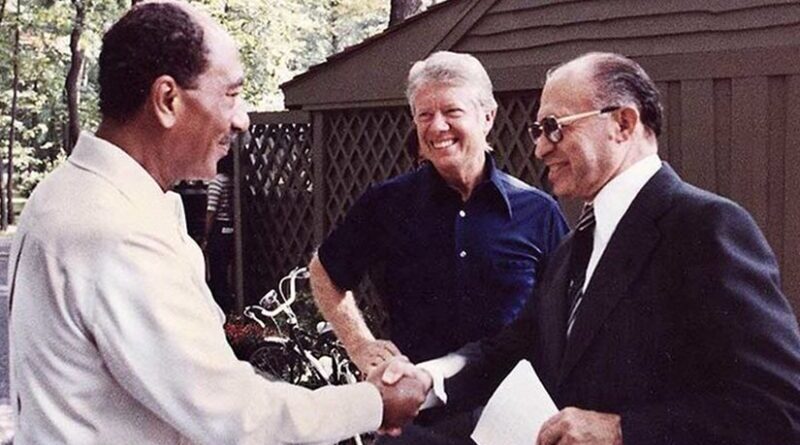
 Israel's Menachem Begin, US' Jimmy Carter and Egypt's Anwar Sadat at Camp David. US govt. archives, Wikipedia Commons.

Responsibility Of The Muslim World On Israeli Actions In Gaza? – OpEd

By 

Does the Islamic World have any responsibility for the incessant and horrific injustice being committed by Israel towards the Palestinian people?  Is it because Harry Truman not only recognized Israel as an independent country and as such gave cover to Israeli air space during the short war with Egypt when Anwar Sadat could have given a death blow to Israel but for the US cover of Israeli air space? 

Laurence Rees, historian, and author, in his newest book published in March 2024 titled The Holocaust, wrote that “The fundamental precondition for the Holocaust happening was Adolf Hitler,” he explained that   “Even as far back as 1921, Hitler said that solving the Jewish question was a central question for National Socialism. And you can only solve it by using brute force.” Hitler had no blueprint for the Holocaust at that point, says Rees. But he did have a pathological problem with Jews. “Hitler believed that something needed to be done,” Rees explains, “and that evolved and changed according to circumstances and political opportunism. “An intriguing part of Rees’s book is his determination to figure out when the collective set of initiatives we now call the Final Solution became official Nazi policy. It’s a question that doesn’t come with a straightforward answer,” Rees maintained.

What is clear, though, is that in the summer of 1940, there was still no concrete plan in place for the extermination of Jews. Furthermore, up until that point, Rees argued, the Nazis were still clinging to the belief that in the long term, the way to solve what they called “the Jewish question” was by expulsion and hard labor. At that point, mass murder was still not the preferred option. By the summer of 1942, however, a sea change had taken place. By that time, the Holocaust was in full swing. Therefore, within the previous two-year period, Rees points out, there were several milestones on the road towards mass extermination. But trying to pinpoint an exact moment where the decision was taken to commit to mass killing is very difficult, says Rees — especially since much of the planning was done in secret without written records. Hitherto, many historians, filmmakers, and writers have pointed to a single meeting where plans for the Holocaust were finally decided upon in the power structures of Nazi officialdom. 

This was known as the Wannsee Conference. It was held in the Berlin suburb of Wannsee in January of 1942 and involved several mid-ranking Nazi officials devising a plot to murder Jews over a shorter timescale and in more efficient ways. But even then, Rees says, no final plans were resolved at the infamous conference. He also points out that key figures from the upper tiers of the Nazi hierarchy — Himmler, Goebbels, and Hitler himself — were not present. “I cannot see how there can have been a decision in 1941,” said Rees. “By that stage, you can say a decision to implement what we would now call the Holocaust had been The moment of no return for the Holocaust,” said the historian, was in the spring and early summer of 1942, when a decision was taken to kill all of the Jews in the General Government in Poland — a German-occupied zone established by Hitler after the joint invasion by the Germans and Soviets in 1939.“By that stage you can say a decision to implement what we would now call the Holocaust had been made,” said Rees. The Jews were transported to Auschwitz between May and July of 1944, where they were murdered. 

Banality Of Evil?

This plan for cold-blooded murder was deviously orchestrated by Adolf Eichmann, who at the time was stationed in Budapest.  What did Hannah Arendt mean by the banality of evil? a question asked by German-American historian and philosopher. Laurence Rees disagreed with Hannah Arendt though she continued to insist that one can do evil without being evil. This was the puzzling question that Arendt grappled with when she reported for The New Yorker in 1961 on the war crimes trial of Adolph Eichmann, the Nazi operative responsible for organizing the transportation of millions of Jews and others to various concentration camps in support of the Nazi’s Final Solution. Arendt found Eichmann was an ordinary, rather bland, bureaucrat, who in her words, was ‘neither perverted nor sadistic’, but ‘terrifyingly normal’. He acted without any motive other than to diligently advance his career in the Nazi bureaucracy. Eichmann was not an amoral monster, she concluded in her study of the case, Eichmann in Jerusalem: A Report on the Banality of Evil (1963). Instead, he performed evil deeds without evil intentions, a fact connected to his ‘thoughtlessness’, a disengagement from the reality of his evil acts. Eichmann ‘never realized what he was doing’ due to an ‘inability… to think from the standpoint of somebody else’. Lacking this particular cognitive ability, he ‘committed crimes under circumstances that made it well-nigh impossible for him to know or to feel that he was doing wrong’.

Arendt dubbed these collective characteristics of Eichmann ‘the banality of evil’: he was not inherently evil, but merely shallow and clueless, a ‘joiner’, in the words of one contemporary interpreter of Arendt’s thesis: he was a man who drifted into the Nazi Party, in search of purpose and direction, not out of deep ideological belief. In Arendt’s telling, Eichmann reminds us of the protagonist in Albert Camus’s novel The Stranger (1942), who randomly and casually kills a man, but then afterward feels no remorse. There was no particular intention or obvious evil motive: the deed just ‘happened’. This wasn’t Arendt’s first, somewhat superficial impression of Eichmann. Even 10 years after his trial in Israel, she wrote in 1971: “I was struck by the manifest shallowness in the doer. ie Eichmann, which made it impossible to trace the uncontestable evil of his deeds to any deeper level of roots or motives. The deeds were monstrous, but the doer – at least the very effective one now on trial – was quite ordinary, commonplace, and neither demonic nor monstrous.” 

Critics Of Arendt

The banality-of-evil thesis was a flashpoint for controversy. To Arendt’s critics, it seemed inexplicable that Eichmann could have played a key role in the Nazi genocide yet had no evil intentions. Gershom Scholem, a fellow philosopher (and theologian), wrote to Arendt in 1963 that her banality-of-evil thesis was merely a slogan that ‘does not impress me, certainly, as the product of profound analysis’.

Mary McCarthy, a novelist and good friend of Arendt, voiced sheer incomprehension. 

Conclusion

On October 6, 1981 Islamic extremists assassinated Anwar Sadat, the president of Egypt, as he reviewed troops on the anniversary of the Yom Kippur War. Sadat, who was shot four times, died two hours later. Despite Sadat’s incredible public service record for Egypt (he was instrumental in winning the nation its independence and democratizing it), his controversial peace negotiation with Israel in 1977-78, for which he and Menachem Begin won the Nobel Peace Prize, made him a target of extremists across the Middle East. Sadat had also angered many by allowing the ailing Shah of Iran to die in Egypt rather than be returned to Iran to stand trial for his crimes against the country.

Friday, March 8, 2024


Pakistani Saga Continues Unabated

In Pakistan, the Army Establishment's firm grip on the nation undeniably confirms the presence of a Deep State in its governance.

  
4 mins read
 
Pakistani army vehicles take part in a military parade to mark Pakistan's National Day in Islamabad, Pakistan on March 25, 2021. [Photo by Muhammed Semih Uğurlu/Anadolu Agency.]

Pakistani saga continues unabated. Imran Khan and his political Party Pakistan Tehrik of Insaf, once favored by the army establishment, are banned from participating in the elections. Imran Khan is now serving fourteen years on corruption charges. In a letter to the famous British Journal, The Economist Imran Khan called the election a farce. His “ fault” was reading out to the National Assembly a coded telegram the Pakistani ambassador in the US had sent home. He is also accused of selling jewelry he and his wife received from places they visited which according to rules should have been deposited in government-maintained treasury. The Army Establishment has been in control of Pakistani politics either through martial law or through controlling the country from behind.

ARMY’S STRANGLEHOLD ON PAKISTAN CONTINUES

Except for a brief period of civilian rule after independence from British rule in 1947 the Army establishment has been in control of the country. The latest tally announced by the Election Commission on 13th February this year shows that the election of the leader of the house, or prime minister must win a simple majority – 169 of the 336 seats. There can be multiple candidates for prime minister. If no candidate secures a majority in the first round, a second vote is held between the top two candidates. Voting will continue till one person can secure a majority. Negotiations for a coalition government are taking place between former Prime Minister Nawaz Sharif’s party, with 75 seats. The party of Bilawal Bhutto Zardari, the son of a former President and assassinated former Prime Minister Benazir Bhutto whose father was also a former Prime Minister but was assassinated by the army establishment,  with 54 seats, as well as other smaller parties. Independent candidates backed by jailed former Prime Minister Imran Khan won the most seats – 93 – and they are also jostling for allies to form government. Candidates were vying for 264 seats out of the assembly’s 336 total number of seats.

DEEP STATE AND PAKISTAN ARMY

This stranglehold by the Army Establishment on Pakistani politics brings in the question of the Deep State which scholars have variously defined. The Economist has observed that American pundits have often used “deep state” interchangeably with the bureaucracies of the military and spy agencies, especially those bits that leak against the government. President Donald   Trump’s relations with his spies have been tense since the intelligence community determined that Russia had tried to influence the election in his favor. He had publicly challenged their assessments of his team’s ties with Russia, chastised them for past intelligence failures, and compared leaks against him to practices in Nazi Germany. His supporters cite “deep-state” leaks embarrassing to Trump’s administration as evidence of a shadowy network of unelected government officials undermining the president. (The president has not publicly used the term.) But the deep state started life as something else entirely. Citizens in Turkey, where the term originated, have long worried about the derin devlet (“deep state”), which refers to a network of individuals in different branches of government, with links to retired generals and organized crime, that existed without the knowledge of high-ranking military officers and politicians. Its goal was purportedly to preserve secularism and destroy communism by any means necessary, outside the regular chain of command. Starting in the 1950s Turkey’s deep state-sponsored killings, engineered riots, colluded with drug traffickers, staged “false flag” attacks, and organized massacres of trade unionists. Thousands died in the chaos it fomented. In its present avatar, “deep state” seems set to go the way of “fake news” in American discourse, a once-useful term rendered meaningless by promiscuous repetition, often about quite different things. Turkey is a pioneer here too. After a handful of city councils in Germany recently canceled rallies in support of Erdogan, Turkey’s foreign minister offered a simple explanation: “This is a systematic move of the German deep state”.

WARNING BY PRESIDENT EISENHOWER TO HIS SUCCESSORS

Coming back to the US one could refer to the farewell address of President Dwight Eisenhower in which he warned future presidents to “guard against the acquisition of unwarranted influence, whether sought or unsought, by the military-industrial complex.”. Following the tumultuous 2016 presidential election, President Donald Trump and his supporters suggested that certain unnamed executive branch officials and intelligence officers were secretly operating as a deep state to block his policies and legislative agenda by leaking information considered critical of him. President Trump,

STEVE BANON AND DEEP STATE ATTACK ON PRESIDENT DONALD TRUMP

White House Chief Strategist Steve Bannon, along with ultra-conservative news outlets like Breitbart News claimed that Former President Obama was orchestrating a deep state attack against the Trump administration. The allegation grew out of Trump’s unsubstantiated claim that Obama had ordered the wiretapping of his telephone during the 2016 election campaign.

CONCLUSION

Current and former intelligence officials remain divided on the question of the existence of a deep state secretly working to derail the Trump administration.  In an article published in The Hill Magazine, retired veteran CIA field operations agent Gene Coyle stated that while he doubted the existence of “hordes of government officials” operating as an anti-Trump deep state, he did believe the Trump administration was justified in complaining about the number of leaks being reported by news organizations. “If you are that appalled at the actions of an administration, you should quit, hold a press conference, and publicly state your objections,” said Coyle. “You can’t run an executive branch if more and more people think, ‘I don’t like the policies of this President therefore I will leak information to make him look bad.’” Other intelligence experts argued that individuals or small groups of individuals leaking information critical of a presidential administration lack the organizational coordination and depth of deep states such as those that existed in Turkey or the former Soviet Union. Coming back to Pakistan one has to admit that the Army Establishment’s stranglehold on the country proves beyond doubt the existence of Deep State in the formulation and conduct of the country.