Saturday, January 25, 2020

Is Inequlity Fated to Stay? The Case of Bangladesh.

Paper No 6536              Dated 25-Jan-2020
By Kazi Anwarul Masud
Hunger, Famine, Inequality, Injustice and many other words in English language may have different interpretation but are intrinsically intertwined and almost incestuous in origin. A person infested in famine must be hungry and is not equal in food intake compared to their richer compatriots. At the extreme pole one could cite one of the most famous quotes in history. At some point around 1789, when being told that her French subjects had no bread, Marie-Antoinette (bride of France's King Louis XVI) supposedly sniffed, “—“Let them eat cake.” Or one could revisit My Fair Lady and the conversation between Colonel Pickering and Alfred Do little where Do Little admonishes Colonel Pickering for boasting for having morals which Pickering could not have afforded had he been as poor as Do Little.
This brings us to the question: whether immorality is deeply connected with famine and hunger. In least developed countries hunger is a common affair and is generally accepted as a way of life. In the race for growth and development these countries get more embroiled with statistical improvement of growth for praise from the World Bank, IMF, Asian Development Bank and other international institution than really improving the life of greater number of people. Trending of lack of interest of women to marry less educated males    post-industrial society where the glass ceiling for the women to rise to be equal or higher than their male colleagues have been broken due to the demand for educated and technologically attired candidates regardless of gender.    “Just as manufacturing had previously displaced agriculture as the major source of employment, sociologist Daniel Bell argued, so the service sector was now displacing manufacturing. In a postindustrial, knowledge-based economy, the production of manufactured goods depended more on technological inputs than on the skills of the workers who actually built and assembled the products….
The revolution in information technology that has swept through the economy in recent decades, meanwhile, has only exacerbated these trends (What the Right and the Left Get Wrong By Jerry Z. Muller March/April 2013Foreign Affairs). Related to this post-industrial society’s emphasis on education Nobel Laureate Paul Krugman’s (THE UNEDUCATED AMERICAN)  blaming of the US’ progressive loss of global position partly on “fiscal responsibility” which greatly affected amount of money spent on education. Consequently, Krugman states that in the USA a college graduation rate is slightly below the average across all advanced economies.
In the context of less developed countries e Bangladesh, for example, prides itself for bringing the country’s poverty rate (people living below $1.90 a day) down to 21.8 percent while people living in extreme poverty, came down at 11.3 percent in 2018, according to the latest data of the Bangladesh Bureau of Statistics.    It has also been claimed that Bangladesh    would be able to attain SDG by eliminating poverty by 2030.  Though famine conditions have not been seen in Bangladesh for decades but the people living in extreme poverty cannot have the required amount of food necessary for living well. In other words, while people do not starve in Bangladesh a determinate number of people are undernourished with consequent denial of access to health and education. While an essential driver for development is hope, and Bangladesh’s promotion from LDC to low middle income country is laudable, an eminent economist points out that “not much is added to our achievement by calling ourselves a “non-LDC developing country”, if at all we have to find a new designation.” (May 15, 2018 Least Developed and Developing Countries-A matter of definition? Wahid Uddin Mahmud). 
Citing th lone case of South Korea who graduated to an industrialized countryafter the Second World WarDr Mahmud continues to explore the path on which Bangladesh should continue “What could then be our next target in terms of country classification? It could be graduating to the high-middle-income status according to the World Bank's classification, which will mean increasing the per capita income nearly fourfold in real terms; or, it could be becoming a developed or industrialized country in the sense it is understood in the common development terminology”. It is given that with enlarging population not necessarily able to gain from demographic dividend, lower productivity due to lack of required skill, dependence on remittance from expatriate manpower  and export of readymade garment, calamitous effects from climate change, losing arable land to feed the growing population, growing youth unemployment, possibility of political unrest that at present appears nowhere near the horizon and the country virtually ruled by a coalition of likeminded people Bangladesh may continue with the Political Capitalism  model--  an economic
system in which business controls government more than government controls business and the economic and political elite cooperate for their mutual benefit. If left unaddressed, in the words of Professor Jerry Muller (March/April 2013 Foreign Affairs), rising inequality and economic insecurity can erode social order and generate a populist backlash against the capitalist system at large. 
 Conceding the thesis the political capitalism is not the midway between socialism and capitalism one cannot but agree that capitalism breeds inequality of opportunity and an undeclared aristocracy emerging through marriage between the scions of ultra-rich families. Thus transference of movable and immovable assets are ensured from one generation to another and as the value of the assets increase over time they are concentrated in fewer hands. This develops the elitist class who are considered superior, by themselves of others, due to wealth and power
(the two are closely related as the retention of power is dependent on the support of the elites in society). In the US, for example, 1% of the population owns almost 39% of the wealth which is twice that the bottom 90% of the people own. Rising inequality, observes Paul Krugman, has both economic and political costs (Paranoia and Plutocrats January 24, 2014). Concentration of wealth in the hands of the few even with higher productivity may cause stagnant wages and worsening living standard along with unaffordability of good education, higher mortality due to lesser income as a proportion to medical costs. The moneyed class who are allied with power have to  contend with explosive resentment of the have-nots and consequent rise of autocrats and diminishing space of democratic values. One would be better advised that Adolph Hitler’s rise to power in 1930 general elections giving the National Socialist Party largest number of seats in the Reichstag was due to the disaffection of the German people with the worsening economic condition, Treaty of Versailles notwithstanding, and partly occasioned by the Great Depression forcing the US government to recall the loans earlier given to the German government. Albeit Thirties scenario is too dystopian and the rise of fascism to be replicated in the present day global society and one has to accept the fact that capitalism has come to stay packaged in basically two varieties---one Western capitalism imbued with democratic ideals and the other being the Chinese variety where private sector thrives under strict supervision by Chinese Communist Party.  The problem of unregulated capitalism result in the money accrued is spent on luxury not needed by the spender which political philosopher Benjamin Barber calls “infanitilisation” e.g. money spent on satisfying infantile desires. Barber’s criticism rests on his argument that while early capitalism encouraged virtues with the working men’s “robust motion of agency and spirited grittiness” while the decay that spells later day capitalism suffers from a paradox—“the needy are without income and the well-heeled are without needs”. This redoubles Paul Krugman’s doubts about the Conservatives that equality of opportunity will gradually bring about equality of income. Such views propagated by the conservatives ignore the culture of poverty resulting in the cycle of poverty also known as “development trap” denoting low income, poor education, poor housing and poor health. Since these disadvantages work in a circular fashion it becomes difficult to break out of this cycle. Conceding the premise that capitalism has come to stay or in any case is better than other alternatives the inequality in all its forms are evident in both developed and developing countries. An OXFAM study recently released tells us that India's richest 1 per cent hold more than four-times the wealth held by 953 million people who make up for the bottom 70 percent of the country's population, while the total wealth of all Indian billionaires is more than the full-year budget.
Releasing the study 'Time to Care' ahead of the 50th Annual Meeting of the World Economic Forum (WEF), rights group Oxfam also said the world's 2,153 billionaires have more wealth than the 4.6 billion people. The report flagged that global inequality is shockingly entrenched and vast and the number of billionaires has doubled in the last decade, despite their combined wealth (The Economic Times January 20, 2020).
 The situation is similar in Bangladesh. The gini coefficient, which is the economic measure of equality was 0.458 in 2010 rose to 0.482 in 2016. The rich has become richer while the poorer became poorer. Capital Dhaka being the center of administration and industrialization the income inequality increased between the urban and rural areas as did the migration to the city from rural areas. One saving factor has been the foreign remittance sent to village homes by Bangladeshi expatriates working abroad. While the World Bank, IMF, ADB and many others are praising the high growth rate of Bangladesh and have projected the rate of growth will remain high in the coming years unemployment remains a problem mainly due to disconnect between growth and employment opportunities.  The IMF mission that visited Bangladesh recently expressed concern over banking sector irregularity, reported by the media time and time again, can derail the growth momentum. IMF mission was also skeptical about the new regulations brought in to arrest the growing amount of bad loans, many of which, may become unrecoverable. What good is economic growth if its fruits are denied to the great majority of the people? Harvard Professor Joseph Nye jr, Nobel laureate Joseph Stieglitz among many others have questioned the efficacy of refusal to address the worry of the have-nots across the world. Very recently Klaus Schwab, the founder of the Davos based World Economic Forum (Capitalism Must Reform to Survive From Shareholders to Stakeholders January 16, 2020) has taken pains to inform the world that “Davos Manifesto’s opening line declared that “the purpose of professional management is to serve clients, shareholders, workers, and employees, as well as societies, and to harmonize the different interests of the stakeholders.”    This information is meant for those who are critical of Wall Street corporations who prefer shareholders’ interest to those of stakeholders.  In conclusion, both the developed and developing nations alike, must recognize the fact the statistical increase of Gross Domestic Product and euphoria over high growth rate alone will not endear any government to the people for votes in the next elections.
   The writer is a former Ambassador and Secretary f Bangladesh.         ..

Sunday, December 1, 2019


Intertwining of the global economy
 Kazi Anwarul Masud | Published:  August 12, 2017 19:09:10 | Updated:  October 24, 2017 21:32:17


Brexit and President Trump's 'America First' rhetoric notwithstanding it is unlikely that nationalism and economic nationalism would be able to arrest the march of globalisation. The world has become too complex and politico-economic relations have become intertwined for other ideologies to interfere in the conduct of global affairs.
A few examples below to point out the intertwining of the global economy:
n A rise in the price of onions in India has increased its price in Bangladesh. Bangladesh has contracted to buy rice from Cambodia because the price in Vietnam and Thailand has gone up. It is reported that a possible rice deal with Thailand may also be in the offing.  For building infrastructure Bangladesh has to borrow money and expertise from China.
n Sri Lanka-China agreement on building Hambantota port has debt-equity swap of 80-20 for China and Sri Lanka with China controlling stake in the port leased for 99 years with the possibility of Sri Lanka buying back the shares after 60 years. Many fear that Sri Lanka may fall into a Chinese debt-trap because its economy would not be able to afford the buyback. This caused last month both domestic and international concern due to suspected Chinese design to increase influence in the South Asia and Association of Southeast Asian Nations (ASEAN) regions (Africa also remains a Chinese target).
n The Bolivian, Venezuelan   and Russian reassertion of state control over energy and industry would not be sustainable in the long run. These are bravados of Bolivian President Evo Morales, Venezuelan President Nicholas Maduro and Russian President Vladimir Putin bravado for their domestic audiences.
n Before David Cameron's departure from No. 10 Downing Street the British demands to the European Union (EU) reportedly included EU make  two "explicit statements":  the UK will be excluded from any moves towards a European super state, and secondly, the Euro is not the official currency of the EU. Albeit late in the day, the pro-remain group argued that the vast majority of British and foreign economists warned that Brexit would be a disaster. The EU remains the world's largest economic area. Brexit would mean loss of hundreds of thousands of jobs and would have marginal control on immigration. In short, Britain remains in a flux as the negotiations have just begun and is expected to continue for two years.
n One could also mention Donald Trump's 'America First' dubbed by The New Yorker magazine as "Trump's dark nationalism" which is in stark contrast with the final inaugural address of Franklin Delano Roosevelt (FDR); Dwight Eisenhower's pledge to build strength to deter the enemy; John Kennedy's summons to the young Americans to fight for liberty; and Roland Reagan's call to fight "communist enemies".  The latest warning that President Trump has given to North Korea to cease its nuclear programme or to see its total annihilation   in a war is something that the world has never seen before. Though political in nature the economic policies successive US Presidents followed had little to do with protectionism.
TWO FACETS OF GLOBALISATION: Globalisation has not been bliss for everyone. Some have described it as "the aggressive programme for the imposition of Western norms of national economic management, economic deregulation and market opening, and facilitating takeovers of indigenous industries and agriculture by multinational companies." Predictably, the international financial institutions and other establishment "experts" have enthusiastically endorsed the expansion of unbridled capitalism throughout the world. The International Monetary Fund (IMF) officials argue, "Globalisation offers extensive opportunities for truly worldwide development." From their perspective, the increasing global integration of national economies holds great promise because "markets promote efficiency through competition and the division of labour...." Still, the IMF concedes, "markets do not necessarily ensure that the benefits of increased efficiency are shared by all." In his well-known book, The Lexus and the Olive Tree, the New York Times columnist Thomas Friedman insists, "Globalisation has fostered a flowering of both wealth and technological innovation the likes of which the world has never before seen." However, he admits that this historical process has produced substantial "disruption and dislocation".
A contrary opinion sees globalisation as "corporate-led globalisation" and the "unrestricted movement of capital" generating enormous profits for transnational corporations but producing significant economic, social, and political harm for the majority of nations and peoples. According to this opinion, "The undermining of small-scale, diversified, self-reliant, community-based agricultural systems and their replacement by corporate-run, export-oriented monocultures" is "a major contributing factor to global environmental devastation."
INTERDEPENDENCY OF ECONOMIES AT DIFFERENT LEVELS: But the call for economic nationalism/protectionism has not come about despite the financial crisis of 2007-2008 considered by many as the worst economic crisis since the Great Depression of 1930s. Contributing factors, as described by an economist, could have been (1) the integration and therefore interdependency of economies; (2) the complexity of the global economy, making it all but impossible to separate by nationality; (3) the greater extensity of world markets compared to the mid-20th century; (4) the redundancy of the various models of economic nationalism.
The question that arises is whether interdependency of economies at different levels can be beneficial. For example, a least developed country (LDC) lacking in physical and human capital, small population and lack of legal institutions that would guard foreign investment is unlikely to have close economic relations with a developed economy. In this case the developed economy is more likely to adopt an extractive policy towards the LDC if it is endowed with natural resources like oil and gas.
In the case of the USA and Europe, economic relations are likely to be more balanced not only because of the comparable economic factors but also because of similar political institutions and values. One can   bring into this debate of economic interdependency Samuel Huntington's hotly contested  Clash of Civilisations thesis in which he classified Western civilisation as comprising North America, Western and Central Europe, Australia and Oceania. He was in two minds whether to include Latin America and the former member states of the Soviet Union or to treat them as their own separate civilisations.
The close economic relations with the emerging economies like China and India with the Western world belies the thesis that trade is possible only with politically compatible countries. Up to June 2017 US exports to China amounted to $ 59338.9 million and imports amounted to $ 229909.9 million leaving a trade deficit of $ 170671 million. In 2016, deficit was $ 347016 million. President Trump is unhappy with Chinese alleged theft of intellectual property and he is pressuring China to cut steel production to ease global over supply.
With India, US imports until June 2017 has been $12105.9 million and imports have been $ 23610 million leaving a deficit of $ 11504 million. Trump had in the past included India in the list of countries stealing US jobs. During the recent visit of Indian Prime Minister this question was not raised.
The US, Chinese and Indian examples demonstrate an interdependent world where economic crisis in any one part affects, in varying degrees, other parts of the globe. It would be wise for the South Asian Association for Regional Cooperation (SAARC) region (Indo-Pakistan animosity remains an impediment) to start closest possible  economic relations while continuing to deal with the developed and developing regions of the world.
The writer is a former Ambassador and Secretary.
kamasud23@gmail.com


Saturday, September 21, 2019

US Global Primacy- Its Significance:SOUTH ASIA ANALYSIS GROUP

Paper No. 6496                   Dated 17- Sep-2019
By Kazi Anwarul Masud
The primacy of the US is expected to remain, though contested by somefor the forthcoming future. Though the emerging economies would like
to have some influence in the conduct of global affairs the huge gapbetween the US, China and India will constrain these powers to
challenge the US.
In 2030 per capita income of the US will be US $60000/- while that of China will be almost half and that of India is expected to be US $ 10000/-. According to IMF the GDP per capita in the US was $59,495 (PPP) / $59,500 (Nominal) as at end 2017. In China it was just $16,624 (PPP) / $8,643 (Nominal). Militarily America’s military superiority remains unrivaled spender.
The United States has a strong military alliance with Europe through NATO, Japan, Australia South Korea, GCC countries (Saudi Arabia, Qatar etc.), while China is not part of any significant military alliance. Could the US and Chin fall for “Thucydides Trap’? Given the latest US-China trade talks, reports by The New York Times (Alexandra Stevenson Sept 11 2019, President Trump’s vow to raise tariffs on $250 billion in Chinese goods, including cars and aircraft parts, to 30 percent from 25
percent on Oct. 1.  may chart a difficult path for the two countries to reach an amicable settlement.
One has to remember that China accounts for a large percentage of the US total imports. However, the US does not account for a similarly large percentage of China’s imports or exports. China imports and exports a lot with other Asian countries and Europe, not just with the US. Basically the US needs China more than China needs the US.  US trade deficit with China was $419 billion in 2018. Us imports was $540 billion while her export were $ 120 billion. That’s not to say China can ignore the US, butrather it is necessary for the global prosperity for the two to reach an amicable settlement.  It should not, however, be presumed that conflict for influence is inevitable. On the contrary efforts are being taken to enable nations to be more responsible. Indeed as Stephen Walt( of Harvard University) points out the world is inflicted by (Asia Has Three Possible Futures foreign policy SEPTEMBER 5, 2019) an escalating trade war between the United States and China, North Korea’s growing nuclear arsenal and improved missile capabilities, deteriorating relations between South Korea and Japan, and increased cooperation between the United States and the Association of Southeast Asian Nations, the Afghanistan peace talks and India’s heavy-handed actions in Kashmir. Walt’s scenario depicts rise of China and a stumbling US where “Unless India had somehow managed to keep pace with China, a balancing coalition confined to Asia would still be weaker than this hypothetical Chinese colossus and would face the usual dilemmas of collective action. This vision of the future is undoubtedly Beijing’s preferred scenario, and Chinese President Xi Jinping has suggested as much in the past.
Pushing the United States out of Asia and getting its immediate neighbors to defer to Chinese preferences would maximize Chinese security while making it easier for Beijing to project power in other areas that it might deem critical such as the Persian Gulf”. But does it have to be so? Democracy imbued with liberal principles still remain to be the preferred destination of most of the countries of the world. Besides China is faced with aging population, environmental degradation, lack of adequate water supplies, geopolitical constraints, restive minorities, financial imbalances, etc.), while the United States retains a number of important strengths, such as a highly favorable geographic location, ample natural resources, and a still-innovative economy.
 Stepping back to the 20th century one may recall that   during the Cold War neither of the super powers thought of nuclear war though the
world was at an edge during the Cuban missile crisis. Dwight Eisenhower’s refusal to use the atomic bomb was a reflection of Eisenhower Doctrine to keep peace after the untold devastation wrought by the Second World War.  This required him to stand steadfast in the gap against civilian and military authority who wished to lower the
threshold or trigger for authorizing the use of nuclear weapons in any confrontation with the Communists. Instead, he refused to use atomic bombs in the Korean War, or against China in that War, or in later fighting over the islands of Quemoy and Matsu off of Formosa after the Nationalist Chinese fled from the mainland. The islands had no strategic value, which he easily recognized since he could not be bluffed or fooled on military matters. Significantly, he fully
recognized that nuclear war with the Soviets would be the end of civilization, and he acted accordingly to prevent atomic War.  Thedoctrine was intended to check increased Soviet influence in the Middle East, which had resulted from the supply of arms to Egypt by communist countries as well as from strong communist support of Arab states against an Israeli, French, and British attack on Egypt in October 1956. Eisenhower proclaimed, with the approval of Congress,
that he would use the armed forces to protect the independence of any Middle Eastern country seeking American help.  It was a continuation
of the U.S. policy of containment of or resistance to any extension of the Soviet sphere of influence. The continuing struggle got influence
between the East and the West came to an end with the fall of the Berlin Wall and the dissolution of the Soviet Empire.
In contrast Harry Truman was the only head of government who actually used a nuclear weapon in warfare. After entering into office, he learned of the atomic bomb and had to decide whether or not to use it. Although he knew that Japan was seeking to surrender, he chose to use the bomb on
two Japanese cities in short succession. This brought the war to a quick end. Truman's other motive was to deter USSR from expanding the
limits of Eastern Europe. Truman in an address to the Congress appealed for support to stop the expansion of communism. He said "Atthe present moment in world history nearly every nation must choose between alternative ways of life. The choice is too often not a freeone. One way of life is based upon the will of the majority, and is distinguished by free institutions, representative government, free elections, guarantees of individual liberty, freedom of speech and religion, and freedom from political oppression. The second way of life is based upon the will of a minority forcibly imposed upon the majority. It relies upon terror and oppression, a controlled press and radio, fixed elections, and the suppression of personal freedoms".
Pronouncement by Pres. Harry Truman. Engaged in the Cold War with theSoviet Union, the U.S. sought to protect those countries from falling
under Soviet influence after Britain announced that it could no longergive them aid. Despite the moral support of a part of the world to
Truman Doctrine one could smell a whiff of Machiavellism.
Machiavelli set the precedent for the cold and calculated regardless of the century they live in. He discusses frankly, the necessity of
cruel actions to keep power. He was in the business of power  preservation not piety. Those who desire power in any situation may
look to his strategies for solid aid. "...he (the leader of the state) must stick to the good so long as he can, but, being compelled be
necessity, he must be ready to take the way of the evil.  Thus the term Machiavelli’s is defined: "The political doctrine of Machiavelli, which denies the relevance of morality in political affairs and holds that craft and deceit are justified in pursuing and maintaining political power." .
 It was a continuation of the U.S. policy of containment of or resistance to any extension of the Soviet sphere of influence. The continuing struggle got influence between the East and the West came to an end with the fall of the Berlin Wall and the dissolution of the Soviet empire. As the world saw during the Iraq war George Bush's failure to bring together the important players like Russia, China and France who after the fleeting unipolar moment wanted a multipolar world to regulate international affairs.
Yet Harvard Professor Joseph Nye   like conservative Robert Kagan believes that American power and leadership will remain crucial to stability and prosperity at home and abroad. But presidents will be better served by remembering their transactional predecessors’ observance of the credo
“Above all, do no harm” than by issuing stirring calls for transformational change.
The problem arises when non-state actors like al-Qaeda and now ISIS in the name of a faith is causing turbulence in
a world that is transforming from industrial age to an information age. Whether such a change with consequent unemployment will bring
happiness to the people of the world is debatable. As is debatable the progression of people from one class to another. Barring exceptions
people are more likely to find themselves bound in the same class, albeit with more money than their parents earned, compared with those
born with silver spoon in their mouth. One may cite FDR and JFK as an examples of gaining the highest office in the land while most of the
post-second world war Presidents came from modest background. Yet social scientists and economists are convinced that the great divide
between the rich and the poor has come to stay.  This divide more prominent between the developed and the developing nations coupled
with religious divide will not let the world the rest in peace.
Many in the West would agree with people like Christopher Caldwell that the grim fact is that no Western European country—not one— has managed even a marginally successful integration of its Muslim immigrants, despite half a century of vast treasury outlays, wholesale
constitutional re-workings, and indefatigable excuse-making. One isdrawn to the conclusion that no successful integration was ever to be
expected. Larger historical currents were at play. Islam was on the rise. Europe had lost its élan vital, or whatever you choose to call
it. The idea that Europe could handle a mass immigration of Muslims may have been a momentous historical mistake.
As Roy Jenkins, the leader of the Liberal Democrats in Britain, remarked in 1989, “We might have been more cautious about allowing the creation in the 1950s of substantial Muslim communities.” Additionally, there are people like Bernard Lewis and Samuel Huntington with his civilizational
thesis to spur the movement of a fresh crusade though not in mediaeval form. The question is does it have to be so? The formation of G-20 or
BRICS or ASEAN-- have all been directed towards economic benefit (EU is omitted as all   are of the same faith though that is not the
binding rope). In South Asia SAARC is a glaring example of economic cooperation which hopefully will turn into a customs union and a free
trade area. The similarities are more than   the differences. Yet there is tension particularly between Pakistan and India, and to an extent though dormant in Bangladesh.
Though India has signed on to the China sponsored AIIB one trillion offered by China for the infrastructural development of the Belt and Road Initiative may only provide seed money as the Asian Development Bank estimates that Asian infrastructural development will need more than $ 20 trillion dollars.
Yet the Chinese initiative should be welcomed but the recipients should be careful lest they fall into a “Debt Trap” like a few other
countries. For countries like Bangladesh it would be easier to cooperate with India as closely as possible because of shared history,
culture, language (with West Bengal), and entwined economic interests.
The writer is a former Ambassador and Secretary of Bangladesh.

Monday, September 16, 2019


11:00 PM, November 21, 2009 / LAST MODIFIED: 11:00 PM, November 21, 2009

Time to wake up from stupor

THE Washington-based Centre for Strategic and International Studies, before the 1/11 change in its Transnational Threat Update, stated: "The current security climate in Bangladesh may allow terrorist groups to organise attacks using a radiological dispersal device. Concerns over this possibility are plausible given that radio substance have proven accessible to terror groups within the country." The recent arrests of militants from Pakistan and India, activists of banned Lashkar-e-Toiba, some of whom were educated in engineering in Bangladesh while recruiting prospective terrorists, confirm anew Eliza Griswold's report in the New York Times (January 2005), raising the possibility of Bangladesh giving birth to the next Islamist revolution. Travelling through Bangladesh, she concluded "The global war on terror is aimed at making the rise of regimes like that of the Taliban impossible, in Bangladesh the trend could be going the other way." In Griswold's footsteps, Bertil Linter's article in the Far Eastern Economic Review (April 2002) warned of the rise of Islamic fundamentalism in Bangladesh. Time magazine and the Asian Wall Street Journal alleged of sanctuaries being given to transnational Islamist elements.

In the eyes of Robert Kaplan, many in Bangladesh view it as a weakly governed state (The Atlantic-September 2009), surprisingly ignore David Held's (of London School of Economics) assertion that we no longer live in a world of discrete national communities but in a world of "overlapping communities of fate." So the Muslims in Bangladesh do not constitute the majority community as they are surrounded by Hindu majority India and Buddhist majority Myanmar, and in the vicinity of non-Muslim South East and Far East Asian countries.

Militancy will not decrease in Bangladesh unless the primary education system is urgently addressed. Mainly due to poverty, coupled with Islamic fervour, people in general send their children to get educated at village madrasas. Since madrasa education is free, but does not carry much financial reward in a labour market demanding non-ecclesiastical skills, students graduating from madrasas are forced to become madrasa teachers or priests in mosques. Coming from impoverished families, they are forced back into poverty in a world racing for material advancement. This vicious cycle of poverty and deprivation find expression in anti-Western feelings, particularly in the aftermath of the decimation of Afghanistan and the illegal invasion of Iraq. Many madrasa students may find Osama bin Laden as a hero. Understandably, the US Congress keeps itself informed of the madrasa education in South Asia. A report by the Congressional Research Service -- "International Terrorism in South Asia" -- states that among the approximately ten thousand madrasas in Pakistan, some have been implicated in teaching militant anti-western and anti-universal values.

The emergence of religious intolerance in Bangladesh, particularly during the BNP-Jamaat regime, should be seen in a global context. If Muslims are to prove historian Bernard Lewis wrong, that "Islam was never prepared, either in theory or in practice, to accord full equality to those who held other forms of worship, and that the centuries old rivalry between Christianity and Islam is no less than a clash of civilisations -­ the perhaps irrational but surely historic reaction of an ancient rival against our Judeo-Christian heritage, our secular present, and the world wide expansion of both," then the Islamic world would have to abjure stoning and imprisoning of rape victims, public flogging, stoning and decapitation of criminal offenders. Globalisation is no longer a choice; it is a reality that all countries have to deal with.

In this game, the West has a decided advantage over the Muslim world, particularly the least developed among them. Countries like Bangladesh, suggests Dr. Biru Prakash Paul (The Daily Star, 15.11.09), should address modern trends and future needs in higher education to ensure quality in education. According to Cybermatrics Lab, Dhaka University has been ranked 4922 among 6000 universities in the world. Indian and Pakistani universities attend American job markets to select the best possible candidates, as do universities in France, Egypt, Singapore and China.

Nobel laureate Paul Krugman (The Uneducated American, October 2009) wrote that if one had to explain US economic success in one word, it would be "education." In the 19th century, America led the way in universal basic education and as other nations followed suit, the "high school revolution" of the 20th century took the Western world to its height of prosperity, and the US continued to lead the world in higher education. Krugman is disappointed that due to the current economic meltdown, described by Josef Stiglitz as a tsunami shock to capitalism and free market as the collapse of the Berlin Wall had been to communism (stoutly refuted by his Columbia University colleague Jagadish Bhagawati), education, mainly the responsibility of state and local governments, has become a victim of austerity as in many other sectors of the economy.

It is possible that emerging economies -- China and India ­- will lead in producing more engineers, doctors and scientists than the US and the West, and bring into question the technological superiority, claimed by some academics as one of the pillars, as to why the 21st century would continue to be the next American, and not Chinese, century.

Unless we wake up, our society will be irreversibly pulled down towards the labyrinth of underdevelopment and darkness

Kazi Anwarul Masud is a former Secretary and ambassador.

Friday, September 13, 2019

SOUTH ASIA ANALYSIS GROUP SAAG

Communalism and India

Paper No. 5871                                Dated 14-Feb-2015
By Kazi Anwarul Masud
Here is a thoughtful essay on Indian communalism and the fears of many well meaning people like the author. To me the issue is not that serious and I am sure the composite culture of India will survive now and in future too as it had survived for centuries in this country. Director:)
Noted Indian historian Bipin Chandra defined communalism as "the belief that because a group of people follow a particular religion, they have, as a result, common social, political and economic interests."
Dilip Simeon, an Indian Labor historian and public intellectual expanded Bipin Chandra’s definition by adding "When communalism achieves state-power, the distinction between community and nation seems to vanish, and the task of critical comprehension becomes even more difficult. The problems do not end here. Communal ideologues possess the gift of speaking with several tongues in a reasonably straight face since self-righteous innocence was (and still is) the emotional ground of every type of communalism, each saw itself as a mere ‘reaction’ to the ‘communalism’ of the other, and the air was often thick with ringing denunciations of communalism by communalists".
Initially when Narendra Modi and BJP won the last general elections in India many among the secularists and Indian intelligentsia had apprehended that perhaps the philosophy of Balgangadhar Tilak’s of uniting all sects to create a "mighty Hindu Nation" would come to pass. This fear was further strengthened by BJP’s victory in Maharashtra and Haryana and winning second position in Jammu & Kashmir. But the resounding victory of Aam Admi Party in Delhi where APP captured 67 seats out of 70 in the Delhi Assembly and reduced BJP to only 3 seats has given hope that India of Lokomanya Tilak’s period and India, an emerging great power in the 21st century, has to be different because the Muslim population constitutes more than 160 million and the Christians, Buddhists and people following other faiths are no less Indians than the Hindus.
It is difficult to imagine an India playing a central role in South Asia, a member of BRICS and other regional organizations, a permanent member of the UN Security Council( recently endorsed by President Obama) while supporting Shiv Sena’s demand for a Hindu Rashtra and Lokmanya’s vicious opposition to the Age of Consent Bill outlawing marriages for girls less than twelve years of age; his refusal to acknowledge an appeal addressed to him by Bombay’s Untouchables for support their temple-entry programme; and opposition to Vithalbhai Patel’s Bill for validating inter-caste marriages on the ground that it was anti-Hindu and especially anti-Brahmin.
Ananya Bajpai write up on Narendra Modi’s victory in the Indian elections in the context of Hindu revivalism beginning in the nineteenth century, when India’s encounter with colonialism produced periods of internal reflection, revision, criticism, and revival among Indian intellectuals and religious leaders, new schools and strands of "reform Hinduism" have led to important changes in traditional beliefs and practices provides an interesting insight.. Chief among these revisionist figures was Vinayak Damodar Savarkar, who pushed for Indian independence from the United Kingdom and who, during the 1920s, developed the concept of Hindutva. In order to possess Hindutva, Savarkar claimed, a person must think of India as both his "fatherland" and his "holy land." He must be attached to India not simply through the fact of his birth there but through a love for "Hindu civilization," which Savarkar defined as representing "a common history, common heroes, a common literature, common art, a common law and a common jurisprudence, common fairs and festivals, rites and rituals, ceremonies and sacraments."..
Savarkar’s dream of a Hindu Rashtra was kept alive over the decades by groups such as the RSS and, later, by the BJP, which transformed Savarkar’s extreme vision of Hindu supremacy with a more palatable pro-business, technocratic approach to politics, all the while stoking Hindu nationalist sentiment by exploiting tensions between Hindus and Muslims. Narendra Modi has perfected this synthesis skilfully making some Indian liberals willing to believe that despite his decades of involvement in Hindu nationalist causes, Modi embraced Hindutva mostly as an electoral strategy and the "real" Modi is not a divisive ideologue but a pragmatic, growth-oriented manager( Foreign Affairs- The Triumph of the Hindu Right/SEPT-OCT ISSUE).
Yet the fear of a divided India along religious lines persists, the fear strengthened by recent conversion of Muslims into Hinduism popularly known as ghar wapsi ( return to the fold) held at Agra. While conversion/reconversion is not illegal conversion in exchange of material benefits is believed to be against the law.
President Barak Obama, the only US President to have visited India twice, in his most recent speech on 27th January in the Siri Fort speech in Delhi said that every person has the right to practice his faith without any persecution, fear or discrimination. India will succeed so long it is not splintered on religious lines," Obama told the audience comprising mainly young people. Obama cited the Indian Constitution dealing with Freedom of religion that guarantees that all people are equally entitled to the freedom of conscience and have right to freely profess and practice and propagate religion. Obama told his audience of the intolerance, violence and terror perpetrated by those who profess to be standing for upholding their faith and warned that all have to guard against any efforts to divide people on sectarian lines or any other thing.
Back in the US speaking at the White House National Prayer Breakfast, Obama spoke of his visit to India - an incredible, beautiful country, full of magnificent diversity - but a place where, in past years, religious faiths of all types have, on occasion, been targeted by other people of faith, simply due to their heritage and their beliefs - acts of intolerance that would have shocked Mahatma Gandhi.
President Obama’s reiteration of the theme of conversion in India and attack on Christians has been seen by some Indian commentators as an indictment on the religious agenda of Narendra Modi. One may wish to recall the editorial of the New York Times that the Gujarat model has a less attractive side to it: a requirement that the state’s curriculum include several textbooks written by Dinanath Batra, a scholar dedicated to recasting India’s history through the prism of the Hindu rightwing. Batra’s teachings instruct students to draw maps of "Akhand Bharat," a greater India, presumably restored to its rightful boundaries, that include Bangladesh, Sri Lanka, Tibet, Nepal, Pakistan and Afghanistan. Batra also believes that aircraft, automobiles and nuclear weapons existed in ancient India, and he wants children to learn these so-called facts. In 1999, the national government, then led by the Bharatiya Janata Party, put Batra in charge of rewriting history textbooks to reflect these and other views of the Hindu right.
Now it appears that the party intends to pick up where it left off when it was voted out of power in 2004. The education of youth is too important to the country’s future to allow it to be hijacked by ideology that trumps historical facts, arbitrarily decides which cultural practices are Indian, and creates dangerous notions of India’s place alongside its neighbors.
It is amazing when one reads Amatya Sen’s An Assessment of The Millennium where he speaks about the influence of Islam on Indian culture. Sen says "that unlike the British rule in India where the rulers remained separate from the ruled, Muslim rules in India were combined with the presence of a large proportion of Muslims in the population itself. A great many people in the land embraced Islam, so much so that three of the four largest Muslim national populations in the contemporary world are situated in this subcontinent: in India, Pakistan and Bangladesh. Islam was by then a native Indian religion.
It is also worth noting that though Islam remained a separate religion from Hinduism, the roles of the different communities in the cultural life of the country were largely integrated. ..While references to raids from Ghazni and other isolated elements of divisive history remains tactically potent and even flammable in the contemporary politics of India, the nature of the present-day Indian civilization cannot be understood without seeing it as a joint product of many influences of which the Islamic component is very strong.".
If India is to get the global prominence that requires a constellation of big productive population, military and economic might then it has to jettison the introverted and sectarian idea of the dominance by the majority.
John Stuart Mill 19th century British philosopher, political economist and an influential contributor to social and political theory and political economy noted that cultural constraints on individuals could have a stronger impact on them than the pursuit of personal financial gain. Max Weber, the German social scientist argued that the Protestant work ethic, supported by Reformation teachings that the pursuit of wealth was a duty, inculcated the virtues needed for maximum economic productivity. For this reason, Protestants were more productive than Catholics throughout Europe- Germany and Great Britain, for instance, compared to Ireland, Spain, Portugal and Italy in his day (The Role of Culture in Economic Development-June 2009). Level of development is determined by how efficiently and intensely the inputs are utilized in production.
Is efficiency particular to any ethnic or religious group? Amy Chua in her highly acclaimed book The World on Fire cites the example of ethnic Chinese in the Philippines, accounting for less than two percent of the population, control 60% of the nation's private economy, including the country's four major airlines and almost all the country's banks, hotels and shopping malls. But it is not just in the Philippines that Chinese ethnic minorities have made their mark. They have come to dominate business in other parts of Southeast Asia as well-especially Indonesia, Thailand, Burma and Malaysia.
Gregory Clark’s book Farewell to Alms, explores the inequality of culture. It was no accident, he argues, that the Industrial Revolution occurred in Great Britain and not some other nation. It was not propelled by the invention of a few power-driven machines but was gradual taking place over the course of several hundred years prior to the 19th century. In his way of thinking, the Industrial Revolution would have never occurred had it not been for the changes in values that were happening for centuries before. Value changes occurred in losing taste for violence, a society with high population growth among the well-to-do, one in which people had to work hard and long to gain a competitive advantage over their peers, a society that was increasingly literate and patient. Thrift, hard work, tenacity, honesty and tolerance are the cultural factors that make all the difference. and have decisive say on what economies will succeed and which will fail.
In case of India she would be well advised to be imbued with the values that makes a country great and a leader in the multipolar world. Narendra Modi’s expressed intention to further relations with India’s neighbours and implement various projects for regional cooperation would stand his country in good stead.
One hopes that India under Modi’s leadership would not be divisive but follow policies befitting a permanent member of the UNSC and prove World Bank and IMF projections correct that India will become the world’s fastest-growing major economy in the next several years.

Thursday, September 12, 2019

Brexit saga and populismFINANCIAL EXPRESS 12TH SEPTEMBER 2019

 Kazi Anwarul Masud |  September 12, 2019 00:00:00

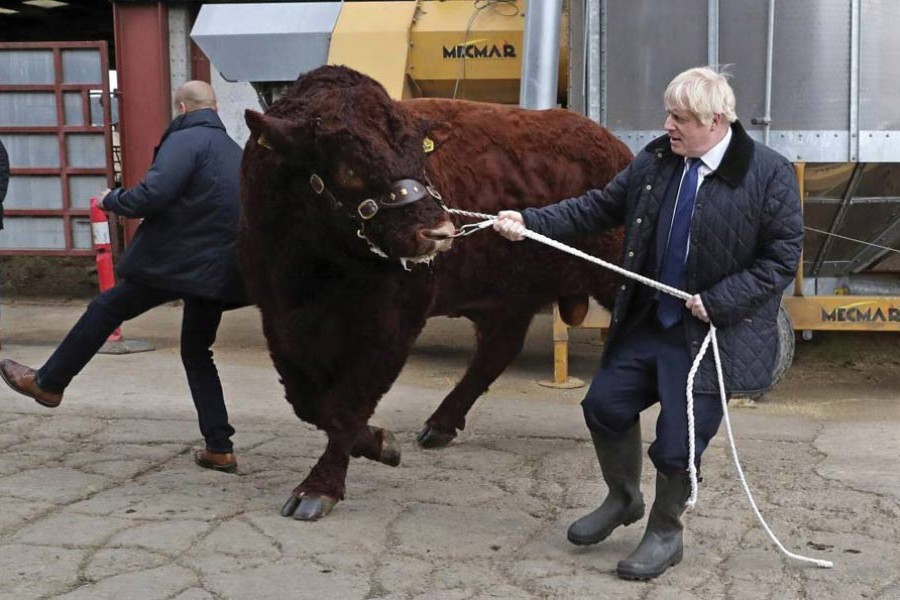
A bull bumps into a plainclothes police officer while being walked by British Prime Minister Boris Johnson during a visit to Darnford Farm in Banchory near Aberdeen, Scotland on September 06, 2019. Earlier in the day Boris Johnson made the Prime Minister's traditional September visit to the Queen at her Balmoral residency and presented the Benn-Burt or No-Deal Brexit bill for Royal Assent which was duly given on September 09. The Prime Minister is said to be contemplating ways and means to circumvent the law to achieve his goal of Brexit with or without any deal with the European Union by October 31. —Photo: AP
The saga of Brexit refuses to leave the headline of news media across the globe as does the fortune of Boris Johnson whose great grandfather, he discovered on his journey to trace his ancestors, was Aly Kemal, a Turkish Muslim. Not that it is of any importance to the British voters or the Conservative Party who may be heading for an election this year without a Hard Brexit. Having lost parliamentary majority Boris Johnson would soon be heading to Brussels to resurrect his attempt to get a deal from the European Union (EU). The EU appears to be in no mood to accommodate Johnson nor is the British Prime Minister willing to concede. His insistence on a new deal has resulted in defection of a sizeable number of Conservative MPs along with the resignation of his brother from the government as well as the House of Commons and his announcement not to seek reelection due to tussle between family loyalty and national interest. Boris Johnson appears to have lost the support of his former colleagues as well.
Chris Patten, last British Governor of Hong Kong, a former EU Commissioner and a former Development Cooperation Minister, has posed a question: Is Britain Becoming a Failed State (Project Syndicate, August 20, 2019)? Patten argues that "Voters elect individual members of parliament, who owe their constituents their best judgment about how to negotiate the predicaments of politics. MPs are not required to do what they are told by an alleged popular will - a system much favoured by despots and demagogues. Instead, they are part of a system that owes much to the conservative political philosopher Edmund Burke and not to Jean-Jacques Rousseau." Chris Patten reminds his readers of how Britain conducted its affairs from an imperial power to a middle sized European country.
In Britain, historically, government has been accountable to parliament, whose opinions it must respect and whose conventions it should follow. He cautions against "avoiding political extremism, achieving a self-adjusting balance between left and right, managing change over decades in peace and war".
Polly Toynbee writing in The Guardian bemoans the fate of the UK as the country "that self-identified so smugly as stable, tolerant and moderate, with a crown to symbolise traditions honed down the centuries, is revealed as fissile, fragile and ferociously divided. A constitution that relied on gentlemanly governments' willingness to bow to parliament has evaporated, blown away now it's led by a man who doesn't give a damn for parliamentary sovereignty: taking back control is for him alone. He is ready to destroy anything that threatens his ambition."
Like many detractors of Boris Johnson The Guardian's Aditya Chakravarty wonder's "When renowned historians are comparing this attempted putsch to the Reichstag fire, when denunciations are raining down from constitutional experts, when MPs and BBC broadcasters speak of little else apart from Britain's democratic crisis - why does such heated talk leave most of the public so cold…… In his own pseudo-bumbling fashion, Johnson is taking a leaf out of the book of Donald Trump, Narendra Modi, Jair Bolsonaro: he is deliberately outraging the norms that have governed politics and society, safe in the knowledge that for much of his electorate those conventions have already rotted away to useless totems. Put bluntly: yes, Britain is mired in a democratic crisis".
Is Britain then, regarded as the mother of democracy by the world save a few exceptions, is passing into the phase of "Post-Democracy" labelled by British political scientist Colin Crouch? A phase in which political space is increasingly constricted, and people's representatives sent to parliament are threatened with expulsion, and people's voice not listened to. Crouch further sees a scenario in which "a tightly controlled spectacle managed by rival teams of professional experts in the techniques of persuasion", in which the interests of multinationals and big businesses would always trump "the political importance of ordinary working people", especially with the withering away of unions".
Across Europe extreme right parties have either captured power or have increased their support among the people. Some fear Boris Johnson could very well be a catalyst of this trend. Brexit saga is yet to end. Both the Brits and the world have to wait for the curtain to fall.
The writer is former Secretary and ambassador. He can be reached at
kamasud23@gmail.com