Wednesday, January 3, 2024


End of Soviet Union And Legacy of Mikhail Gorbachev

At the best of times, U.S.-Russia ties are a mixture of cooperation and competition, but today they are largely adversarial.

  
5 mins read
 
As tributes poured in for Mikhail Gorbachev, Vladimir Putin said he had "rightfully earned great prestige and recognition".(Reuters: ITAR-TASS/Kremlin Press Service)

These days the world is rightly involved with the genocidal activities of the Israeli government of Benjamin Netanyahu even though the Jews had suffered unspeakable atrocities by Hitler’s Nazi Germany the world and the media are not getting adequate coverage of another story relating to the great change taking place in Europe since 1945. Russian President Vladimir Putin appears to be following the footsteps of Adolph Hitler through the acquiescence of the European countries and most notably the US.

HAVE US-RUSSIA RELATIONS HIT THE BOTTOM

As Angela Stent of John University in New York in her article (Why are US-Russia relations so challenging? Dated April 27, 2020) pointed out The United States’ relationship with Russia is today the worst that it has been since 1985. Moscow’s interference in the 2016 U.S. presidential election and what appears to be its continuing attempts to affect the 2020 election campaign have made Russia a toxic domestic issue in a way that it has not been since the 1950s. She added The U.S. National Security Strategy declares Russia and China the two top threats to U.S. national security. At the best of times, U.S.-Russia ties are a mixture of cooperation and competition, but today they are largely adversarial. Yet, as the world’s two nuclear superpowers, Russia and the United States bear a unique responsibility to keep the peace and discourage the proliferation of nuclear, biological, and chemical weapons around the globe.

EMERGENCE OF CHINA HAS COMPLICATED THE GLOBAL SCENARIO

These are hopeful words but one can only hope that the aspirations of the rest of the world which have become more complex with the addition of China and complex economic relations among different countries giving rise to phrases like “decoupling” and “ de-risking” in the global dictionary.  Coming back to Europe and President Vladimir Putin one has to remind oneself of Putin’s red line he had repeatedly asked the West to ensure Russia’s strategic interests. As Angela Stent wrote Russia’s legitimate interests were ignored by the United States. This includes Russia’s right to a sphere of influence in the post-Soviet states, meaning that they should not aspire to join NATO or the European Union. Today, Russia defines its security perimeter not as the borders of the Russian Federation, but as the borders of the former Soviet Union. It demands that the United States and Europe acknowledge this.

VLADIMIR PUTIN’S LAMENTATION ON THE FALL OF SOVIET UNION

This reminds the world of Putin’s lamentation that the fall of the Soviet Union in 1991 was the demise of “historical Russia,” a comment that did fuel speculation about his foreign policy intentions amid a buildup of tens of thousands of Russian troops in regions bordering Ukraine. “It was the disintegration of historical Russia under the name of the Soviet Union,” Putin said of the 1991 breakup of the Soviet Union while speaking in a documentary film called Russia aired on state television. Putin, a former agent of the Soviet KGB security service, has previously lamented the collapse of the Soviet Union, calling it the “the greatest geopolitical disaster of the 20th century.” The comments in the documentary, however, reveal how much he feels the disintegration of the Soviet Union devastated Russia’s power. Soviet Union’s final hours were described by Christopher Klein described the ten-minute speech by Mikhail Gorbachev announcing the dissolution of the Soviet Union and his resignation as its eighth and final leader. Three of the Soviet Union’s 15 republics had already declared independence, and days earlier the leaders of 11 others agreed to leave the USSR to form the Commonwealth of Independent States. Once the republic leaders signed the Soviet Union’s virtual death warrant, all that was left was for Gorbachev to pull the plug. The process of the demise of the Soviet Union was not short. The reforms enacted by Gorbachev set the stage for a series of mostly bloodless revolutions that swept through the Soviet satellite countries of Eastern Europe in 1989.

COULD MIKHAIL GORBACHEV BECOME A DICTATOR?

As the Berlin Wall fell, the Soviet leader chose not to order a military response. The historic changes earned Gorbachev the Nobel Peace Prize and Time magazine’s “Man of the Decade” honor, but the USSR had lost its communist Eastern Bloc. Increasingly, Gorbachev was being pulled in two different directions by democrats who wanted even greater freedoms and autonomy for the republics and conservatives who wanted to end the reforms that they believed were breaking the union apart. The maverick leader of the Russian republic, Boris Yeltsin, was a particularly radical thorn in Gorbachev’s side. Yeltsin, who had dramatically quit the Communist Party in 1990, called for Gorbachev’s resignation after the Soviet army cracked down in Lithuania and other republics that sought independence and greater sovereignty.  In March 1991, the USSR held a public referendum to determine whether the union should be preserved or dissolved. More than three-quarters of voters wanted the USSR to endure, but six republics abstained from voting altogether. Despite the results, the referendum did little to stop the fracturing of the country. Yeltsin and other democrats continued to push Gorbachev to introduce more radical reforms, and the Soviet President negotiated a treaty that decentralized power from the central government to the republics. In his letter of resignation, President Mikhail Gorbachev wrote “Due to the situation which has evolved as a result of the formation of the Commonwealth of Independent States, I hereby discontinue my activities at the post of President of the Union of Soviet Socialist Republics,” Gorbachev said in his address. “The policy prevailed of dismembering this country and disuniting the state, which is something I cannot subscribe to.” “We’re now living in a new world. An end has been put to the Cold War and to the arms race, as well as to the mad militarization of the country, which has crippled our economy, public attitudes, and morals,” he said before lamenting that “the old system collapsed before the new one had time to begin working.” Mikhail Gorbachev appointed Vladimir Putin as his successor and thus began Putin’s rule which continues till today.

LEGACY OF MIKHAIL GORBACHEV

On his death, an analyst writing on Gorbachev’s legacy wrote: Mikhail Gorbachev will remain one of the most controversial figures in modern Russian history. A son of poor peasants, he was a Nobel laureate, the first and the last president of the Soviet Union, the initiator of nuclear disarmament, the main contributor to ending the Cold War, and the architect of glasnost (openness) and perestroika (economic restructuring). Yet, to many ordinary Russians, his rule is likened to that of Tsar Nicholas II, a humble ruler with noble aspirations yet unable to cope with complex challenges, who made erratic choices that ultimately led to his country’s disintegration, accompanied by sharp economic decline and a demographic catastrophe. Unlike Nicholas II, however, Gorbachev’s resignation in December of 1991 did avert a large civil war. And some of his decisions were transformative. The unification of Germany and the dissolution of the Warsaw Pact would not have been possible without him. He dreamed that these events would be followed by the dissolution of NATO and the opening up of a “Greater Europe,” a trans-Atlantic community “from Vancouver to Vladivostok.” Now, the dream and the dreamer are no more. It is difficult, indeed impossible, to bring into words the life and legacy of any great people. Such attempts remain elusive and the people can only paint them as they see fit.

Sunday, December 17, 2023


How Long Will Bangladesh Remain Saddled with The Rohingya Problem?

Awami League government in Bangladesh has over the past decade expanded economic and political cooperation with Beijing, a relationship that the latter is happy to continue building as it seeks to reduce its reliance on traditional allies India and Western countries

  
7 mins read
 
A Rohingya refugee man pulls a child as they walk to the shore after crossing the Bangladesh-Myanmar border by boat through the Bay of Bengal in Shah Porir Dwip. [Photo: Reuters]

INTRODUCTION

Throughout history, there have been incidents of genocide on particular people often based on religion. The most horrific one has been the Holocaust by Adolf Hitler’s Nazi Germany which still stirs the conscience of the people of the world. Such a genocide is taking place in Myanmar and the burden has been placed on the shoulders of Bangladesh, itself a developing country fighting its way out of poverty to a developing one. In June 2021 Bangladesh’s Foreign Minister told the attendees in New York of the bold decision and humanitarian gesture of Bangladesh Prime Minister Sheikh Hasina to provide shelter to the over a million Rohingya, as they fled atrocities in Myanmar, and the efforts of the government to ensure the wellbeing of Rohingya despite severe resources and space constraints.

Bangladesh’s Foreign Minister recalled the efforts of the international community including the General Assembly and the Human Rights Council in keeping the issue of Rohingya alive; while the efforts of the Security Council have always fallen short of concrete actions. He expressed hope that the Council would fulfill its Charter obligations and take urgent measures to resolve the crisis in Myanmar so that the Rohingya people can return to their homes in safety, security, and dignity. He also urged the regional countries and other stakeholders to play their due role.

The Foreign Minister recalled the efforts of the international community including the General Assembly and the Human Rights Council in keeping the issue of Rohingya alive; while the efforts of the Security Council have always fallen short of concrete actions. He expressed hope that the Council would fulfill its Charter obligations and take urgent measures to resolve the crisis in Myanmar so that the Rohingya people can return to their homes in safety, security, and dignity. He also urged the regional countries and other stakeholders to play their due role. He thanked the then President of the United Nations General Assembly (PGA) for convening the upcoming plenary session on Myanmar in the General Assembly.

US’ UNEQUIVOCAL SUPPORT TO BANGLADESH

As expected of the leader of the free world the United States of America strongly supported Bangladesh on the Rohingya issue, unfortunately, China and India’s geopolitical and geo-economic interests in Myanmar left Bangladesh to manage the Rohingya crisis alone.  All three countries are eager to see repatriation take place, albeit for very different reasons. Myanmar’s military regime wants some refugees to return to assist with its definition at the International Court of Justice, where The Gambia has brought a case against it under the Genocide Convention for the 2017 crackdown on the Rohingya in Rakhine State. 

WOULD THE MYANMAR MILITARY JUNTA TAKE BACK ROHINGYA REFUGEES?

From the regime’s point of view, allowing returns would undermine allegations that it committed genocide, which requires showing that the perpetrator had genocidal intent. More broadly, and however wishful its thinking may be, it believes that repatriation will alleviate the international pressure it is facing in the post-coup crisis. Yet it will only be willing to take back a limited number of refugees – likely far short of the 750,000-plus who entered Bangladesh in 2016-2017.

Myanmar authorities say no more than 500,000 fled to Bangladesh, claiming that some of these people are “newcomers” who had migrated illegally to Rakhine State. They have so far reviewed the eligibility of barely 15 percent of the Rohingya whom Bangladesh has put forward for repatriation. Of those, they have rejected around one-third. An official told Crisis Group that the process would move slowly, as the Myanmar side wanted to make sure there were no “extremists” among the returnees. The official added: “Those refugees who have settled in Myanmar for generations will want to come back and getting citizenship should be easy for them. Those who are newcomers from Bangladesh, they won’t want to come back”

INTRA-POLITICAL RIVALRY ON ROHYNGA ISSUE IN BANGLADESH

Bangladesh’s ruling political party, the Awami League government, was keen to show progress on repatriation to the public, including ahead of a general election scheduled for January 2024. At first, the decision to accept Rohingya refugees was popular in the Muslim-majority country. But over six years on, many are growing impatient with the situation, particularly Bangladeshis in Cox’s Bazar. Recent large-scale surveys have shown there is little support for even allowing the Rohingya to stay in Bangladesh until it is safe to return. Meanwhile, the opposition Bangladeshi Nationalist Party (BNP) has criticized the government’s handling of the crisis and put forward its sixteen-point plan for “resolving” it.  

CHINESE GAME IN ROHYNGA ISSUE

For China, facilitating Rohingya repatriation is an opportunity to cement its position as a partner of Dhaka and Naypyitaw, the capital of Myanmar, at a time of heightened geopolitical competition with the U.S. It also wishes to project an image as a constructive player in the international arena – burnishing its credentials as a mediator, following its brokering of an agreement between Iran and Saudi Arabia in March. Since it emerged from its extremely stringent pandemic management measures, which it lifted in December 2022, and appointed a special envoy for Asian affairs at the end of 2022, Beijing has stepped up its engagement in Myanmar and seems keen to increase its leverage with the military regime. Meanwhile, the Awami League government in Bangladesh has over the past decade expanded economic and political cooperation with Beijing, a relationship that the latter is happy to continue building as it seeks to reduce its reliance on traditional allies India and Western countries (US -Bangladesh Relations on Rohynga Issue).

MYANMAR MILITARY JUNTA CONTINUES PERSECUTION

In one of the latest reports, Doctors Without Borders calculated that at least 6,700 Rohingya people died violently in the first month of the campaign by the Burmese military, including 730 children. The head of the UN Agency for Human Rights later referred to the military’s conduct as “acts of horrific barbarity,” potential “acts of genocide,” and “a textbook example of ethnic cleansing”. While International Crisis Group (ICG) says, “To date, not a single refugee has returned to Rakhine State through the formal repatriation mechanism that Myanmar and Bangladesh set up in November 2017.” Since the military overthrew Aung San Su Ki’s government in February 2021, the political, economic, and humanitarian crises in Burma have only worsened. According to sources, there have been close to 3,000 fatalities, close to 17,000 arrests, and more than 1.5 million displaced people.

The continued scorched-earth effort by the dictatorship continues to do harm and take the lives of innocent people, halting discussions about the return of Rohingya, igniting an escalating military conflict inside of Burma, and fostering insecurity outside of its borders.  Bangladesh continues to house them despite being forced to use a significant portion of her meagre resources to cover expenditures and mitigate effects on her economy, society, and environment. In this path of providing humanitarian aid to the Rohingya, Bangladesh is joined by numerous European, British, and American countries. 

The United States of America, in particular, has pledged massive assistance to Bangladesh in its efforts to shelter Rohingyas. Since the crisis, the United States has been the single most important country in providing funds for Rohingya refugees. Since 2017, the United States has provided more than $1.9 billion in humanitarian assistance to people in Myanmar, Bangladesh, and other parts of the region. The United States remains firm in its position that the regime’s planned elections cannot be free or fair, not while the regime has killed, detained, or forced possible contenders to flee, nor while it continues to inflict brutal violence against its peaceful opponents. The United States vows to continue to promote accountability for the military’s atrocities, including through support to the UN’s Independent Investigative Mechanism for Myanmar and other international efforts to protect and support vulnerable populations, including Rohingya.  The United States is working with ASEAN, the United Nations (following the recent passage of a UN Security Council Resolution on the situation in Burma), and the international community at large to uphold ASEAN’s Five-Point Consensus, increase diplomatic and economic pressure on the military, and support a peaceful, democratic, and prosperous Burma. 

In December 2022, both houses of the US legislature has passed for the fiscal 2023 National Defense Authorization Act (NDAA) that includes — the US’s support to return to a democratic govt., providing non-military assistance to EAOs and PDFs, funds to support the pro-democracy movement, assisting in ethnic reconciliation, protecting political prisoners, and investigating and documenting atrocities. In December of last year, 24 of the selected 62 Rohingyas left Bangladesh for the United States as part of the US government’s resettlement program. According to the US Embassy in Dhaka, US President Biden reaffirmed the US commitment to welcoming refugees by keeping the total admissions target in the Presidential Determination on Refugee Admissions for 2022-23 at 125,000, with a regional allocation of 15,000 for East Asia.  US Secretary of State Antony Blinken, State Department Counsellor Derek Chollet, Assistant Secretary of the US Bureau of Population, Refugees, and Migration, Julieta Valls Noyes, and other top diplomats expressed the same ideology as Bangladesh that the ‘root cause of the Rohingya crisis lies in Myanmar’ and that ‘safe and dignified repatriation of Rohingyas to Myanmar’ is the only sustainable solution. 

CONCLUSION

One would have thought that the Holocaust was the result of paranoia of Adolf Hitler for blaming the Jews for the German defeat in the First World War, the acquiescence of the great powers of Hitler’s intention to have a pure German race, and his miscalculation of the nature of Joseph Stalin and then the Soviet Union which finally goaded Hitler to the “Final Solution” of extermination of the Jews from the world. According to Encyclopedia Britannica German-Soviet Nonaggression Pact, (August 23, 1939), a nonaggression pact between Germany and the Soviet Union that was concluded only a few days before the beginning of World War II and which divided eastern Europe into German and Soviet spheres of influence. The Soviet Union had been unable to reach a collective security agreement with Britain and France against Nazi Germany. By early 1939 the Soviets faced the prospect of resisting German military expansion in Eastern Europe virtually alone.  In May 1939, Joseph Stalin began negotiations with the Nazi foreign minister, Joachim Von Ribbentrop.

The Soviets also kept negotiating with Britain and France, but in the end, Stalin chose to reach an agreement with Germany. By doing so he hoped to keep the Soviet Union at peace with Germany and to gain time to build up the Soviet military establishment. The Western democracies’ hesitance in opposing Adolf Hitler, along with Stalin’s inexplicable personal preference for the Nazis, also played a part in Stalin’s final choice. For his part, Hitler wanted a nonaggression pact with the Soviet Union so that his armies could invade Poland virtually unopposed by a major power, after which Germany could deal with the forces of France and Britain. 

The end result of the German-Soviet negotiations was the Nonaggression Pact signed by   Ribbentrop and Molotov in the presence of Stalin, in Moscow. It would be unnecessary to go further into the history of the Second World War Suffice it would be to say that the world should be more active in sharing with Bangladesh the unbearable burden of the Rohingya crisis which without splitting hair is now on the verge of genocide.

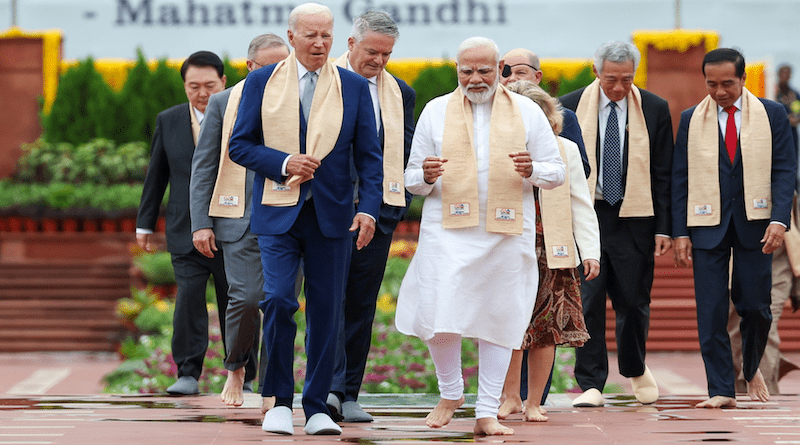
 US President Joe Biden with India's PM Narendra Modi and G20 leaders as they arrive at the Samadhi of Mahatma Gandhi at Rajghat, in New Delhi on September 10, 2023. Photo Credit: India PM Office

India The Largest Democracy In The World – OpEd

By 

Respected British magazine in its June 15,, 2023 issue termed Indian Prime Minister Narendra Modi as the most popularly elected Prime Minister despite his odious treatment of the minority Muslim community. With an approval rating of 77%, the Prime Minister is more than twice as popular as his party. He is by far the world’s most popular elected leader. Asked to give relative weight to the factors including the failure of the opposition Congress Party of Rahul Gandhi, whose great grandfather Pandit Jawaharlal Nehru, grandmother Indira Gandhi, and father Rajiv Gandhi were all elected Prime Ministers of India. Yet Narendra Modi’s popularity is attributed mainly to the ineffectiveness of his opponents and 65% to his political skills.

Analysts attributed Narendra Modi’s popularity only 15% which could seem surprising, given how conspicuous it is. Patrick Wintour Diplomatic Editor of The Guardian in a write-up (dated 8th September 2023) wrote at length that President Joe Biden took fresh steps to lure India’s Prime Minister Narendra Modi into an alliance designed to contain China, at a bilateral meeting in Delhi where the pair struck a series of commercial and defense deals covering remote-controlled aircraft, semiconductors, and quantum computing. However, the question of press freedom also dominated the agenda on the eve of the full G20 summit.  Before the bilateral at the Prime Minister’s residence, the US press corps, used to being given privileged access to the Joe Biden were told to remain outside in a van, out of eyesight of the two leaders. Biden received a Bollywood-style greeting after landing onboard Air Force One. The meeting was given an added symbolic importance as Biden was able to seize upon Chinese President Xi Jinping’s decision not to attend Modi’s much-vaunted summit.

The US is trying gradually to make the traditionally neutral India a more explicit partner and part of a wider political and defense alliance in the Indo-Pacific. The White House said in a statement after the meeting that Biden welcomed the joint commitment to democratic values, and specifically that he welcomed an Indian defense department request to buy US-built remotely controlled aircraft. India has several disputes with China but it has been wary of joining an implicitly anti-Beijing alliance. Kurt Campbell, the White House Indo-Pacific envoy, said relations with India continued to be a work in progress. The two leaders agreed to progress agreements reached in June this year when Modi visited Washington, including a deal to allow General Electric to produce jet engines in India to power Indian military aircraft. 

The US does not expect to make immediate progress in shifting India from its largely neutral stance on the Russian invasion of Ukraine but believes that if it can start to replace Russia as a leading arms supplier to Delhi, India will have greater latitude to criticize Moscow. The episode with the journalists accompanying Biden underlined the state of press freedom in India despite the two leaders’ stated shared commitment to democracy. Narendra Modi released a handful of official photographs of the meeting, showing the two leaders seated side by side and chatting amiably. Biden decided to delay his planned post-summit press conference and hold it at his next stop in Vietnam, reflecting the tight press controls being mounted by the Indian security services. The incident comes after protracted negotiations were needed before Indian officials agreed to Modi taking one question from US reporters during his visit to Washington in June this year.

“The president believes the free press is the pillar of our democracy,” the White House spokesperson Karina Jean-Pierre told journalists onboard Air Force One, insisting they were doing all they could to secure media access. At the Washington press conference with Joe Biden in June the one question to Modi came from the Wall Street Journal reporter Sabrina Siddiqui, who asked the Hindu nationalist about accusations of repression of Muslims in India and the country’s record on human rights. Siddiqui was subsequently subjected to “intense online harassment”, the White House Correspondents’ Association said, “including from people with ties to the prime minister’s political party”. 

India ranks 161 out of 180 in this year’s Press Freedom Index published by Reporters Without Borders. In recent years, journalists have been arrested and some are stopped from traveling abroad. Dozens are facing criminal prosecution, including for sedition. The government has also introduced sweeping regulatory laws for social media companies that give it more power to police online content. Several media outlets critical of Modi have been subjected to tax searches, including the BBC after it aired a documentary that examined the prime minister’s role in 2002 anti-Muslim riots in the western state of Gujarat, where he was chief minister at the time. The US treasury secretary, Janet Yellen, joined the bilateral, as did the White House national security adviser, Jake Sullivan. Indian attendees included the external affairs minister, Subrahmanyam Jaishankar, and the security adviser Ajit Doval. 

Biden is bringing cash for the World Bank and promises on the climate crisis that he hopes will show debt-ridden economies in Africa that he has their interest at heart in a way that the Chinese Belt and Road infrastructure project does not. President Biden sets great store by personal relations in diplomacy and has done as much with Narendra Modi as with any other world leader to cultivate a personal relationship. He continues to raise human rights but it is clear Biden has put the treatment of religious minorities in India on a relative back burner. Chinese-Indian relations were damaged before the summit as the Chinese ministry of natural resources website displayed Arunachal Pradesh and the Doklam Plateau – over which the two sides have feuded – as included within Chinese borders, along with Aksai Chin in the western section that China controls but India still claims.

President Biden’s preference for personal relationship with world leaders was evident in Vice President Kamal Harris’s recent visit to the Middle East to explain US Middle East policy to the Arab leaders. Kamala Harris’s visit to Dubai demonstrated President Biden’s strategy of having the Vice President personally lead U.S. efforts to start conceiving what the “day after” may look like for Israel, the people of Palestine, the region, and the world—the Biden administration is making it clear that it is taking a comprehensive, strategic approach to managing the current crisis. Her visit also demonstrated President Biden’s preference that unlike many other Vice President’s in past administrations Joe Biden would like Kamala Harris to shoulder the responsibility of conducting foreign affairs as personal emissary of the US President. It, however, remains to be seen whether future Presidents would follow such practice and its justification thereof.  

Conclusion

Coming back to India the writer believes that given Pakistan’s strong belief that it is India’s nemesis and is destined to continue its unending enmity despite millions of Muslims had voted with their feet to remain in Pandit Nehru’s India and not go to army ruled Pakistan. The present anti-Muslim pogrom conducted by Narendra Modi’s Bharatiya Jajata Party adherents is difficult to explain for a country which always prided itself as the largest practicing democracy in the world. One hopes that India will steer clear of this quirk of history and will regain its true self as the largest democracy in the world.