Friday, January 12, 2024


Is it Conceivable for Russia to Use Nuclear Weapons?

The Kremlin should not retain its monopoly on public discussion of nuclear use, and nuclear threats must be responded to rather than with panic. Russia should be challenged directly over its own toxic and irresponsible domestic and international nuclear statements.

by Kazi Anwarul Masud

INTRODUCTION

One would like to answer in the negative given the fact that such a move would not only end mankind as we know it but would also mean the end of Russia itself. There is no reason to believe that the world regardless of the number of nuclear weapons they possess would let a madman survive. Yet Vladimir Putin’s remarks, are often misrepresented by learned people whose writings are printed in respected magazines e. g. Foreign Affairs and other publications as well, perhaps on the ground that freedom of expression is guaranteed by democracies throughout the world. I found it interesting to read an article by Peter  Schroeder (The Real Russian Nuclear Threat. The West Is Worried About the Wrong Escalation Risks in the December 20, 2023 issue.)

A U.S. nuclear test in the Nevada desert in 1953 Foto: National Nuclear Security Administration

US POLICY ON RUSSIAN USE OF NUCLEAR WEAPONS

 The writer quoted at length US President Joe Biden in the following words: “I worry about Putin using tactical nuclear weapons,” U.S. President Joe Biden said in June. The risk, he continued, is “real.” However, officials do not appear to believe that the war in Ukraine could lead Russia to use its nuclear arsenal against a NATO state, however furious it is at the West for supporting Ukraine. That is a mistake. U.S. officials have it backwards. It is quite unlikely that Russian President Vladimir Putin will use a nuclear weapon on the battlefield in Ukraine, but he may move toward using one against NATO. Unlike the West, Putin may not fear a nuclear standoff: he is well versed in Russia’s nuclear arsenal and the tenets of nuclear deterrence, and possibly sees himself as uniquely suited to navigating a nuclear crisis.

RUSSIAN PRESIDENT ON USE OF NUCLEAR WEAPONS

Vladimir  Putin has been remarkably consistent that Russia is willing to use nuclear weapons against NATO to defend its interests in Ukraine.” Peter Schroeder added that even eight years ago, in a television interview done a year after Russia invaded Crimea, Russian President Vladimir Putin declared that he had been ready to place Russian nuclear forces on alert to prevent Western forces from interfering in Moscow’s takeover of the peninsula.

Russian nuclear weapons use is not imminent. But if Putin does escalate the war, for instance by attacking NATO with conventional weapons, he will likely move very swiftly, so as not to give the United States a chance to manoeuvre away from a crisis. Washington will struggle to deter a Kremlin so emboldened.

INVASION OF UKRAINE AND RUSSIAN NUCLEAR POLICY

Ukraine is too central to the Kremlin’s ambitions—and too secondary to the United States—for Putin to believe any American threats. Ultimately, Vladimir Putin will expect the United States to back down before fighting a nuclear conflict over land so far from home.

Do people believe that such an eventuality can happen in a world that has become so complex and so interdependent with phrases like ‘de-risking” and “ de-globalization” and many other phrases being taught in schools from primary levels?

RUSSIAN SUSPENSION OF NEW START TREATY

In his long article Peter Schroeder wrote that in February 2023, Russia suspended participation in the New START treaty, which regulated how many nuclear weapons Moscow and Washington could have. In March, the Kremlin announced that it would move some of its nuclear weapons into Belarus. In October of that year, Vladimir Putin suggested that Russia might restart nuclear testing.

All the while, Russian government officials have threatened to launch a nuclear attack, as former President Dmitriy Medvedev did in July when he said Russia could “use nuclear weapons” to conclude the Ukraine war in a few days. U.S. officials, of course, have paid attention to these threats, but they have not been convinced by them. They imagined that Moscow may use small so-called tactical nuclear weapons on the battlefield, but not large so-called strategic ones against NATO states.

THE US IS HOPEFUL THAT RUSSIA WILL NOT USE NUCLEAR WEAPONS

According to National Security Adviser, Jake Sullivan  U.S. experts in recent days thought that there was little fear that Russia would use strategic nuclear weapons in Ukraine or against the West, but some remained concerned that Russia could use tactical weapons. Putin, their thinking went might use these weapons to help Russian forces halt a Ukrainian attack that appeared on the verge of taking back Crimea or inflicting a significant defeat that threatened to push Russian forces out of eastern Ukraine. However, the growing complacency among U.S. officials is based on a misunderstanding of Putin’s rhetoric and the dynamics that keep Moscow from using nuclear weapons.

When Putin invokes his arsenal, he is not trying to warn that Russia could use tactical nuclear weapons in Ukraine. Rather, his rhetoric is designed to threaten NATO itself. It is a blinking red light, a warning to American decision-makers that Moscow is willing to create a nuclear confrontation with Washington if needed to win in Ukraine. So long as Putin remains optimistic about Russia’s odds, he is unlikely to rock the boat in Ukraine. Tactical nuclear weapons would do little to help Russia break the stalemate. Ukrainian forces are well entrenched along a frontline that extends for roughly 600 miles, so even dozens of tactical weapons would not be enough to let Russia push through. Even if they were, Russia does not have the manoeuvrable reserve forces needed to exploit any opening created by these weapons.

CHATHAM HOUSE WEIGHS IN ON RUSSIAN NUCLEAR POLICY

Peter Schroeder’s thesis was countered by Valeria Akimenko, Senior Research Analyst, Conflict Studies Research Centre of Chatham House explaining the myth of the use of Russian nuclear weapons and wrote that the circumstances under which Russia might use nuclear weapons have been the subject of lengthy and heated debate. This is in part because of mixed messages from Russia itself. Published nuclear doctrine describes a very limited set of circumstances predicting a nuclear response by Russia. But this is at odds with consistent public rhetoric from President Vladimir Putin down through the entire information apparatus of the Russian state, which has frequently made both implicit and explicit Russia’s nuclear rhetoric being incessant and emphasised readiness to use these weapons.

But it aims to extract the maximum possible practical value from their mere possession, with or without actual intent to use. The impact of these threats builds on an intensive and highly effective program by Russia’s extended network of influencers abroad promising almost inevitable escalation to nuclear war if Russia’s plans are opposed. While the constant Russian nuclear refrain suggests a greater willingness to consider nuclear use in real life, in turn, based on Russia’s demonstrated greater willingness to inflict mass destruction and mass casualties in pursuit of its aims, the rationale behind these threats is to increase Russia’s operational latitude without actually having to go to war, by undermining Western will to resist.

This campaign has been effective in creating an impression that Russia has an exceptionally low threshold for nuclear use and that a wide range of circumstances or ‘provocations’ could cause that threshold to be crossed.

RUSSIAN MILITARY DOCTRINE PROVIDES FIRST USE OF NUCLEAR WEAPONS IN CONVENTIONAL WAR

Russian nuclear doctrine provides for nuclear first use in a conventional war when the country’s ‘very existence’ is at risk. But this has not prevented a wide range of risks in any war, even one started by Russia, being described as existential. It is argued that there need not even be a war. International sanctions and even “aggressive” statements by Russia’s “enemies” have repeatedly proved sufficient to trigger renewed nuclear threats.

Western political leaders have themselves confirmed that Russia has succeeded in shaping their behaviour through nuclear intimidation. A wide range of experienced analysts outside Russia hold the opinion that  Russia’s nuclear weapons would only actually be used in extremis. This view holds that Russia’s nuclear arms are a political, defensive deterrent, and thus unlikely to be employed. It further suggests that advances in Russia’s conventional capabilities have made it less likely to need to resort to the use of nuclear weapons. The debate is further complicated by the layering of Russia’s nuclear capabilities, from non-strategic to strategic weapons.

The contributions of Russian commentators on the nuclear policy should be treated with skepticism, but in many cases, they too have played down the likelihood of nuclear use. The arms control specialist Nikolai Sokov holds that Russia’s nuclear doctrine is defensive and that it reserves nuclear use ‘exclusively for situations when Russia is attacked’, albeit in a broader range of circumstances than the widely recognized criterion of an attack ‘which threatens the existence of the state itself’.

LIMITED NUCLEAR WAR IS “ALIEN” TO RUSSIAN STRATEGY

Meanwhile, the former Russian military intelligence officer and Carnegie Moscow analyst Dmitri Trenin has argued that the notion of a limited nuclear war has always been ‘alien’ to Russian strategy.

Informed analysts outside Russia have also noted a trend for the threshold for Russian nuclear use to become higher, not lower, as Moscow’s conventional military capabilities have improved from their nadir in the 2000s. Kristin Ven Bruusgaard observed that ‘Russia today is less, not more likely to use nuclear weapons than it was 10 or 15 years ago’. Olga Oliker has also argued there is little evidence Russia has lowered its threshold for nuclear use. 

Disagreements over the precise threshold for Russia to use nuclear weapons risk obscuring the key point that that threshold is far lower than for Western nuclear powers. The moral dimension of nuclear use is also far less of a constraint for Russia than for democracies, as is also the case with other actions in Russia’s conduct of war that cause revulsion abroad – most recently highlighted in Ukraine. Russia also continues to upgrade its nuclear command and control systems, regarded as a vital second-strike and warfighting capability.

Moreover, while Russia’s nuclear doctrine posits its nuclear weapons as ‘exclusively’ a deterrent, it also sets out specific criteria for their employment. Each of these criteria allows for nuclear first use in circumstances that no Western leader ‘would even consider’.

RUSSIA SHIFTS TO POLICY OF FIRST USE OF NUCLEAR WEAPONS

Russia’s shifting first-use posture in the late 1990s and into the 2000s – a pivot from ‘no first use’ to ‘first use if necessary’ to ‘assured first use if Russia’s survival is at stake’ – demonstrates its reliance on a nuclear arsenal for both deterrent and warfighting purposes.

The risks of miscalculation, meanwhile, have been strongly emphasized by Russia in its campaign of intimidation but do nevertheless exist.

However, while all of these factors demonstrate that Russia’s attitude to nuclear use is significantly different from that of a NATO nuclear power, this attitude does not set preconditions for reckless, pointless or suicidal nuclear attacks in response to marginal threats.

While Russia’s attitude to nuclear use is significantly different from that of a NATO nuclear power, this attitude does not set preconditions for reckless, pointless or suicidal nuclear attacks in response to marginal threats.

As noted above, the most direct and obvious success of Russia’s nuclear threats is in constraining Western support for Ukraine. But Russia capitalizes far more broadly on the perception that it must not be impeded, offended or, most of all, defeated. This means there are few credible options for responding in the event of Russian use of non-strategic nuclear weapons (NSNWs), which in turn enhances their intimidatory power. In other words, the threat of massive US retaliation alone is inadequate if Western nuclear deterrence is to remain credible.

CHATHAM HOUSE ADVISES RESTRAINT TO THE WEST IN DEALING WITH RUSSIAN NUCLEAR THREATS

Valeryia Akimenko concludes by saying that good policy means responding soberly to Russian nuclear threats, while at the same time ensuring that any actual nuclear use cannot go unanswered. Russia has weaponized nuclear rhetoric to great effect, evident in the near-panic that ensues every time President Putin mentions the possibility of nuclear use. The international community should recognize that this is a routine element of Russian state communications and should take a long view in assessing such propaganda rather than reacting to each new occasion when it is employed. Consistent long-term policy is called for instead.

To close the deterrence gap, NATO must re-examine and re-emphasize its nuclear deterrent in such a way as to address the threat, however remote, of low-yield nuclear weapons being employed for limited military objectives and localized effect. It must better calibrate its capabilities to the developments in Russia’s arsenal, and address the gaps in NATO’s escalatory ladder that have formed as a result. Conventional and nuclear, defensive and offensive, symmetrical and asymmetrical military countermeasures must be demonstratively available for use for maximum effect in deterring any consideration of nuclear use by Russia. The gulf in non-strategic nuclear capability demands policy adjustment, beyond the step already taken to fit several low-yield warheads to strategic submarine-launched ballistic missiles. Cheaper and more credible delivery platforms, distinguishable from those designed for a strategic nuclear strike, are essential.

This is not to argue for a full-on nuclear arms race. Rather, it is essential to signal resolve, which is often lacking, as well as to demonstrate potential, which at the moment is also absent. Defensive action against the use of NSNWs, such as the hardening of high-value targets, must be considered. A coordinated division of labour is necessary both within NATO and more broadly. NATO’s non-nuclear member states and other like-minded non-nuclear nations must also contribute towards advanced conventional deterrent capabilities, including missile defence and a full range of stand-off fires.

The Kremlin should not retain its monopoly on public discussion of nuclear use, and nuclear threats must be responded to rather than with panic. Russia should be challenged directly over its own toxic and irresponsible domestic and international nuclear statements. Above all, situations that would warrant a limited nuclear response by Western nuclear powers, such as Russian use of NSNWs or other weapons of mass destruction, should be discussed publicly to reduce Russia’s confidence in Western self-deterrence. All of these measures would render Russia’s nuclear threats even less realistic, and hence a less effective tool for intimidation.( Publication date: 23 August 2022).

CONCLUSION

Given the above information on Russian nuclear weapons and her policy on the use of nuclear weapons we the people of the world would like to be hopeful for the continued prosperity of mankind. The rise of China, albeit a wrinkle in global politics, is expected to contribute to the development of mankind. One hopes that the “limitless friendship” between Russia and China will not be able to stand in the way of the progress of democratic people regardless of the opposition by the Sino-Russian entente. Many developing countries would indeed be attracted by China’s Bridges and Road (BRI) initiative aimed at developing the infrastructures of these countries that have the need but not the resources. China’s BRI initiative is attractive to developing countries because China does not impose any restrictions on the loans given to these countries. But BRI projects have been publicly criticized by the Americans in particular dubbing the initiative as Debt Trap. Such accusations, however, do not touch Russia or its policy on nuclear weapons. 

Sunday, January 7, 2024

Is China setting up Debt Traps in Developing Countries?

By Kazi Anwarul Masud
Date : 05 Jan , 2024

In December 2019 Deborah Brautigham of John University in New York in the US wrote an interesting paper A Critical Look at Chinese Debt Trap Diplomacy: The Rise of a Meme. The paper delves into depth of the idea which US Vice President Mike Pence publicly warned the developing countries to be aware of the Chinese strategic plan of her aspiration to become a rising superpower that will write the rules to be abided by the rest of the world.

China is a rogue donor about its finances, is a new colonialist, and a predatory and pernicious lender that snares vulnerable states in a debt trap by leveraging its loans to have its way with weak victim.

Additionally, Deborah Brautigham wrote of the warning to African leaders by Hillary Clinton, then Secretary of State on a visit in 2011 to Africa to warn Africans against ‘the new colonialism’; and at the 2014 US–Africa summit, President Barack Obama’s paternalistic advice to African leaders that they ‘make sure that if China is putting in roads and bridges, that they’re hiring African workers”. This US claim that China does not employ African workers, has been proved to be unfounded by scholars such as Barry Sautman (Sautman & Yan, 2015).

Is China a Rogue Donor to the Needy Countries?

The result is a situation where for over a decade Western politicians and pundits have warned that China is a rogue donor about its finances, is a new colonialist, and a predatory and pernicious lender that snares vulnerable states in a debt trap by leveraging its loans to have its way with weak victim. It is debatable how far these warnings by the Western countries are worthwhile given the fact that the Chinese loans given to developing countries are mainly used for financing the infrastructural development of the recipient countries for which these countries have the need but not the resources. Given this background, it is difficult to ignore Western concerns about China’s intentions.

Can We Ignore the Sri Lankan Example?

In the case of Sri Lanka, it has to be noted that China Merchants Port Holdings will take charge of all commercial and administrative management operations at Hambantota Port under the $1.5 billion deal, giving it a 70 percent stake, with Sri Lanka Holding Company owning the remaining 30 percent.

Sri Lankans appear to be happy with the deal as they feel that the agreement will be beneficial for Sri Lanka’s 20 million people, injecting new vitality into the strategic cooperative partnership in various fields. It is expected that it will boost Sri Lanka’s foreign exchange reserves by encouraging Chinese investors to establish cement, iron industries, and various refineries in and around Hambantota.

South China Sea where the Chinese are fortifying islands and creating new ‘facts on the ground’ claiming large swaths of the area to be part of China.

Since 2014, India has raised repeated concerns over the deal, fearing the Chinese-built port would provide a naval advantage on its doorstep. Some Indian media even criticized the project as China’s “debt-trap diplomacy” given the debt-ridden nature of the Sri Lankan economy.

Some Sri Lankan analysts believe that the Chinese presence is important to keep the island nation free from Indian and Western influence. Most Sri Lankans believe China has no ulterior motive in the country or the region.

Western Concern about Chinese Engagements Abroad cannot be Ignored

Deborah Brautigham did mention that the West had reasons for concern about new developments in Chinese engagements overseas. An example is the South China Sea where the Chinese are fortifying islands and creating new ‘facts on the ground’ claiming large swaths of the area to be part of China. She added that the heightened concern about Chinese overseas engagements which has a concrete foundation that in July 2017 the Chinese opened their first overseas military (support) base in Djibouti, even though establishing an overseas base is something that China repeatedly said it would never do.

Djibouti occupies a strategic location on the Bab-el-Mandeb Strait that separates the Horn of Africa from Yemen and the Arabian Peninsula. The Chinese facility lies on the major Gulf of Aden–Suez Canal maritime shipping route and is located only 7 kilometers from the US special operations Camp Lemonnier used to prosecute the ‘War on Terror’.

Conclusion

In the Sri Lankan case, the debt-diplomacy meme asserts that China inveigled Sri Lanka to ‘cough up a port’. However, Indian concerns about the potential military uses of Hambantota spilled over into US government concerns about China’s port investments in the small African country of Djibouti. Senior officials in the US administration charged in December 2018 that Djibouti might incite ambitions in China that may be viewed as potentially risky.

In the case of Sri Lanka, it was proposed that in the construction of Hambantota Port China’s Exim Bank would offer billions of dollars for the running and construction of the port on the condition that the Chinese Banks would own seventy percent of the equity while the Sri Lankans would own thirty percent. Consequently, one could give credence to Western criticism that China has forced Sri Lanka to cede a part of its territory on which Sri Lanka would effectively have no sovereignty.


Can George Orwell or Aldous Huxley Be the Fate of the World?

Aldous Huxley used the setting and characters in his science fiction novel to express widely felt anxieties, particularly the fear of losing individual identity in the fast-paced world of the future.

  
6 mins read
 
Aldous Huxley’, author of the Brave New World

HOW “LIMITLESS” CAN THE SINO-RUSIAN ENTENTE BE?

Is the “limitless” friendship between Russia and China which has declared war on the superiority of the socialist system to reach the essentials to the needy much faster than those who sing the tune of democracy would bring about a war between the two camps? Can such a disparity in views lead to scenarios that the countries of the world would hate even to dream of? Would the Sino-Russian friendship usher in the spectacle of George Orwell’s Nineteen Eighty-Four as both Vladimir Putin and Xi—Jinping has demonstrated scant regard for independent thinking which does not reflect the propaganda of the Chinese Communist Party or Vladimir Putin’s dictates? Aldous Huxley wrote Brave New World while living in France, in 1931. The book which caught the attention of the readers also led Aldous Huxley to write Brave New World.

WHAT DROVE ALDOUS HUXLEY TO WRITE BRAVE NEW WORLD

Aldous Huxley used the setting and characters in his science fiction novel to express widely felt anxieties, particularly the fear of losing individual identity in the fast-paced world of the future. An early trip to the United States gave Brave New World much of its character. Huxley was outraged by the culture of youth, commercial cheeriness, sexual promiscuity, and the inward-looking nature of many Americans. In a letter to George Orwell about Nineteen Eighty-Four, Huxley wrote “Whether the policy of the boot-on-the-face can go on indefinitely seems doubtful. My own belief is that the ruling oligarchy will find less arduous and wasteful ways of governing and of satisfying its lust for power, and these ways will resemble those which I described in Brave New World.”   He went on to write “Within the next generation I believe that the world’s rulers will discover that infant conditioning and narco-hypnosis are more efficient, as instruments of government, than clubs and prisons, and that the lust for power can be just as completely satisfied by suggesting people into loving their servitude as by flogging and kicking them into obedience.” George Orwell’s was a house of horrors. He seemed to strain credulity because he posited a regime that would go to any lengths to own and possess history, to rewrite and construct it, and to inculcate it using coercion. Whereas Aldous Huxley  rightly foresaw that any such regime could break because it could not bend.

SOVIET UNION OPENS ITS FANGS

In 1988, four years after 1984, the Soviet Union scrapped its official history curriculum and announced that a newly authorized version was somewhere in the works. This was the precise moment when the regime conceded its extinction. For true blissed-out and vacant servitude, though, you need an otherwise sophisticated society where no serious history is taught. Even if the world today because of its complicated intra-tied economic and political relations among different countries, both the industrialized North, defined by Wikipedia, as flows:-

WIKIPEDIA DEFINES GLOBAL NORTH AND GLOBAL SOUTH

 Global North and Global South are terms used to describe a grouping of countries along the lines of socio-economic and political characteristics. The Global South broadly comprises the countries in the regions of Africa, Latin America, and the Caribbean, Asia (without Israel, Japan, and South Korea), and Oceania (without Australia and New Zealand), according to the  (UNCTAD). Most of the countries in the Global South are commonly identified as lacking in standard of living, which includes having: lower income, high poverty, dense population, limited educational opportunities, and deficient health system among others. 

Cities in the global South are characterized by their poor characteristics. The Global South forms one side of the divide and on the other is the Global North (broadly comprising Northern America and Europe, Israel, Japan and South Korea, as well as Australia and New Zealand, according to the UNCTAD). As such, the terms Global North and Global South do not refer to the cardinal directions of north and south as many of the Global South countries are geographically located in the Northern Hemisphere. Countries that are developed are considered as Global North countries, while those developing are considered as Global South countries. 

The term as used by governmental and developmental organizations was first introduced as a more open and value-free alternative to “Third World” and similarly potentially “valuing” terms like developing countries. Countries of the Global South have been described as newly industrialized or are in the process of industrializing, and are frequently current or former subjects of colonialism. The Global North generally correlates with the Western world while the South largely corresponds with the developing countries and the Eastern world. The two groups are often defined in terms of their differing levels of wealth, economic development, income inequality, democracy, and political and economic freedom, as defined by freedom indices. States that are generally seen as part of the Global North tend to be wealthier and less unequal.

They are developed countries, which export technologically advanced manufactured products. Southern states are generally poorer developing countries with younger, more fragile democracies that are heavily dependent on primary sector exports and are largely agrarian-based.  Some scholars have suggested that the gap of inequality between the North and the South is narrowing due to globalization. Other scholars have disputed this position, suggesting that the Global South has gotten poorer, relative to the North, since globalization unquote.

AMERICAN PEOPLE’S ATTITUDE TOWARDS CHINA AND RUSSIA.

Three-quarters of Americans now view China as an enemy amid Russia’s ongoing invasion of Ukraine, which nearly the same number fear could expand to involve the United States, a recent survey has found. This time last year, 65 percent of Americans considered China an enemy. That number has risen to 75 percent, according to the Regan National Defense Survey published on December 1, a poll of 2,538 U.S. adults conducted between November 9 and 17, and commissioned by the Ronald Reagan Presidential Foundation and Institute (Newsweek December 05-2022). A majority, 54 percent, supported a reduction in U.S.-China trade.  U.S. views on China have implications for Taiwan.  Officials in Washington and lawmakers on Capitol Hill have discussed several timelines for a potential Chinese invasion of the democratically governed island claimed by Beijing. Analysts have proposed D-Days in 2024, 2027, 2035, and 2049, while many subject-matter experts say China’s long-ruling Communist Party itself likely doesn’t know when it would make a move. Seven in 10 respondents told the Reagan Institute survey that Russia’s actions this year would inspire “other authoritarian countries to invade their democratic neighbors,” with the same number concerned about a Chinese attack on Taiwan years.

DIFFERENCE BETWEEN XI-JINPING AND MAO’S SUCCESSORS

State control over the expression of independent opinion was not on the card. Xi-Jinping differed from the way Mao-Tse-Tung’s successors behaved.  Ian Johnson in his article ( Xi’s Age of Stagnation. The Great Walling-Off of China.  September/October 2023. Published on August 22, 2023) wrote that Chinese leaders have always viewed universities somewhat suspiciously, installing party secretaries to oversee them and surrounding them with walls. Still, for decades, universities were also home to freethinking academics, and their gates were rarely shut to visitors. Since Xi came to power, however, these freedoms have gradually been eliminated. In 2012, the government began to impose bans on teaching subjects such as media freedom, judicial independence, promoting civil society, and independent historical inquiry. Then, with the onset of the pandemic, the government expanded surveillance and added new security measures that have since become permanent, transforming universities into fortresses. He added that after Mao died, party elders around Deng Xiaoping realized that the party confronted a crisis of legitimacy. They introduced market reforms and relaxed the party’s grip on society. Likewise, after the 1989 Tiananmen massacre and the collapse of the Soviet Union in 1991, Deng and his immediate successors came to believe that a lack of economic progress underpinned both events and pushed through wide-ranging reforms that transformed China into an emerging economic superpower. This adaptive authoritarianism can be attributed in part to a generation of leaders who saw the People’s Republic as a work in progress that could be continually improved rather than as a fixed political system that had to be preserved at all costs. Leaders such as Deng had helped found the new country in 1949, but they knew that it was prone to large-scale crises that needed correction. In the aftermath of the Mao years, they also realized that their rule was precarious.

CONCLUSION

Relinquishing political control was off the table, but most other things were open for discussion. Today it’s almost shocking to read government policy documents from the Deng era. In decades past, if accidents or disasters occurred that reflected poorly on the party, leaders such as former president Hu Jintao and former Prime Minister Wen Jiabao visited the locales in question to show they cared, drawing on much the same playbook as their Western counterparts in such situations. Xi-Jinping also travels often around China, but rarely to express condolences, let alone to take implicit government responsibility for failures. Instead, he mostly visits local communities to exhort them to comply with party doctrine and government policy. This feeds into the impression among many Chinese people of an increasingly remote leadership that allows few dissenting viewpoints, shuns internal debate, and feels no compulsion to explain itself to the public. This difference between Deng Xiaoping and Xi Jinping’s attitudes towards the Chinese people- one of imperial outlook and the other of being together with distressed people has made a difference, in particular with the independent-minded scholars who are hopeful that the new generation would be able to see a China free of George Orwell or Aldous Huxley’s fate of the world.

 Man Running Apocalypse Back

Do George Orwell And Aldous Huxley Show The Fate Of World? – OpEd

By 

Is the “limitless” friendship between Russia and China which has declared war on the superiority of the socialist system to reach the essentials to the needy much faster than those who sing the tune of democracy would bring about a war between the two camps? Can such a disparity in views lead to scenarios that the countries of the world would hate even to dream of? Would the Sino-Russian friendship usher in the spectacle of George Orwell’s Nineteen Eighty-Four as both Vladimir Putin and Xi—Jinping has demonstrated scant regard for independent thinking which does not reflect the propaganda of the Chinese Communist Party or Vladimir Putin’s dictates? Aldous Huxley wrote Brave New World while living in France, in 1931. The book which caught the attention of the readers also led Aldous Huxley to write Brave New World. 

Aldous Huxley used the setting and characters in his science fiction novel to express widely felt anxieties, particularly the fear of losing individual identity in the fast-paced world of the future. An early trip to the United States gave Brave New World much of its character. Huxley was outraged by the culture of youth, commercial cheeriness, sexual promiscuity, and the inward-looking nature of many Americans. In a letter to George Orwell about Nineteen Eighty-Four, Huxley wrote “Whether the policy of the boot-on-the-face can go on indefinitely seems doubtful. My own belief is that the ruling oligarchy will find less arduous and wasteful ways of governing and of satisfying its lust for power, and these ways will resemble those which I described in Brave New World.”   He went on to write “Within the next generation I believe that the world’s rulers will discover that infant conditioning and narco-hypnosis are more efficient, as instruments of government, than clubs and prisons, and that the lust for power can be just as completely satisfied by suggesting people into loving their servitude as by flogging and kicking them into obedience.” George Orwell’s was a house of horrors. He seemed to strain credulity because he posited a regime that would go to any lengths to own and possess history, to rewrite and construct it, and to inculcate it using coercion. Whereas Aldous Huxley  rightly foresaw that any such regime could break because it could not bend. 

In 1988, four years after 1984, the Soviet Union scrapped its official history curriculum and announced that a newly authorized version was somewhere in the works. This was the precise moment when the regime conceded its extinction. For true blissed-out and vacant servitude, though, you need an otherwise sophisticated society where no serious history is taught. Even if the world today because of its complicated intra-tied economic and political relations among different countries, both the industrialized North, defined by Wikipedia, as flows:-

 Global North and Global South are terms used to describe a grouping of countries along the lines of socio-economic and political characteristics. The Global South broadly comprises the countries in the regions of Africa, Latin America, and the Caribbean, Asia (without Israel, Japan, and South Korea), and Oceania (without Australia and New Zealand), according to the  (UNCTAD). Most of the countries in the Global South are commonly identified as lacking in standard of living, which includes having: lower income, high poverty, dense population, limited educational opportunities, and deficient health system among others. Cities in the global South are characterized by their poor characteristics. The Global South forms one side of the divide and on the other is the Global North (broadly comprising Northern America and Europe, Israel, Japan and South Korea, as well as Australia and New Zealand, according to the UNCTAD). As such, the terms Global North and Global South do not refer to the cardinal directions of north and south as many of the Global South countries are geographically located in the Northern Hemisphere. Countries that are developed are considered as Global North countries, while those developing are considered as Global South countries. The term as used by governmental and developmental organizations was first introduced as a more open and value-free alternative to “Third World” and similarly potentially “valuing” terms like developing countries. Countries of the Global South have been described as newly industrialized or are in the process of industrializing, and are frequently current or former subjects of colonialism.

The Global North generally correlates with the Western world while the South largely corresponds with the developing countries and the Eastern world. The two groups are often defined in terms of their differing levels of wealth, economic development, income inequality, democracy, and political and economic freedom, as defined by freedom indices. States that are generally seen as part of the Global North tend to be wealthier and less unequal. They are developed countries, which export technologically advanced manufactured products. Southern states are generally poorer developing countries with younger, more fragile democracies that are heavily dependent on primary sector exports and are largely agrarian-based.  Some scholars have suggested that the gap of inequality between the North and the South is narrowing due to globalization. Other scholars have disputed this position, suggesting that the Global South has gotten poorer, relative to the North, since globalization unquote. 

Three-quarters of Americans now view China as an enemy amid Russia’s ongoing invasion of Ukraine, which nearly the same number fear could expand to involve the United States, a recent survey has found. This time last year, 65 percent of Americans considered China an enemy. That number has risen to 75 percent, according to the Regan National Defense Survey published on December 1, a poll of 2,538 U.S. adults conducted between November 9 and 17, and commissioned by the Ronald Reagan Presidential Foundation and Institute (Newsweek December 05-2022). A majority, 54 percent, supported a reduction in U.S.-China trade.  U.S. views on China have implications for Taiwan.  Officials in Washington and lawmakers on Capitol Hill have discussed several timelines for a potential Chinese invasion of the democratically governed island claimed by Beijing. Analysts have proposed D-Days in 2024, 2027, 2035, and 2049, while many subject-matter experts say China’s long-ruling Communist Party itself likely doesn’t know when it would make a move. Seven in 10 respondents told the Reagan Institute survey that Russia’s actions this year would inspire “other authoritarian countries to invade their democratic neighbors,” with the same number concerned about a Chinese attack on Taiwan years.

State control over the expression of independent opinion was not on the card. Xi-Jinping differed from the way Mao-Tse-Tung’s successors behaved.  Ian Johnson in his article ( Xi’s Age of Stagnation. The Great Walling-Off of China.  September/October 2023. Published on August 22, 2023) wrote that Chinese leaders have always viewed universities somewhat suspiciously, installing party secretaries to oversee them and surrounding them with walls. Still, for decades, universities were also home to freethinking academics, and their gates were rarely shut to visitors. Since Xi came to power, however, these freedoms have gradually been eliminated. In 2012, the government began to impose bans on teaching subjects such as media freedom, judicial independence, promoting civil society, and independent historical inquiry. Then, with the onset of the pandemic, the government expanded surveillance and added new security measures that have since become permanent, transforming universities into fortresses. He added that after Mao died, party elders around Deng Xiaoping realized that the party confronted a crisis of legitimacy. They introduced market reforms and relaxed the party’s grip on society. Likewise, after the 1989 Tiananmen massacre and the collapse of the Soviet Union in 1991, Deng and his immediate successors came to believe that a lack of economic progress underpinned both events and pushed through wide-ranging reforms that transformed China into an emerging economic superpower. This adaptive authoritarianism can be attributed in part to a generation of leaders who saw the People’s Republic as a work in progress that could be continually improved rather than as a fixed political system that had to be preserved at all costs. Leaders such as Deng had helped found the new country in 1949, but they knew that it was prone to large-scale crises that needed correction. In the aftermath of the Mao years, they also realized that their rule was precarious. 

Conclusion

Relinquishing political control was off the table, but most other things were open for discussion. Today it’s almost shocking to read government policy documents from the Deng era. In decades past, if accidents or disasters occurred that reflected poorly on the party, leaders such as former president Hu Jintao and former Prime Minister Wen Jiabao visited the locales in question to show they cared, drawing on much the same playbook as their Western counterparts in such situations. Xi-Jinping also travels often around China, but rarely to express condolences, let alone to take implicit government responsibility for failures. Instead, he mostly visits local communities to exhort them to comply with party doctrine and government policy. This feeds into the impression among many Chinese people of an increasingly remote leadership that allows few dissenting viewpoints, shuns internal debate, and feels no compulsion to explain itself to the public. This difference between Deng Xiaoping and Xi Jinping,s attitudes towards the Chinese people- one of imperial outlook and the other of being together with distressed people has made a difference, in particular with the independent-minded scholars who are hopeful that the new generation would be able to see a China free of George Orwell or Aldous Huxley’s fate of the world. .

Wednesday, January 3, 2024

o Peace in Palestine with Benjamin Netanyahu in Power

By Kazi Anwarul Masud
Issue:  Net Edition    | Date : 20 Dec , 2023

According to the British newspaper The Guardian (Chris Mcgreal-16th November 2023) as with almost everything to do with the Palestine conflict, it depends on whom you ask. Some will begin with the Romans. Others will start with the late 19th-century Jewish migration to what was then the Ottoman Empire – to escape the pogroms and other persecutions in Eastern Europe – and the rise of Zionism.

Some would cite the Balfour declaration by the British government in 1917 in support of a “national home for the Jewish people” in Palestine and the ensuing conflicts with Arab communities there. But the starting point for many people is the United Nations’ vote in 1947 to partition land in the British mandate of Palestine into two states – one Jewish, one Arab – following the destruction of much of European Jewry in the Holocaust.

Neither the Palestinians nor the neighboring Arab countries accepted the founding of modern Israel. Fighting between Jewish armed groups, some of which the British regarded as terrorist organizations, and Palestinians escalated until the armies of Egypt, Iraq, Transjordan, and Syria invaded after Israel declared independence in May 1948.

With Israel’s new army gaining ground, an armistice agreement in 1949 saw new de facto borders that gave the fledgling Jewish state considerably more territory than it was awarded under the UN partition plan.

What happened to the Palestinians who were living there?

About 700,000 Palestinians were expelled or fled – about 85% of the Arab population of the territory captured by Israel – and were never allowed to return. Palestinians called the exodus and eradication of much of their society inside Israel the Nakba, or “catastrophe”, and it remains the traumatic event at the heart of their modern history. Arabs who remained in Israel as citizens were subject to official discrimination. They were placed under military rule for nearly two decades, which deprived them of many basic civil rights. Much of their land was expropriated and Arab Israeli communities were deliberately kept poor and underfunded.

What is the Palestine Liberation Organization? In 1964, a coalition of Palestinian groups founded the Palestine Liberation Organization under the leadership of Yasser Arafat to pursue armed struggle and establish an Arab state in place of Israel. The PLO drew international attention to its cause with high-profile attacks and hijackings.

How did the occupied Palestinian territories become occupied?

In 1967 Israel launched what it said was a pre-emptive defensive war against Jordan, Egypt, and Syria, as they appeared to be preparing to invade. The attack caught Arab governments by surprise and saw Israel achieve rapid victories including seizing the Sinai peninsula and the Gaza Strip from Egypt, the Golan Heights from Syria, and the West Bank and East Jerusalem from Jordan. The six-day war was a spectacular military success for Israel. Its capture of all of Jerusalem and newly acquired control over the biblical lands called Judea and Samaria opened the way to the construction of Jewish settlements in the West Bank, which became central to the conflict. Israel placed the Arab population of the West Bank under military rule, which is enforced to this day.

Is Hammas a Terrorist Organization?

The PLO was a generally secular organization modeled on other left-wing guerrilla movements of the time, although most of its supporters were Muslim. Islamist groups such as the Muslim Brotherhood had previously avoided armed conflict and were largely dedicated to working for a more religious society. But that position shifted under the leadership of Sheikh Ahmed Yassin, a charismatic quadriplegic living in Gaza who helped found several Islamist organizations in Gaza including Mujama al-Islamiya, which won support by establishing a network of social services including schools, clinics, and a library.

Shortly after the outbreak of the first intifada, Yassin used support for Mujama al-Islamiya as the foundation for the formation of Hamas in 1987 in alliance with other Islamists. Israel has always denied encouraging the rise of the Islamist movement in Gaza but it saw the groups as a way of undermining support for the PLO and recognized Mujama al-Islamiya as a charity, allowing it to operate freely and build support.

Israel also approved the creation of the Islamic University of Gaza, which became a breeding ground of support for Hamas.

What was the first intifada?

Israel regarded the Palestinian population under its control as largely quiescent even as it went on expanding Jewish settlements in Gaza and the West Bank and expropriating Arab land. Palestinians were also treated as a cheap source of largely manual labor inside Israel. That illusion was shattered in 1987 as young Palestinians rose up. The uprising was marked by mass stone-throwing. The Israeli army responded with large-scale arrests and collective punishments.

The intifada is largely recognized as a success for the Palestinians, helping to solidify their identity independently of neighboring Arab states and forcing Israel into negotiations. It also strengthened Arafat’s hand to make compromises with Israel, including adopting the principle of a two-state solution. Whatever happened to the peace process? As the first intifada wound down in 1993, the Oslo peace process started with secret talks between Israel and the PLO.

Israel’s prime minister at the time, Yitzhak Rabin, signed an agreement with Arafat aimed at fulfilling the “right of the Palestinian people to self-determination” although Rabin did not accept the principle of a Palestinian state. The Oslo Accords established the Palestinian National Authority, granting limited self-governance over patches of the West Bank and Gaza Strip.

Further negotiations were intended to resolve issues such as the status of Jerusalem, the future of the Israeli settlements, and the right of return for the millions of Palestinians still classified as refugees after their forebears were never permitted to return to their homes. Some prominent Palestinians regarded the accords as a form of surrender while rightwing Israelis opposed giving up settlements or territory.

Among Israelis, the political charge against Oslo was led by the future prime ministers Ariel Sharon and Benjamin Netanyahu, who fronted rallies at which Rabin was portrayed as a Nazi. Rabin’s widow blamed the two men for her husband’s assassination by an ultranationalist Israeli in 1995.

What caused the second intifada?

Peace negotiations sputtered along until the failure of Bill Clinton’s attempts to broker a final deal at Camp David in 2000, which contributed to the outbreak of the second intifada. The uprising was markedly different from the first intifada because of widespread suicide bombings against Israeli civilians launched by Hamas and other groups, and the scale of Israeli military retaliation.

By the time the uprising ended in 2005, more than 3,000 Palestinians and 1,000 Israelis were dead. The political ramifications of the intifada were significant. It led to a hardening of attitudes among ordinary Israelis and the construction of the West Bank barrier. But it also prompted then Prime Minister Ariel Sharon to say that Israel could not go on occupying the Palestinians’ territory – although he did not say that the alternative was an independent Palestinian state.

Is Gaza still occupied?

One consequence of the second intifada was Sharon’s decision to “disengage” from the Palestinians beginning in 2005 with the closing of Israeli settlements in Gaza and parts of the northern West Bank. It is not clear how much further Sharon would have gone with this policy as he had a stroke and went into a coma the following year. The status of Gaza since the disengagement remains disputed. Israel says it is no longer occupied.

The United Nations says otherwise because of Israel’s continued control of airspace and territorial waters, and also access into the territory, along with Egypt. Israel has also blockaded the enclave since Hamas came to power in 2006.In addition, many Palestinians in Gaza do not see themselves as a separate entity from the rest of their territories in the West Bank and East Jerusalem and so argue that as a whole they remain occupied.

Is Israel or Hammas the Aggressor?

Hamas won the 2006 Palestinian legislative elections in part because of a backlash against the corruption and political stagnation of the ruling Fatah party. The Hamas leader Ismail Haniya was appointed Prime Minister. Israel began arresting Hamas members of the Palestinian parliament and imposed sanctions against Gaza. Deteriorating relations between Hamas and Fatah resulted in violence. An agreement to form a national unity government fell apart and Hamas led an armed takeover of Gaza while Fatah continued to control the Palestinian Authority in the West Bank. There have been no elections since.

Hamas has continued to attack Israel from Gaza, mostly using rockets until the latest ground incursion. Israel has maintained a tight blockade of the territory which has contributed to deteriorating living conditions and deepening poverty. Although Western governments still pay lip service to a two-state solution, there has been no progress toward an agreement under Israel’s longest-serving prime minister, Benjamin Netanyahu, who has repeatedly said he will never accept a Palestinian state. His present government includes far-right parties that openly advocate the annexation of all or part of the West Bank to Israel and the continued governance of the Palestinians without full rights or the vote.

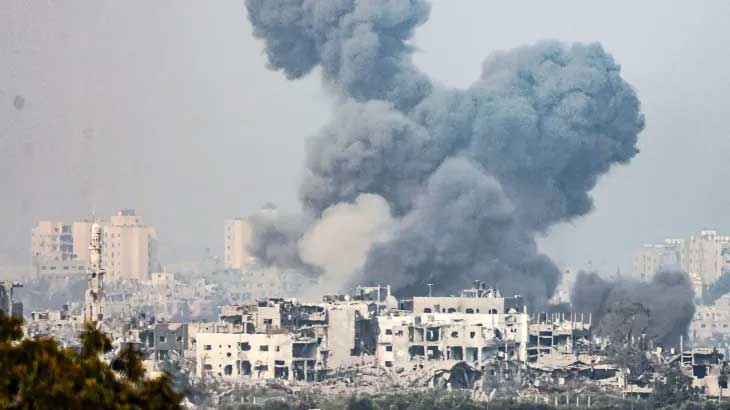
Israeli and foreign human rights groups say Israel has increasingly carved out a form of apartheid in the occupied territories. The killing by Hamas of more than 1,200 people in Israel, and retaliatory Israeli airstrikes on the Gaza Strip that have killed thousands, have moved the conflict into uncharted territory.

The Guardian Reflects the Global Concern 

We have all been profoundly shaken by recent events in Israel and Gaza. This latest conflict marks the start of a chapter that is likely to affect millions of lives, both in the Middle East and further afield, for years to come. With reporters on the ground, and others producing live blogs, videos, podcasts, and photo essays as the story unfolds, the Guardian is dedicated to bringing you independent, fact-checked journalism 24/7.