Saturday, May 18, 2024

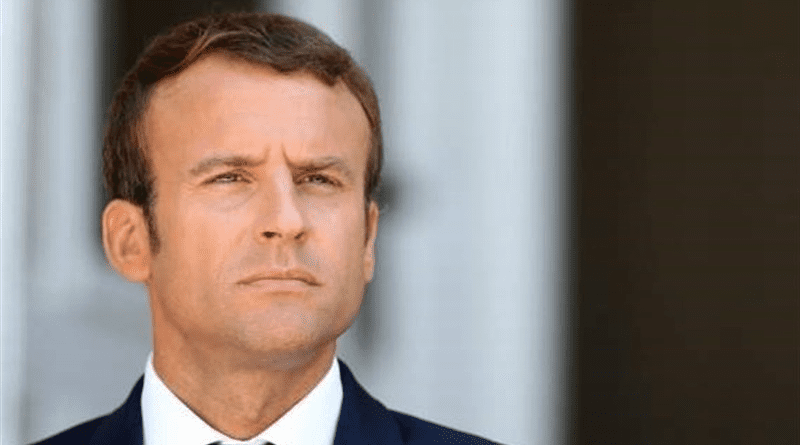
 France's President Emmanuel Macron. Photo Credit: Tasnim News Agency

Macron’s Warning To Europe Against Falling Into Thucydides Trap – OpEd

By 

The famous British magazine The Economist cited French President Emmanuel Macron as a Jupetarian president thinking about his legacy.

World History Encyclopedia has termed Jupiter, the supreme god. He was Jupiter Elicius – one who brings forth. By the rise of the Republic, Jupiter’s identity as the greatest of all the gods was firmly established, but two members of the old triad were replaced with Juno (his sister and wife) and Minerva (his daughter). Jupiter’s most important title was Jupiter Optimus Maximus, meaning the Best and Greatest and signifying his role as father of the gods. Jupiter, however, had his detractors and challenges. After the death of Julius Ceaser, who at one time served as a flamen dialis or Jupiter’s personal priestly officer, Emperor Augustus’s followers initiated an imperial cult: the worship of the emperor as a god.

President Macron, writes The Economist, is adamant that, whoever is in the White House in 2025, Europe must shake off its decades-long military dependence on America and with it the head-in-the-sand reluctance to take hard power seriously. “My responsibility,” he says, “is never to put [America] in a strategic dilemma that would mean choosing between Europeans and [its] own interests in the face of China.” He calls for an “existential” debate to take place within months. 

Bringing in non-EU countries like Britain and Norway, this would create a new framework for European defense that puts less of a burden on America. Macron is willing to discuss extending the protection afforded by France’s nuclear weapons, which would dramatically break from Gaullist orthodoxy and transform France’s relations with the rest of Europe. 

Macron’s second theme is that an alarming industrial gap has opened up as Europe has fallen behind America and China. For Macron, this is part of a broader dependence in energy and technology, especially in renewables and artificial intelligence. Europe must respond now, or it may never catch up. He says the Americans “have stopped trying to get the Chinese to conform to the rules of international trade”. Calling the Inflation Reduction Act “a conceptual revolution”, he accuses America of being like China by subsidizing its critical industries. “You can’t carry on as if this isn’t happening,” he says.  Macron’s solution is more radical than simply asking for Europe to match American and Chinese subsidies and protection. He also wants a profound change to the way Europe works.  

But one wonders whether Emmanuel Macron’s call to Europe does not repeat Cassandra prophecy who was loved by the god Apollo and promised to  bestow upon her the gift of prophecy if she would comply with his desires. Cassandra accepted the proposal, received the gift, and then refused the god her favors. Apollo revenged himself by ordaining that her prophecies should never be believed. She accurately predicted such events as the fall of Troy and the death of Agamemnon but her warnings went unheeded. During the sack of Troy, Ajax the Lesser dragged Cassandra from the altar of Athena and raped her. For this impiety, Athena sent a storm that sank most of the Greek fleet as it returned home. In the distribution of the spoils after the capture of Troy, Cassandra fell to Agamemnon and was later murdered with him.

Leaving aside Greek mythology it would be useful to discuss current affairs. President Macron’s message to Europe relates to the Russian invasion of Ukraine and the rise of China aspiring for a seat at the table that sets “rule based” world. which the real super power – the USA- has been the driving force for fifty years: setting rules to its advantage, more often than not breaking the so-called rules, dealing with Joseph Stalin, the division of defeated Germany, setting up the Nuremberg Trials, in short running the world as the US pleased till the rise of multipolar world when it is now forced to take along European powers as partners and also newly independent countries that gained freedom from British rule. 

The world today has become too complex, particularly with the rise of China which is now considered as the greatest enemy of the US depicted by both President Donald Trump and now the Biden administration. In a recent article in Foreign Affairs  (Matt Pottinger and Mike GallagherMay/June 2024) affirmed that there can be no Substitute for Victory. America’s Competition With China Must Be Won, Not Managed. The authors added that amid a presidency beset by failures of deterrence—in Afghanistan, Ukraine, and the Middle East—the Biden administration’s China policy has stood out as a relative bright spot. The administration has strengthened U.S. alliances in Asia, restricted Chinese access to critical U.S. technologies, and endorsed the bipartisan mood for competition. Yet the administration is squandering these early gains by falling into a familiar trap: prioritizing a short-term thaw with China’s leaders at the expense of a long-term victory over their malevolent strategy. The Biden team’s policy of “managing competition” with Beijing risks emphasizing processes over outcomes, bilateral stability at the expense of global security, and diplomatic initiatives that aim for cooperation but generate only complacency. The United States shouldn’t manage the competition with China; it should win it. 

Beijing is pursuing a raft of global initiatives designed to disintegrate the West and Beijing usher in an antidemocratic order. It is underwriting expansionist dictatorships in Russia, Iran, North Korea, and Venezuela. It has more than doubled its nuclear arsenal since 2020 and is building up its conventional forces faster than any country has since World War II. These actions show that China isn’t aiming for a stalemate. Neither should America. The authors in the aforementioned article added that Washington will need to adopt rhetoric and policies that may feel uncomfortably confrontational but in fact are necessary to reestablish boundaries that Beijing and its acolytes are violating. That means imposing costs on Chinese leader Xi Jinping for his policy of fostering global chaos. It means speaking with candor about the ways China is hurting U.S. interests. It means rapidly increasing U.S. defense capabilities to achieve unmistakable qualitative advantages over Beijing. It means severing China’s access to Western technology and frustrating Xi-Jinping’s efforts to convert his country’s wealth into military power. And it means pursuing intensive diplomacy with Beijing only from a position of American strength, as perceived by both Washington and Beijing. 

No country should relish waging another cold war. Yet a cold war is already being waged against the United States by China’s leaders. Rather than denying the existence of this struggle, Washington should own it and win it. Lukewarm statements that pretend as if there is no cold war perversely court a hot war; they signal complacency to the American people and conciliation to Chinese leaders. Like the original Cold War, the new cold war will not be won through half measures or timid rhetoric. Victory requires openly admitting that a totalitarian regime that commits genocide, fuels conflict, and threatens war will never be a reliable partner. Like the discredited détente policies that Washington adopted in the 1970s to deal with the Soviet Union, the current approach will yield little cooperation from Chinese leaders while fortifying their conviction that they can destabilize the world with impunity. 

The duo added that Security Dialogue, bringing together the leaders of Australia, India, Japan, and the United States, and convened high-profile trilateral summits with the leaders of Japan and South Korea. Biden also unveiled AUKUS, a defense pact among Australia, the United Kingdom, and the United States. As it turned out, however, aggression would come from the opposite direction, in Europe. Less than three weeks before invading Ukraine, Russian President Vladimir Putin had signed a “no limits” security pact with Xi-Jinping. 

Across Asia, Biden’s diplomats pulled longtime allies and newer partners closer together. They organized the first summits of the Quad, or Quadrilateral Jinping in Beijing. In a prudent step after the invasion, Biden drew a redline by warning Xi-Jinping in a video call that the U.S. government would impose sweeping sanctions if China provided “material support” to Moscow. Xi-Jinping nonetheless found plenty of ways to support the Russian war machine, sending semiconductors, unarmed drones, gunpowder, and other wares. China also supplied Moscow with badly needed money in exchange for major shipments of Russian oil.

Chinese officials, according to the U.S. State Department, even spent more money on pro-Russian propaganda worldwide than Russia itself was spending. Beijing was also coordinating more closely with Iran and North Korea, even as those regimes sent weapons to help Moscow wage war in Europe. Yet Washington was pursuing siloed policies—simultaneously resisting Russia, appeasing Iran, containing North Korea, and pursuing a mix of rivalry and engagement with China—that added up to something manifestly incoherent. Indeed, the situation that Xi had forecast at the start of the Biden administration was becoming a reality: “The most important characteristic of the world is, in a word, ‘chaos,’ and this trend appears likely to continue,” Xi-Jinping told a seminar of high-level Communist Party officials in January 2021. Xi-Jinping made clear that this was a useful development for China. “The times and trends are on our side,” he said, adding, “Overall, the opportunities outweigh the challenges.” 

By March 2023, Xi Jinping revealed that he saw himself not just as a beneficiary of worldwide turmoil, but also as one of its architects. “Right now, there are changes, the likes of which we haven’t seen for 100 years,” he said to Vladimir Putin on camera while wrapping up a visit to the Kremlin. “And we are the ones driving these changes together.”

The entire world would be well advised to listen to the implied threat that China-Russia “limitless” friendship carries and not let emerging powers to fall into the Thucydides Trap, reminding us of the perils inherent in power transitions between states. While history may not repeat itself exactly, the underlying dynamics highlighted by Thucydides remain relevant in understanding contemporary geopolitical challenges. By heeding these lessons, policymakers can strive to navigate power shifts with wisdom and foresight, ultimately working towards a more stable and peaceful international order.


French President’s warning to Europe against falling Into Thucidydes Trap

By Kazi Anwarul Masud
Date : 14 May , 2024

Is Emmanuel Macron a Juperatian President

Famous British magazine The Economist cited French President Emmanuel Macron as a Jupetarian President thinking about his legacy. World History Encyclopedia has termed Jupiter, the supreme god. He was Jupiter Elicius – one who brings forth. By the rise of the Republic, Jupiter’s identity as the greatest of all the gods was firmly established, but two members of the old triad were replaced with Juno (his sister and wife) and Minerva (his daughter). Jupiter’s most important title was Jupiter Optimus Maximus, meaning the Best and Greatest and signifying his role as father of the gods. Jupiter, however, had his detractors and challenges. After the death of Julius Ceaser, who at one time served as a flamen dialis or Jupiter’s personal priestly officer, Emperor Augustus ‘s followers initiated an imperial cult: the worship of the emperor as a god. President Macron, writes The Economist, is adamant that, whoever is in the White House in 2025, Europe must shake off its decades-long military dependence on America and with it the head-in-the-sand reluctance to take hard power seriously. “My responsibility,” he says, “is never to put [America] in a strategic dilemma that would mean choosing between Europeans and [its] own interests in the face of China.” He calls for an “existential” debate to take place within months.

Emmanuel Macron advocates inclusion of Non-European Countries to Lessen Burden on the USA

Bringing in non-EU countries like Britain and Norway, this would create a new framework for European defense that puts less of a burden on America. He is willing to discuss extending the protection afforded by France’s nuclear weapons, which would dramatically break from Gaullist orthodoxy and transform France’s relations with the rest of Europe.  Macron’s second theme is that an alarming industrial gap has opened up as Europe has fallen behind America and China. For Macron, this is part of a broader dependence in energy and technology, especially in renewables and artificial intelligence. Europe must respond now, or it may never catch up. He says the Americans “have stopped trying to get the Chinese to conform to the rules of international trade”. Calling the Inflation Reduction Act “a conceptual revolution”, he accuses America of being like China by subsidizing its critical industries. “You can’t carry on as if this isn’t happening,” he says.  Macron’s solution is more radical than simply asking for Europe to match American and Chinese subsidies and protection. He also wants a profound change to the way Europe works. 

Will Macron’s call will turn into Cassandra Prophecy

But one wonders whether Emmanuel Macron’s call to Europe does not repeat Cassandra prophecy who was loved by the god Apollo and promised to  bestow upon her the gift of prophecy if she would comply with his desires. Cassandra accepted the proposal, received the gift, and then refused the god her favors. Apollo revenged himself by ordaining that her prophecies should never be believed. She accurately predicted such events as the fall of Troy and the death of Agamemnon but her warnings went unheeded. During the sack of Troy, Ajax the Lesser dragged Cassandra from the altar of Athena and raped her. For this impiety, Athena sent a storm that sank most of the Greek fleet as it returned home. In the distribution of the spoils after the capture of Troy, Cassandra fell to Agamemnon and was later murdered with him. Leaving aside Greek mythology it would be useful to discuss current affairs. President Macron’s message to Europe relates to Russian invasion of Ukraine and the rise of China aspiring for a seat at the table that sets “rule based” world which the real super power- the USA- has been the driving force for fifty years, setting rules to its advantage, more often than not breaking the so-called rules, dealing with Josef Stalin, division of defeated Germany, setting up the Nuremberg Trial, in short running the world as the US pleased till the rise of multipolar world when the US is now forced to take along European powers as partners and also newly independent countries which gained freedom from British rule.

US Considers China as the Greatest Enemy

The world today has become too complex particularly with the rise of China which is now considered as the greatest enemy of the US depicted by both President Donald Trump and now Biden administration. In a recent article in Foreign Affairs magazine  (Matt Pottinger and Mike GallagherMay/June 2024) affirmed that there can be no substitute for  victory. America’s Competition With China Must Be Won, Not Managed. They added that amid a presidency beset by failures of deterrence—in Afghanistan, Ukraine, and the Middle East—the Biden administration’s China policy has stood out as a relative bright spot. The administration has strengthened U.S. alliances in Asia, restricted Chinese access to critical U.S. technologies, and endorsed the bipartisan mood for competition. Yet the administration is squandering these early gains by falling into a familiar trap: prioritizing a short-term thaw with China’s leaders at the expense of a long-term victory over their malevolent strategy. The Biden team’s policy of “managing competition” with Beijing risks emphasizing processes over outcomes, bilateral stability at the expense of global security, and diplomatic initiatives that aim for cooperation but generate only complacency. The United States shouldn’t manage the competition with China; it should win it.

China-Russia “Limitless” Freindship

Beijing is pursuing a raft of global initiatives designed to disintegrate the West and usher in an antidemocratic order. It is underwriting expansionist dictatorships in Russia, Iran, North Korea, and Venezuela. It has more than doubled its nuclear arsenal since 2020 and is building up its conventional forces faster than any country has since World War II. These actions show that China isn’t aiming for a stalemate. Neither should America. They added that Washington will need to adopt rhetoric and policies that may feel uncomfortably confrontational but in fact are necessary to reestablish boundaries that Beijing and its acolytes are violating. That means imposing costs on Chinese leader Xi Jinping for his policy of fostering global chaos. It means speaking with candor about the way China is hurting U.S. interests. It means rapidly increasing U.S. defense capabilities to achieve unmistakable qualitative advantages over Beijing. It means severing China’s access to Western technology and frustrating Xi-Jinping’s efforts to convert his country’s wealth into military power. And it means pursuing intensive diplomacy with Beijing only from a position of American strength, as perceived by both Washington and Beijing.

Is another Cold War in the Offing?

No country should relish waging another cold war. Yet a cold war is already being waged against the United States by China’s leaders. Rather than denying the existence of this struggle, Washington should own it and win it. Lukewarm statements that pretend as if there is no cold war perversely court a hot war; they signal complacency to the American people and conciliation to Chinese leaders. Like the original Cold War, the new cold war will not be won through half measures or timid rhetoric. Victory requires openly admitting that a totalitarian regime that commits genocide, fuels conflict, and threatens war will never be a reliable partner. Like the discredited détente policies that Washington adopted in the 1970s to deal with the Soviet Union, the current approach will yield little cooperation from Chinese leaders while fortifying their conviction that they can destabilize the world with impunity.

Non-European Countries Encouraged for Security Dialogue

The duo added that Security Dialogue, bringing together the leaders of Australia, India, Japan, and the United States, and convened high-profile trilateral summits with the leaders of Japan and South Korea. Biden also unveiled AUKUS, a defense pact among Australia, the United Kingdom, and the United States. As it turned out, however, aggression would come from the opposite direction, in Europe. Less than three weeks before invading Ukraine, Russian President Vladimir Putin had signed a “no limits” security pact with Xi-Jinping.  Across Asia, Biden’s diplomats pulled longtime allies and newer partners closer together. They organized the first summits of the Quad, or Quadrilateral. In a prudent step after the invasion, Biden drew a redline by warning Xi-Jinping in a video call that the U.S. government would impose sweeping sanctions if China provided “material support” to Moscow. Xi-Jinping nonetheless found plenty of ways to support the Russian war machine, sending semiconductors, unarmed drones, gunpowder, and other wares. China also supplied Moscow with badly needed money in exchange for major shipments of Russian oil. Chinese officials, according to the U.S. State Department, even spent more money on pro-Russian propaganda worldwide than Russia itself was spending. Beijing was also coordinating more closely with Iran and North Korea, even as those regimes sent weapons to help Moscow wage war in Europe. Yet Washington was pursuing siloed policies—simultaneously resisting Russia, appeasing Iran, containing North Korea, and pursuing a mix of rivalry and engagement with China—that added up to something manifestly incoherent. Indeed, the situation that Xi had forecast at the start of the Biden administration was becoming a reality: “The most important characteristic of the world is, in a word, ‘chaos,’ and this trend appears likely to continue,” Xi-Jinping told a seminar of high-level Communist Party officials in January 2021. Xi-Jinping made clear that this was a useful development for China. “The times and trends are on our side,” he said, adding, “Overall, the opportunities outweigh the challenges.”

China sees itself as Beneficiary of Global Turmoil

By March 2023, Xi-Jinping had revealed that he saw himself not just as a beneficiary of worldwide turmoil but also as one of its architects. “Right now, there are changes, the likes of which we haven’t seen for 100 years,” he said to Vladimir Putin on camera while wrapping up a visit to the Kremlin. “And we are the ones driving these changes together.”The entire world would be well advised to listen to the implied threat that China-Russia “limitless” friendship carries and not let emerging powers to fall into the Thucydides Trap, reminding us of the perils inherent in power transitions between states. While history may not repeat itself exactly, the underlying dynamics highlighted by Thucydides remain relevant in understanding contemporary geopolitical challenges. By heeding these lessons, policymakers can strive to navigate power shifts with wisdom and foresight, ultimately working towards a more stable and peaceful international order.


Israel-Palestine: Examining Islamic Accountability

  
9 mins read
 
People grieve over victims killed in an Israeli airstrike in the southern Gaza Strip city of Rafah, on April 16, 2024. (Photo by Khaled Omar/Xinhua)

ISLAMIC WORLD’S RESPONSIBILITY FOR HORRIFIC INJUSTICE COMMITTED BY ISRAEL

 Does the Islamic World have any responsibility for the incessant and horrific injustice being committed by Israel towards the Palestinian people? Is it because Harry Truman not only recognized Israel as an independent country and as such gave cover to Israeli air space during the short war with Egypt when Anwar Sadat could have given a death blow to Israel but for the US cover of Israeli air space? Lawrence Rees, historian, and author, in his newest book published in March 2024 titled The Holocaust, wrote that “The fundamental precondition for the Holocaust happening was Adolf Hitler,” he explained that “Even as far back as 1921, Hitler said that solving the Jewish question was a central question for National Socialism. And you can only solve it by using brute force.” Hitler had no blueprint for the Holocaust at that point, says Rees. But he did have a pathological problem with Jews. “Hitler believed that something needed to be done,” Rees explains, “and that evolved and changed according to circumstances and political opportunism. “An intriguing part of Rees’s book is his determination to figure out when the collective set of initiatives we now call the Final Solution became official Nazi policy. It’s a question that doesn’t come with a straightforward answer, Rees maintained.

What is clear, though, is that in the summer of 1940, there was still no concrete plan in place for the extermination of Jews. Furthermore, up until that point, Rees argued, the Nazis were still clinging to the belief that in the long term, the way to solve what they called “the Jewish question” was by expulsion and hard labor. At that point, mass murder was still not the preferred option. By the summer of 1942, however, a sea change had taken place. By that time, the Holocaust was in full swing. Therefore, within the previous two-year period, Rees points out, there were several milestones on the road towards mass extermination. But trying to pinpoint an exact moment where the decision was taken to commit to mass killing is very difficult, says Rees — especially since much of the planning was done in secret without written records. Hitherto, many historians, filmmakers, and writers have pointed to a single meeting where plans for the Holocaust were finally decided upon in the power structures of Nazi officialdom. This was known as the Wannsee Conference. It was held in the Berlin suburb of Wannsee in January of 1942 and involved several mid-ranking Nazi officials devising a plot to murder Jews over a shorter timescale and in more efficient ways. But even then, Rees says, no final plans were resolved at the infamous conference. He also points out that key figures from the upper tiers of the Nazi hierarchy — Himmler, Goebbels, and Hitler himself — were not present. “I cannot see how there can have been a decision in 1941,” said Rees. ‘By that stage, you can say a decision to implement what we would now call the Holocaust had been finally decided.

The moment of no return for the Holocaust, said the historian, was in the spring and early summer of 1942 when a decision was taken to kill all of the Jews in the General Government in Poland — a German-occupied zone established by Hitler after the joint invasion by the Germans and Soviets in 1939.“By that stage, you can say a decision to implement what we would now call the Holocaust had been made,” said Rees. Hungary was beautiful to the Nazis, given the number of Jews that resided there. The Jews were transported to Auschwitz between May and July of 1944, where they were murdered. This plan for cold-blooded murder was deviously orchestrated by Adolf Eichmann, who at the time was stationed in Budapest. American scholar Hannah Arendt felt that the presence of Adolf Eichmann was an accident of history and not a deliberate act as Eichmann happened to be at the time he was there and was simply wanted a promotion to a higher post. Hannah Arendt’s explanation was not an apology for Eichmann but a quirk of history. Adolf Eichmann was fully responsible for the crimes he committed and was justly punished.

The Guardian(London) described Palestine as the largest prison in the world an open-air Israel’s sweeping restrictions on leaving Gaza to deprive its more than two million residents of opportunities to better their lives, Human Rights Watch said today on the fifteenth anniversary of the 2007 closure. The closure has devastated the economy in Gaza, contributed to the fragmentation of the Palestinian people, and forms part of Israeli authorities’ crimes against humanity of apartheid and persecution against millions of Palestinians. Israel’s closure policy blocks most Gaza residents from going to the West Bank, preventing professionals, artists, athletes, students, and others from pursuing opportunities within Palestine and from traveling abroad via Israel, restricting their rights to work and education.

Restrictive Egyptian policies at its Rafah crossing with Gaza, including unnecessary delays and mistreatment of travelers, have exacerbated the closure’s harm to human rights. Israel, with Egypt’s help, has turned Gaza into an open-air prison,” Israel and Palestine director at Human Rights Watch. “As many people around the world are once again traveling two years after the start of the Covid-19 pandemic, Gaza’s more than two million Palestinians remain under what amounts to a 15-year-old lockdown.” Israel should end its generalized ban on travel for Gaza residents and permit free movement of people to and from Gaza, subject to, at most, individual screening and physical searches for security purposes. One could imagine the youngsters who grew up in that prison with no rights, driven from their homes while being assisted by the Israeli army to capture what they used to call their homes.

MODERN ADOLF HITLER

Analysts have written volumes that while President Biden championed the merits of democracy during various campaign stops in swing states, former President Donald Trump hosted far-right Hungarian autocratic President Viktor Orbán at Mar-a-Lago and even took him to a concert. Trump’s friendliness with the Hungarian prime minister is likely because Victor Orbán’s central guiding philosophy and preferred method of governing are similar to Trump’s, and could provide insight as to what a second Trump presidency would look like. Like Trump, Orbán is hostile toward immigrants and notably built a massive border fence in the wake of the Syrian refugee crisis to keep asylum-seekers out of Hungary.

His political party, Fidesz, has cracked down on press freedom and has sought to revise textbooks to exclude mentions of the LGBTQ+ community. And most revealingly, Orbán has made changes to Hungary’s government that allow him to stay in power for an extended period. While addressing a crowd at Mar-a-Lago, Trump extolled his leadership style publicly, saying “There’s nobody better, smarter or a better leader than Viktor Orbán, he’s fantastic… He says, ‘This is the way it’s going to be,’ and that’s the end of it. He’s the boss.” The vile reason Hungary’s Viktor Orban is manipulating US politics Trump’s comments caused significant alarm on social media, with journalists, commentators, and elected officials urging voters to pay attention to the former president’s praise of an “autocrat.” “How many different ways does Trump need to tell you he’s going to rule as a dictator before you believe him?” Philadelphia Inquirer columnist Will Bunch tweeted. Former federal prosecutor Richard Signorelli wrote on X/Twitter that Orbán was “Trump’s Mussolini,” suggesting the former president and the Hungarian leader could be the “new Axis powers’ alliance.” “History is repeating itself but outcome not inevitable if we defeat our modern-day Hitler & his deranged MAGA/Nazi cult at [the] ballot box,” Signorelli tweeted.

“Unfortunately, I do not see law enforcement timely addressing the menace so it’s left to us again.” ‘Path to dictatorship’: Columnist says Trump’s ‘thirst for vengeance’ would go unchecked in 2nd term Others viewed the video as an illuminating preview of what Trump hopes to do if he retakes the White House. Sen. Brian Schatz (D-Hawaii) called the former president “the leader of a global fascist movement” and added his role as the catalyst for the global far-right should be seen as the “central historical context of the coming campaign.” Journalist and lawyer Daniel Miller called on the New York Times in particular to publish a “massive headline about Trump wanting to be a dictator” every day until the election. And Sarah Longwell, who is the publisher of the anti-Trump conservative website The Bulwark, urged news outlets to not hold back in calling out Trump’s affinity for far-right dictators. “Just because it’s old news that Donald Trump loves autocrats doesn’t mean it doesn’t deserve wall-to-wall coverage when he does things like this,” she wrote. “Because it’s insane.” Columnist and podcaster Charles Adler tweeted about his firsthand experience with Orbán’s brand of governing, writing that he “destroyed democracy in Hungary – the land of my birth.” “Hungarians of my generation fled for the US and Canada to get the hell away from authoritarianism,” Adler said. “Now this decaying Mar-A-Lago conman is huckstering Hungarian authoritarianism. It’s as if [Russian President Vladimir] Putin is producing this sideshow.

” US-CHINA STRUGGLE FOR A SO-CALLED PLACE IN “RULE-BASED” TABLE RULING THE WORLD

 During the Cold War, most national governments in Eastern Europe and some in Asia were led by a single political party. In many cases, these regimes evolved into totalitarian systems that exercised total control over their societies. In other cases, the role of the secret police was more relaxed, and citizens did not face constant surveillance. Single-party regimes are led by a hegemonic party with a strong grip on power. Although only one leader is officially in charge, many political elites must work together to form and execute governmental policies.

Classic examples of single-party rulers include the Chinese Communist Party, the Vietnamese Communist Party, and the People’s Action Party of Singapore. Studies have noted that single-party systems tend to perform much better in terms of economic growth and development than personalistic or military-junta systems. The emphasis on consensus in policymaking ensures that policy output is not erratic or predicated on the whims of the dictator. Monarchies are led by a ruling family and operate in ways similar to those of a single-party regime, with many individuals participating in the discussion, consultation, and decision-making processes. For this reason, the policy output of monarchies has tended to be predictable as well, making monarchies—like single-party regimes—one of the most durable forms of rule.

During the Arab Spring beginning in 2010–11, for example, the republics in Libya, Yemen, and Egypt were all overturned, while the monarchies faced protests but never wavered. The stability of authoritarian rule in the Middle East led to studies searching for explanations of how regimes that have a relatively well-off population can prevent the rise of a disgruntled middle class pushing for democratic rights and representation. The answer for some scholars was the regimes’ possession of certain valuable natural resources, which resulted in huge “rents.” Rents constitute revenues that go directly to a government without the need for stimulating productivity or collecting taxes. They include foreign aid and funds from the sale of natural resources such as oil, natural gas, and diamonds. Many oil-rich countries use oil rents to pay off elites and the public, thereby ensuring that they remain apolitical. Instead of investing in citizens, taxing them, and representing their interests, the regime effectively co-opts them. Oil revenues in particular have been used to strengthen the state’s repressive institutions, thereby ensuring that there are no challenges to the status quo.

A few decades earlier, the growth of an educated middle class, along with pressure from students and labor, led to an increase in the number of democracies during what the American political scientist Samuel Huntington (1927–2008) referred to as the “Third Wave.” Additional weak autocracies collapsed when they ceased to receive financial support from either of the two superpowers. The press is another target of authoritarian regimes. Although it is not usually completely owned by the state, journalists and media outlets face limits on what they can say and how critical of the government they can be. Failure to respect such boundaries can result in imprisonment, harassment, threats, fines, or revocation of operating licenses.

In other cases, the regime simply ensures that major media outlets are captured by cronies—who are willing to supply pro-regime content—as in Hungary under Prime Minister Victor Orban. Authoritarian regimes today also incorporate legislatures, political parties, and judiciaries, but those institutions do not have much power, if any. A legislature may exist, but it is filled with political lackeys who never vote against the leader. While it is true that what are called “electoral autocracies” allow some opposition within legislatures or a limited level of judicial independence, such practices are usually just a democratic facade designed to maintain the regime’s domestic and international legitimacy.

DO MOST COUNTRIES HAVE MORE EXPERIENCE THAN DEMOCRACY? IS IT BECAUSE AUTHORITARIAN DICTATORS CAN REACH THE ESSENTIALS TO THE NEEDY FASTER THAN DEMOCRATS?

 Most countries have had less experience with democracy than with autocracy. In the early 21st century, survey research in Russia found that nearly 60 percent of all adults took a positive view of the Soviet dictator Joseph Stalin, while only about 20 percent held a similar opinion of the reforming president Mikhail Gorbachev. Digital authoritarianism” Authoritarian regimes in the 21st century have tapped into the fears of citizens in new and old democracies, posing a massive threat to democratic systems. For example, Russia and other authoritarian countries have used the Internet to spread disinformation designed to widen political divisions within democratic countries and to undermine public faith and trust in democratic institutions. Republican opponent, Donald Trump, who unexpectedly won the election.

Few countries have been able to maintain a system of digital authoritarianism as sophisticated and technologically advanced as that of China. At the turn of the 21st century, China began work on a digital infrastructure that would prevent its citizens from accessing information that could destabilize its government. Known outside China as the Chinese Firewall (and inside China as the Golden Shield), the infrastructure incorporated a centralized system of Internet traffic choke points that enabled the government to prevent domestic Internet users from accessing websites based in other countries and to limit access to Chinese websites by foreign Internet users. The threats of authoritarian rule to democracies are substantial. Most people live in nondemocratic systems. Nevertheless, although authoritarianism has been resurgent in many countries, these changes are not likely to be permanent.