Friday, June 7, 2024


Why Israel’s Generals Are Now Openly Speaking Out Against Netanyahu

Israel's foundational conflict is playing out in the Gaza war. Both Netanyahu and Sinwar need to win, so the Gaza war will carry on.

  
8 mins read
 
This photo released on April 14, 2024, shows Israeli Prime Minister Benjamin Netanyahu making a phone call with U.S. President Joe Biden. (GPO/Handout via Xinhua)

Senior Israeli Military Criticizes Netanyahu

Hiding behind “senior officers in the Israel Defense Forces” or “members of the General Staff,” the message went out to the news organizations. The troops were being sent in for a second time to Jabalya, a third time to Zeitoun, and other locations in the northern part of the Gaza Strip because Hamas had returned. And Hamas had returned because Prime Minister Benjamin Netanyahu had refused to provide a “day after” strategy for an alternative force to take control of the power vacuum in Gaza once Hamas’ military structure had been dismantled.

The Generals’ Message is Not New

It wasn’t entirely a new message. The generals have been grumbling about the army having to go into Gaza without an overarching strategy from the government from the earliest stage of the campaign – even before the ground maneuver began on October 24. But this is the first time these complaints have not just been made in off-the-record conversations, but as part of what can only be a coordinated briefing against the prime minister. Netanyahu can hardly complain. He has been briefing against the generals from the start of the war, and in a much more orderly fashion. They, and the heads of the intelligence services, have been set up by him and his media proxies as being solely responsible for “the concept” that allowed Israel to be taken by surprise on October 7.

Qatari Funding is Contingent on Leading to Palestinian Statehood

Not him, the man who was in favor of allowing Hamas to entrench itself in Gaza – including with the help of Qatari funding, at his urging – in order to serve his agenda of sidelining the Palestinian Authority and averting any concessions that could lead to Palestinian statehood. View IDF Chief of Staff Lt. Gen. Herzl Halevi talking with Defense Minister Yoav Gallant earlier this month. Naturally, Netanyahu was ready with his counter-briefing. This came in two forms. There was a more measured response for respectable journalists from a “senior political source,” who explained that those demanding a strategy for the “day after” in Gaza while Hamas still has military power are “detached from reality.” No alternative force can be envisaged until Hamas is destroyed militarily. What this message was hinting at, the less respectable mouthpieces were only too happy to spell out: If the IDF’s defeatist Chief of Staff Lt. Gen. Herzl Halevi is not prepared to destroy Hamas, he should resign and make room for officers who are not “captive to the concept.”

Israel’s Foundational Conflict is Playing Out in Gaza Conflict

Israel’s foundational conflict is playing out in the Gaza war. Both Netanyahu and Sinwar need to win, so the Gaza war will carry on. Biden’s ‘doomsday weapon’ threat to Israel is no false alarm. This could have been a legitimate debate on how to conduct the war. There are valid arguments on both sides. The IDF claims it has delivered and now Netanyahu is squandering its gains by lack of a follow-up plan.

Netanyahu Wants Total Degradation of Hamas as a Fighting Force

Netanyahu and those who support his stance say it is pointless trying to organize an alternative to Hamas in Gaza until Hamas has been totally degraded as a fighting force. Upon closer examination, though, both arguments have gaping holes in them and are largely self-serving. Netanyahu has made sure that not only is there no alternative force getting ready to take control of parts of Gaza, but until now, in the eighth month of the war, there has not even been any serious discussion on it and talks with the potential candidates (the Palestinian Authority, relatively moderate Arab states, or Western allies).

Netanyahu’s Ultimate Goal is Reoccupying Gaza for Good

Prime Minister Benjamin Netanyahu speaking at Yad Vashem on the eve of Holocaust Remembrance Day last week. His avoidance of the issue is primarily political. He is afraid of the far-right parties in his governing coalition who would nix any suggestion that stands in the way of their ultimate goal – reoccupying Gaza for good. That isn’t Netanyahu’s goal. His is to remain in power. The generals have indeed been trying to get Netanyahu and the war cabinet to furnish them with a clearer strategic framework from the beginning of the war. They were rebuffed at every turn, including when the General Staff set up its own team to try to formulate its own strategic ideas. But they should have realized that

Netanyahu’s Tactical Plan

Netanyahu was not going to give them what they needed and made their tactical plans accordingly. They pushed to go big with the ground maneuver, to send entire armored divisions into Gaza City and uproot nearly 2 million civilians. It was their war plan that Netanyahu signed off on. They were aware there was little prospect of having anyone prepared to come in and help run Gaza, yet they proceeded as if there would be. An Israeli strike on eastern Rafah, Gaza Strip, last week. The time for the generals to confront Netanyahu about the lack of a strategy was before embarking on the ground maneuver. They have grounds to blame him now for squandering the tactical gains, but they also shoulder part of the blame. The debate on the “day after” is an essential one, but it’s taking place seven months too late. Israeli Prime Minister Benjamin Netanyahu and his government are finding themselves increasingly boxed into a corner. Netanyahu is waging a devastating war in the Gaza Strip that has riled global public opinion and placed him and his government before two of the world’s most significant courts.

The International Court of Justice is expected to deliver a ruling soon on a request to Israel to cease military operations in Gaza, including its offensive on the southernmost city of Rafah. Ihsan Tharoor in his latest Washington Post report has written that Israeli Prime Minister Benjamin Netanyahu and his government are finding themselves increasingly boxed into a corner. Netanyahu is waging a devastating war in the Gaza Strip that has riled global public opinion and placed him and his government before two of the world’s most significant courts. Global anger deepened all the more this week in the wake of yet another deadly Israeli strike on Gaza.

Adding to the already considerable pressure on President Biden to change course in its staunch support for Israel’s campaign. After the strike, White House officials struggled to explain how the ongoing Israeli offensive in Rafah did not cross Biden’s blurry red line. “We still don’t believe that a major ground operation in Rafah is warranted,” White House spokesman John Kirby told reporters. “We still don’t want to see the Israelis, as we say, smash into Rafah with large units over large pieces of territory.” Whatever the criteria surrounding “large units” and “large pieces of territory,” the stark reality is that Israel has already driven out hundreds of thousands of people who had been sheltering in Rafah after fleeing other parts of the Gaza Strip. Its capture and closure of the main border crossing into Egypt cratered a struggling humanitarian operation. Aid agencies describe the war-ravaged Gaza Strip as a place where Palestinians have nowhere safe to go. And Israeli officials are adamant that they won’t let up anytime soon in their quest to vanquish militant group Hamas.

Tzachi Hanegbi, national security adviser to Israeli Prime Minister Benjamin Netanyahu, told local radio this week that his government expected to wage its operations in Gaza for “at least another seven months.” He said the extended mission would be “to fortify our achievement and what we define as the destruction of the governmental and military capabilities” of Hamas and other Palestinian militant groups in the territory. In seven months’ time, a rather different political dispensation may exist in Washington. Netanyahu reportedly met this month with three foreign policy envoys working with former president and current presidential candidate Donald Trump — who could yet win the election despite being convicted on felony counts of falsifying business records in his New York state hush money case. Though it’s unclear how he would have handled the crisis differently from Biden, the former president has invoked Biden’s friction with Netanyahu as evidence of U.S. failure and expressed little public sympathy for Palestinian suffering. Trump has told donors that if he returns to the White House, he would severely crack down on pro-Palestinian groups in U.S. universities and even deport foreign students participating in these protests.

Netanyahu, who benefited immensely from Trump’s first term, is arguably hoping for a similar dividend in the event of a second. In the interim, he has openly rejected the Biden administration’s hopes for the Palestinian Authority to take the lead in the postwar administration of Gaza, and he and his allies have shown no interest in even engaging in the White House on reviving pathways for a Palestinian state. And contrary to the Biden administration’s wishes, Netanyahu may soon act on a Republican invitation to address a joint session of Congress. Standing up to Biden — whose favorability among Israelis has dropped in recent months — may help shore up the support Netanyahu needs from the Israeli right and curry favor among their counterparts in the United States. It also accelerates a deeper shift in the U.S.-Israeli relationship. “Over the past 16 years, Netanyahu has departed sharply from his predecessors’ studious bipartisanship to embrace Republicans and disdain Democrats, an attitude increasingly mirrored in each party’s approach to Israel,” my colleagues wrote this week in a piece examining the prime minister’s role in widening a growing divide — even as Biden remains a staunch supporter of Israel and is reviled by many on the U.S. left for being complicit in the deaths of tens of thousands of civilians in Gaza. It’s not just Netanyahu who is waiting for Trump.

The evidence is clearer that Russian President Vladimir Putin is holding out for a Trump victory, which would probably help the Kremlin consolidate its illegal conquests of Ukrainian territory. “Trump’s proposal consists of pushing Ukraine to cede Crimea and the Donbas border region to Russia, according to people who discussed it with Trump or his advisers and spoke on the condition of anonymity because those conversations were confidential,” they reported. Such a move would fracture the transatlantic coalition built up in support of Ukraine’s resistance to Russian invasion.

It would cement the Republican turn away from Europe’s security at a time when Western resolve around Ukraine is flagging. And it would be yet another sign of Trump’s conspicuous affection for the strongman in the Kremlin. “In his eight years as the GOP’s standard-bearer, Trump has led a stark shift in the party’s prevailing orientation to become more skeptical of foreign intervention such as military aid to Ukraine,” my colleagues wrote. “Trump has consistently complimented Putin, expressed admiration for his dictatorial rule and gone out of his way to avoid criticizing him, most recently for the death in jail of political opponent Alexei Navalny.” My colleagues reported this week about growing tensions between Kyiv and officials in the Biden administration, with Ukraine pushing its Western allies to loosen rules over the usage of some of their weaponry on targets on Russian soil. Pessimism has set in over what Ukrainian forces can achieve militarily this summer, as Russia launches new offensives.

Conclusion

“I think the best we can hope for until the election is a stalemate,” John Bolton, Trump’s former national security adviser and now vocal critic, recently said. “Putin is waiting for Trump.” Trump’s team “is thinking about this very much in silos, that this is just a Ukraine-Russia thing,” Hill said. “They think of it as a territorial dispute, rather than one about the whole future of European security and the world order by extension.” “Former president Trump’s inexplicable and admiring relationship with Putin, along with his unprecedented hostility to NATO, cannot give Europe or Ukraine any confidence in his dealings with Russia,” said Tom Donilon, President Barack Obama’s national security adviser. “Trump’s comments encouraging Russia to do whatever it wants with our European allies are among the most unsettling and dangerous statements made by a major party candidate for president. His position represents a clear and present danger to U.S. and European security.”


Disgraced Departure of Benjamin Netanyahu from Israeli Politics

Netanyahu’s argument against postwar plans and operations is that the war isn’t over and “there is no alternative to military victory.

  
6 mins read
 
Israeli Prime Minister Benjamin Netanyahu. Source: AAP

DISGRACED DEPARTURE OF NETANYAHU COULD SOLVE MIDDLE EAST CRISIS

The world, including many in Israel, is fed up with the behavior of Prime Minister Netanyahu, whose departure from the Israeli political scene now appears to be the only solution for peace in the Middle East. Benjamin Netanyahu must depart in disgrace as he and his wife are charged with selling priceless jewelry, which they received as gifts on their trips abroad but should have been deposited in the state treasury.

DETAILS OF CORRUPTION CASES

The two main corruption scandals involving Netanyahu concern allegations of illicit dealings with rich and powerful men. In one case, Netanyahu is accused of receiving expensive gifts from billionaires and then taking action on their behalf. In another case, he is accused of striking an illicit deal with a newspaper publisher. Netanyahu is alleged to have received tens of thousands of dollars’ worth of gifts. Netanyahu has acknowledged receiving the gifts but denies they were illegal or constituted bribes. He is also involved in two other corruption scandals, and his wife and son are in trouble too.

SARA NETANYAHU IS ISRAEL’S MARIE ANTOINETTE

Meanwhile, Sara Netanyahu is likely to be indicted for misusing public funds at the couple’s official residences. The Israeli first lady is accused of using government money to pay for private chefs at family events, a caregiver for her father, and weekend electrical work at the couple’s home. The allegations have long dogged Sara Netanyahu, who sometimes comes off in the Israeli media as the country’s Marie Antoinette.

NETANYAHU MAY HAVE TO RESIGN IF POLICE RECOMMEND INDICTMENT

Netanyahu could be nearing indictment but might still stay in office. So what does this mean for the prime minister, who has governed Israel since the beginning of the Obama administration? It depends on two factors: whether he is indicted and whether that creates enough pressure to force him to resign. If police recommend an indictment, it could still take several months until the attorney general formally indicts Netanyahu. Even then, he isn’t legally required to resign. This is why the prime minister’s fate may come down to pressure from fellow politicians and the public. A poll found that 66 percent of Israelis believe Netanyahu should resign if indicted. There is intrigue within Netanyahu’s Likud party as well, with some ministers openly backing him while another, speaking anonymously, said he should resign if indicted.

FAREED ZAKARIA IN WASHINGTON POST

Israeli officials and generals are turning on the prime minister, and the country must adjust course. Fareed Zakaria added that on Gaza, Biden is right and Netanyahu is wrong. Something very unusual is happening in Israel. Senior military officials have begun voicing criticism of how Prime Minister Benjamin Netanyahu is conducting the war in Gaza. Israeli media has been reporting on a weekend security meeting at which the chief of staff of the Israel Defense Forces, Gen. Herzi Halevi, criticized Netanyahu’s lack of a clear strategy. Pointing out that the Israeli military had reentered northern Gaza — an area it had claimed to have cleared in January — Halevi warned that unless there was a plan to set up some kind of non-Hamas government in these areas, the IDF would have to keep repeating these kinds of operations endlessly. Israeli Defense Minister Yoav Gallant has gone further, publicly criticizing Netanyahu by pointing out that “the day after Hamas will only be achieved by actors who replace Hamas” and declaring that he would not permit Israel to try to govern Gaza directly.

A stunning victory with the shield creates an opening for Israel. The Middle East is on the precipice of a wider war no one wants. Guernica doubles down on retraction of an essay on the Israel-Gaza war. Much has been written about whether the Israeli military is being careful or callous in its concern for civilian casualties when carrying out its attacks in Gaza. But the larger point has to do with its counterinsurgency strategy. In the United States’ only successful counterinsurgency campaign in recent memory — the 2007 surge in Iraq — its strategy was designed to protect the civilian population, isolate the insurgents, and then crush them. To that end, Army Gen. David Petraeus worked tirelessly with Iraq’s Sunnis — the community spawning the insurgency — to win them over, give them a stake in Iraq’s government, and thus isolate the insurgents and militias. He then used lethal force against those militias. This is almost the inverse of Israel’s strategy, which has been first and foremost to go after Hamas, guns blazing, with very little regard for winning the hearts and minds of Gaza’s civilian population.

Netanyahu’s argument against postwar plans and operations is that the war isn’t over and “there is no alternative to military victory. The attempt to bypass it with this or that claim is simply detached from reality.” Benjamin Netanyahu has repeatedly said that he would continue the war until he achieves total victory, by which he presumably means either a surrender by Hamas or its total eradication.

BIDEN ADMINISTRATION’S POLICY ON ISRAEL

Fareed Zakaria added that from early on in the war, the Biden administration has believed that Netanyahu’s strategy was flawed because there was no way to defeat Hamas militarily without a political strategy to isolate it and offer an alternative that had some credibility and legitimacy. That was why the White House wanted to begin discussions with the Palestinian Authority and a group of Arab states, including Egypt and Saudi Arabia, to make plans for reconstruction and governance in a non-Hamas Gaza. Netanyahu will not consider any such plans. Netanyahu refuses to talk about the postwar because he knows that his own postwar future is bleak. Many Israelis continue to hold him responsible for the policies that led to the Oct. 7 attack. Were new elections to be called, he would likely lose office — and then face ongoing prosecution as well as potential inquiries about the failures that led to Oct. 7. All of this can be pushed off as long as the prime minister insists on a Hamas surrender, which he will not get but will keep the war going indefinitely. It is a strategy not designed to secure Israel’s future but rather his own.

CONCLUSION

Given the complexities enmeshed in the world today, where the rise of China along with the limitless friendship between Xi Jinping and Vladimir Putin is putting the world into two sides — one led by the USA and her colleagues — it is clear that multipolarity has become a fact of life. In the words of Nina Khrushcheva, great-granddaughter of the Soviet leader Nikita Khrushchev, who was responsible for destroying the bilateral relationship by denouncing Stalin in 1956: Stalin was never a loyal ally to China. As Khrushcheva recalled, in 1951, when the Korean War had reached a stalemate, the Soviet dictator derided Mao as a talentless guerrilla fighter.

In any case, Putin was not in Beijing just for the show. Since he launched his full-scale invasion of Ukraine two years ago — and the West responded with unprecedented sanctions — Russia has become highly dependent on China. So, when Putin landed in Beijing, his hand was practically already outstretched. But Xi, like Stalin 75 years ago, has reservations. Yes, Russia has its uses. As Xi noted at the recent summit, he views the bilateral relationship as a “factor in maintaining global strategic stability and democratization of international relations.” That helps to explain why, as Putin pointed out, the two countries have created a “weighty portfolio” of 80 major investment projects.

There are, however, clear limits on what China is willing to sacrifice for Russia. Start with the economy. In recent months, Xi has met with several Western leaders, including German Chancellor Olaf Scholz, French President Emmanuel Macron, and US Secretary of State Antony Blinken. All of them relayed the same message: if China keeps supplying “dual-use” materials and technologies that can bolster Russia’s war effort, its firms will face secondary sanctions. Xi made sure to come across as unmoved. But it is probably no coincidence that Chinese exports to Russia have declined, falling by 14% in March alone. Moreover, since the beginning of this year, China has steadily reduced direct deliveries of machinery, equipment (including electrical equipment), mechanical parts, and accessories to Russia. Given that China is Russia’s largest source of imports — accounting for about 45% of the total last year — this is a major cause for concern in the Kremlin.

In addition, China has been dragging its feet when it comes to the Power of Siberia-2 gas pipeline, which will transport Russian gas to China. Well aware that he has the upper hand, Xi expects Russia to foot the entire bill for the pipeline’s multi-billion-dollar construction, while continuing to offer China steep discounts on energy. This year, China paid just $300 per 1,000 cubic meters of gas pumped through the Power of Siberia-1 pipeline, while Europe and Turkey paid more than $500 per 1,000 cubic meters. Progress on the Power of Siberia-2 pipeline is so important to Putin that he brought Russian Deputy Prime Minister Alexander Novak, who is responsible for energy relations, with him to Beijing. But all Novak could offer after the meeting was a vague assurance that a contract will be signed “in the near future.”

Putin’s Mao-like bid for a full-fledged military alliance, including commitments to mutual defense, also seems to have failed. Though China has held joint military exercises with Russia, it has sought to position itself as a proponent of “win-win cooperation,” in contrast to the “Cold War mentality” that assumes the world’s division into competing blocs. Why would Xi jeopardize his position as a kind of conduit between Russia and the West? Xi is not interested in quarreling, at least not overtly, and Putin’s agenda includes nothing but quarrels. The world, complex as it has become, has to hold its breath to see how things unfold in the future. It is, however, certain that the cost of annihilation of the adventurists, including a nuclear race, is not in the cards.

Saturday, May 25, 2024


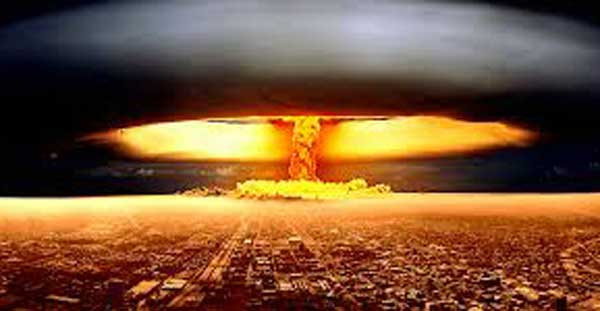
Can the World afford to enter Nuclear Race?

By Kazi Anwarul Masud
Issue:  Net Edition    | Date : 22 May , 2024

Worldwide holding of Nuclear Weapons

Currently about 13080 nuclear warheads exist worldwide, with Russia holding the most (6,257) and the U.S. following (5,550), a reduction from Cold War peaks. Nuclear weapons have been used in warfare twice: the U.S. dropped bombs on Hiroshima and Nagasaki in 1945, causing massive destruction and casualties. The Cold War arms race peaked in 1986 with the Soviet Union and U.S. accumulating over 40,000 and 23,000 nuclear warheads, respectively, driven by mutually assured destruction.

Destructive Capacity of Nuclear Weapons

A nuclear weapon is an explosive device that derives its destructive force from nuclear fission, nuclear fusion, or a combination of the two. Nuclear weapons are alternately called atom bombs, atomic bombs, A-bombs, nuclear bombs, nuclear warheads, or simply nukes. All nuclear weapons fit into one of two broad categories: fission and combination weapons, or the even-more-destructive fusion-based designs, which are technically thermonuclear weapons and may also be referred to as thermonuclear bombs, fusion weapons, hydrogen bombs, or H-bombs. Nuclear weapons unleash enormous amounts of explosive force, which is measured in kilotons (1,000 tons of TNT) and megatons (1,000,000 tons of TNT), as well as heat and radiation. They are easily the most fearsome weapons on Earth, capable of producing more death, destruction, injury, and sickness than any other weapon. Nuclear weapon stockpiles today It is estimated that there are approximately 13,080 nuclear warheads in the world today. While this is far fewer than either the U.S. or Russia possessed during their Cold War peak, it is notable that there are more countries with nuclear weapons than there were 30-40 years ago. At present, Russia maintains the highest number of nuclear weapons, with an estimated 6,257 total warheads. Of these, 1,458 are actively deployed (current START II treaty limits both the U.S. and Russia to 1550 deployed total), 3039 are inactive but available to be made active, and 1,760 are retired and awaiting dismantling. The United States follows closely behind with 5,550 total nuclear weapons: 1,389 active, 2,361 inactive but available, and 1,800 in line to be dismantled.

Nuclear Bombs dropped during World War II

To date, nuclear weapons have been used in war only twice. At the end of World War II, the United States dropped a nuclear bomb on Hiroshima, Japan on August 6, 1945, and a second bomb on Nagasaki, Japan, on August 9, 1945. One detonated with an explosive force of approximately 15 kilotons, which leveled most buildings within a 1-mile radius. The shock wave was followed by a blast of heat at 6,000°C (10,830°F), which ignited or incinerated anything flammable and turned the blast zone into a firestorm. Finally, the explosion produced lethal ionizing radiation and lingering radioactive fallout, in which debris blasted into the stratosphere by the initial explosion is held aloft by atmospheric winds and settles back to Earth over the next several days. All told, the bombing of Hiroshima was estimated by a 1945 government report to have resulted in 66,000 deaths and another 69,000 injuries. Nagasaki’s totals were a lesser, but still devastating 39,000 deaths and 25,000 injuries.

Nuclear Escalation during the Cold War

Recently war, kicked off an arms race between the United States and the Soviet Union. A major component of the “Cold War,” in which the U.S. and U.S.S.R. openly competed without actually declaring war on one another, the stockpiling of nuclear weapons continued into the late 1980s. According to the Bulletin of Atomic Scientists, the nuclear arms race reached its peak in 1986. The bombings of Hiroshima and Nagasaki established nuclear weapons as the ultimate weapons which time the Soviet Union possessed more than 40,000 nuclear warheads and the United States had 23,000 (down from more than 31,000 in 1967). Much of this proliferation was based around the idea of “mutually assured destruction,” in which both sides believed that the best way to avoid nuclear war was to have so many nukes that the opponent would not launch an attack because they feared they could not destroy enough of the target country’s arsenal to avoid being devastated themselves by a retaliatory attack. After the Soviet Union dissolved Nuclear Non-Proliferation Treaty (NPT) in 1991, thousands of nuclear weapons on both sides were dismantled.

Treaties that limit Nuclear Weapons

Because of the broad lethality and destructive potential of nuclear weapons, governments have negotiated arms control agreements such as the 1970 Nuclear Non-Proliferation Treaty, the 1972 Strategic Arms Limitation Treaty (SALT), and the 1991 Strategic Arms Reduction Treaty (START). The NPT’s purpose is to inhibit the spread of nuclear weapons. It designates five countries as nuclear-weapon states (NWS)—the United States, Russia, China, France and the United Kingdom—and classifies the rest as non-nuclear weapon states (NNWS). Under the treaty, NWS agree not to help NNWS develop or obtain nuclear weapons, and NNWS agree not to attempt to develop or obtain nuclear weapons on their own. Countries of both classifications further agree to help one another develop nuclear energy for peaceful purposes and to negotiate nuclear disarmament in good faith. Nearly every country in the world had accepted the NPT as of 2022, though North Korea withdrew from the Treaty in 2003.

Cuban Crisis Wikipedia

Reports that throughout the 1950s and the early 1960s the U.S. and the USSR both endeavored, in a tit-for-tat approach, to prevent the other power from acquiring nuclear supremacy. This had massive political and cultural effects during the Cold War. As one instance of this mindset, in the early 1950s it was proposed bomb on the Moon as a globally visible demonstration of American weaponry. As a show of political strength, the Soviet Union tested the largest-ever nuclear weapon in October 1961 which was tested in a reduced state with a yield of around 50 megatons—in its full state it was estimated to have been around 100 Mt. In its full, dirty, design it would have increased the amount of worldwide fallout since 1945 by 25%. In 1963, all nuclear and many non-nuclear states signed the Limited Test Ban Treaty pledging to refrain from testing nuclear weapons in the atmosphere, underwater, or in outer space. President Dwight D Eisenhower’s doctrine of “massive retaliation” in the early years of the Cold War was a message to the USSR, saying that if the Red Army attempted to invade the parts of Europe not given to the Eastern bloc during the Potsdam Conference (such as West Germany), nuclear weapons would be used against the Soviet troops and potentially the Soviet leaders. The Cuban Crisis during the Presidency of John Kennedy was seen as the closest the U.S. and the USSR ever came to nuclear war and had been narrowly averted by last-minute compromise by both superpowers. Fears of communication difficulties led to the installment of the first hotline, a direct link between the superpowers that allowed them to more easily discuss future military activities and political maneuverings. It had been made clear that missiles, bombers, submarines, and computerized firing systems made escalating any situation to Armageddon far easier than anybody desired.

The Second Nuclear Age

The second nuclear age can be regarded as proliferation of nuclear weapons among lesser powers and for reasons other than the American-Soviet-Chinese rivalry. India embarked relatively early on a program aimed at nuclear weapons capability, but apparently accelerated after the 1962 Sino-Indian war. After the disintegration of Pakistan Pakistan’s Prime Minister Bhutto launched research on nuclear weapons. The Indian test caused Pakistan to spur its programme. India tested fission in 1998, and Pakistan did the same year, raising concerns they would use nuclear weapons on each other. All the non-Russian former Soviet bloc countries with nuclear weapons – Belarus, Ukraine, and Kazakhstan – transferred their warheads to Russia by 1996. Israel is widely believed to possess an arsenal of up to several hundred nuclear warheads, but this has never been officially confirmed or denied. Key US scientists involved in the American bomb program, clandestinely helped the Israelis and thus played an important role in nuclear proliferation. North Korea announced in 2003 that it had several nuclear explosives.

Conclusion

All nuclear weapons holders are aware that possession of weapons has a price because it will have no survivors including the one foolish enough to undertake such a venture. The world will not permit such an adventure to be undertaken that will wipe out billions of years of human history.


Did America’s Misreading of Saddam Hussein Lead to the Iraq War?

Once Saddam survived the Gulf War, it was reasonable for the United States to try to contain him without getting sucked into another full-scale conflict.

  
7 mins read
 
Vintage photo of Saddam Hussein during a press conference with his daughter Hala

FATEFUL MISREADING OF SADDAM

Gideon Rose, a Senior Fellow and deputy director of National Security Studies at the Council on Foreign Relations from 1995 to 2000, was appointed managing editor of Foreign Affairs to replace Fareed Zakaria. On June 3, 2010, it was announced that Rose would succeed James F. Hoge Jr. as editor of Foreign Affairs, a position he took up on October 1, 2010. In an article, Rose wrote about the importance of technology in the modern world, given the complex situation today.

The rise of China and its ambition for a seat at the table that dictates the ‘rules-based’ world, previously the sole prerogative of the US for almost fifty years, has ended. The US, having replaced the United Kingdom as the dominant power, outsourced regional security to local contractors. This strategy collapsed in 1990 when Iraq seized Kuwait and threatened Saudi Arabia. At this point, the George H. W. Bush administration stepped in to manage the situation directly, leading an international coalition to reverse Iraq’s aggression and restore Kuwait’s sovereignty. But Iraq’s leader, Saddam Hussein, managed to survive the war and regain control of most of his country. Thus, the administration adopted a policy of sanctions and containment, continued by its successors for a decade.

9/11 ATTACKS ON AMERICAN SOIL

Then came the 9/11 attacks. In their wake, the George W. Bush administration decided to address not only the terrorism problem but also the Iraq problem by conquering the country and forcibly eliminating Saddam’s regime. The conquering part went largely as planned, but the aftermath proved chaotic. Liberation turned into occupation; local uncertainty turned into insurgency and then civil war. U.S. troops ended up staying in Iraq, fighting various foes for almost two decades. The Iraq war was disastrous, costly, and an unforced error. In retrospect, it seems to be the hinge of the entire post–Cold War era, the moment when American hegemony shifted from successful to problematic, from welcomed to resisted.

VANISHING AMERICAN APPETITE FOR ACTIVE INTERNATIONAL ENGAGEMENT AND RISE OF UNIPOLAR MOMENT

Two decades on, the unipolar moment has faded, along with dreams of a better Middle East and the American appetite for active international engagement. Recent historiography shows that Bush administration officials believed containment was falling apart and feared what Iraq might do afterward. What they did not know, and would not have believed, was that Saddam’s regime had destroyed almost all its WMD programs in the early 1990s but continued for a decade to give every indication of having kept much of them. Based largely on captured Iraqi records and interviews with former officials, Saddam’s behavior after the Gulf War was dangerously provocative and irrational. After 9/11, a new administration in Washington brought its own confusion to decision-making.

RASHOMON IN THE DESERT

Saddam Hussein himself was a hitman in his 20s and a prolific novelist in his 60s. He thought people’s loyalty could be judged by eavesdropping on their children and checking where his picture was displayed in their homes. His sons, Uday and Qusay, were monsters. In the 1990s, Saddam bribed Russian, French, Chinese, and UN officials to gain their support, and his foreign minister, Tariq Aziz, could not understand why the UN’s chief weapons inspector, the Swedish diplomat Rolf Ekeus, would not get with the program.

The result was a dialogue of the deaf, with little comprehension by either side. In the 1980s, for example, the Reagan administration worked with Israel to provide military support to Iran in hopes of gaining the release of American hostages held by Hezbollah in Lebanon, using the proceeds of the arms sales to support anticommunist rebels in Nicaragua. When this intrigue came to light, Saddam was bitter but not surprised, telling his team that the Iran-contra affair was an Israeli-sponsored conspiracy to destroy him.

THE MISSING WEAPONS

The Achilles Trap spends a lot of time on covert operations but little on the debates that went on inside each administration over how to handle Iraq. Saddam Hussein emerged as a paranoid, self-deluded megalomaniac, someone almost impossible to deal with constructively. These traits emerged in the actions the Iraqi government took during the 1990s, which are even more astonishing now that the full story is known. Having largely reconstituted his domestic position following the Gulf War, Saddam Hussein had no regrets about anything and was determined to wait out his enemies, regain his military strength and full freedom of action, and continue taking on the world. He recognized that being caught with WMD would be problematic, so in mid-1991, he got rid of most of his programs—but without telling anybody or keeping records of what had been done. Having thus guaranteed utter confusion, and while continuing to deny any charges against him that had not already been proven, Saddam then acted as if everybody should have understood what had happened. He assumed that an all-powerful CIA already knew that he had no nuclear, chemical, or biological weapons.

CONTAINMENT TO ROLLBACK

The Achilles Trap paints the Iraqi leader as an unrepentant serial aggressor determined to rebuild his military power. Several of those in the West who advocated for lifting sanctions, meanwhile, were on his payroll, making their arguments suspect. Even without the faked evidence peddled by charlatans such as the Iraqi exile Ahmed Chalabi, there were ample grounds for believing that someday Saddam Hussein would once again plunge his strategically critical region into conflict.

WHAT CAUSED THE WAR IN IRAQ

Nor did 9/11 have to lead to such an outcome, since what happened that day had nothing to do with Iraq. What produced the war was the underlying challenge of maintaining Gulf security, combined with Saddam’s bizarre behavior, and the psychological impact of 9/11 on a handful of idiosyncratic, unconstrained American officials. The Clinton administration did not like the messy containment policy it inherited from its predecessor, but it could never find a better alternative. As vice president, Gore was on the hawkish side of the Clinton administration’s Iraq debates, but he never came close to advocating an unprovoked invasion, and there is no reason to think he would have launched one as president.

Iraq was strong enough to pose a threat but weak enough to be conquerable. A similar scenario might have played out had George W. Bush appointed different Republican national security grandees to key positions in his administration, such as Brent Scowcroft and Robert Gates instead of Vice President Dick Cheney and Secretary of Defense Donald Rumsfeld, or had chosen to empower different ones among those he did appoint, such as Secretary of State Colin Powell. Yet even with Bush elected and his administration stocked with hard-liners, there was no move to attack until 9/11, which set the administration on a path to war not just in Afghanistan but in Iraq as well.

RISE OF AL QAEDA AND BOMBING ON US SOIL

During the Clinton administration, independent radical Islamist terrorist groups had emerged as an increasingly worrisome threat. They bombed the World Trade Center in New York in 1993, the U.S. embassies in Tanzania and Kenya in 1998, and the USS Cole in Yemen in 2000. During the presidential transition, outgoing Clinton officials told their incoming Bush counterparts that such groups constituted the most urgent threat the country faced, but the Bush team discounted such warnings—along with those of its own increasingly frantic intelligence officials—because it believed that rogue states posed much greater dangers.

When al Qaeda struck New York and Washington on 9/11, therefore, the administration’s senior figures were devastated by grief, anger, and guilt. Rather than trying to learn why they had been wrong about this attack, they looked for future ones they could prevent and in so doing recast themselves as prescient heroes. “Your response isn’t to go back and beat yourself up about 9/11,” National Security Adviser Condoleezza Rice would put it. “It’s to try to never let it happen again.” From this perspective, Iraq represented not only a danger but also an opportunity. Two weeks after the catastrophe, Bush asked Rumsfeld to review war planning for Iraq. By the end of 2001, Tommy Franks, the head of the U.S. military’s Central Command, had delivered a blueprint for an invasion. And by mid-2002, Bush had decided to strike unless Saddam Hussein indisputably confirmed his disarmament.

TO BAGHDAD AND BEYOND

Other administrations had dreamed of being rid of Saddam, but none had gone to war for it, because none wanted the responsibility of managing his country afterward. The George W. Bush administration got around that problem by ignoring it. Its war plan lacked an ending—and so, unsurprisingly, the war never really ended, with the conflict lurching from one battle to another for years to come. It is now clear that several people were responsible for that glaring omission. But the buck has to stop at the incurious commander in chief, who didn’t think through the foreseeable consequences of the decisions he was making. Last year, in his book Confronting Saddam Hussein, the diplomatic historian Melvyn Leffler revisited this ground. “Bush disliked heated arguments, and, therefore, did not invite systematic scrutiny of the policies he was inclined to pursue,” Leffler wrote, adding, “He was unable to grasp the magnitude of the enterprise he was embracing, the risks that inhered in it, and the costs that would be incurred.”

When that kind of thing happens in dictatorships like Saddam’s Iraq or Vladimir Putin’s Russia, observers naturally assume it is because of the terrible costs of dissent. The American invasion of Iraq shows that no such coercion is necessary. Two sets of lessons emerge from this sorry spectacle, one about process and the other about policy. At no time did the administration force itself to officially state the war’s objectives and the strategy for achieving them—a failure that allowed the huge gaps in its planning to remain unnoticed and unchallenged.

EXECUTION OF SADDAM HUSSEIN

Good process does not necessarily lead to good policies, but it can help weed out obviously bad ones, which is something. Even Zen masters following best management practices, however, would have found it challenging to deal with Saddam. In December 2003, Saddam Hussein was captured in a hole on a farm near Tikrit, and he died on a scaffold three years later. President Bill Clinton once told his staff that he found Iraq “the most difficult of problems because it is devoid of a sensible policy response.”

Once Saddam survived the Gulf War, it was reasonable for the United States to try to contain him without getting sucked into another full-scale conflict. But that approach was costly, risky, and hard to sustain. The George W. Bush administration refused to accept that such an unsatisfying course was the least bad option available and blindly plunged into the abyss. Had leaders in either Baghdad or Washington behaved less recklessly, the war would not have happened. But the challenge of protecting the global economy from Baghdad’s own Tony Montana would have remained.

(The author of this article is indebted to Gideon Rose, editor of Foreign Affairs magazine, an Adjunct Senior Fellow at the Council on Foreign Relations, and the author of How Wars End.)