Monday, January 22, 2024

 flags united states russia (source tasnim)

Why US-Russia Relations Are So Challenging – OpEd

By 

These days the world is rightly involved with the genocidal activities of the Israeli government of Benjamin Netanyahu even though the Jews had suffered unspeakable atrocities by Hitler’s Nazi Germany the world and the media are not getting adequate coverage of another story relating to the great change taking place in Europe since 1945. Russian President Vladimir Putin appears to be following the footsteps of Adolph Hitler through the acquiescence of the European countries and most notably the US. As Angela Stent in her article (Why are US-Russia relations so challenging? Dated April 27, 2020) pointed out The United States’ relationship with Russia is today the worst that it has been since 1985. Moscow’s interference in the 2016 U.S. presidential election and what appears to be its continuing attempts to affect the 2020 election campaign have made Russia a toxic domestic issue in a way that it has not been since the 1950s. 

She added The U.S. National Security Strategy declares Russia and China the two top threats to U.S. national security. At the best of times, U.S.-Russia ties are a mixture of cooperation and competition, but today they are largely adversarial. Yet, as the world’s two nuclear superpowers, Russia and the United States bear a unique responsibility to keep the peace and discourage the proliferation of nuclear, biological, and chemical weapons around the globe. 

These are hopeful words but one can only hope that the aspirations of the rest of the world which have become more complex with the addition of China and complex economic relations among different countries giving rise to phrases like “decoupling” and “ de-risking” in the global dictionary.  Coming back to Europe and President Vladimir Putin one has to remind oneself of Putin’s red line he had repeatedly asked the West to ensure Russia’s strategic interests. 

As Angela Stent wrote Russia’s legitimate interests were ignored by the United States. This includes Russia’s right to a sphere of influence in the post-Soviet states, meaning that they should not aspire to join NATO or the European Union. Today, Russia defines its security perimeter not as the borders of the Russian Federation, but as the borders of the former Soviet Union. It demands that the United States and Europe acknowledge this. 

This reminds the world of Putin’s lamentation that the fall of the Soviet Union in 1991 was the demise of “historical Russia,” a comment that did fuel speculation about his foreign policy intentions amid a buildup of tens of thousands of Russian troops in regions bordering Ukraine. “It was the disintegration of historical Russia under the name of the Soviet Union,” Putin said of the 1991 breakup of the Soviet Union while speaking in a documentary film called Russia aired on state television. Putin, a former agent of the Soviet KGB security service, has previously lamented the collapse of the Soviet Union, calling it the “the greatest geopolitical disaster of the 20th century.” The comments in the documentary, however, reveal how much he feels the disintegration of the Soviet Union devastated Russia’s power. 

Soviet Union’s final hours were described by Christopher Klein described the ten-minute speech by Mikhail Gorbachev announcing the dissolution of the Soviet Union and his resignation as its eighth and final leader. Three of the Soviet Union’s 15 republics had already declared independence, and days earlier the leaders of 11 others agreed to leave the USSR to form the Commonwealth of Independent States. Once the republic leaders signed the Soviet Union’s virtual death warrant, all that was left was for Gorbachev to pull the plug. The process of the demise of the Soviet Union was not short. The reforms enacted by Gorbachev set the stage for a series of mostly bloodless revolutions that swept through the Soviet satellite countries of Eastern Europe in 1989. As the Berlin Wall fell, the Soviet leader chose not to order a military response. 

The historic changes earned Gorbachev the Nobel Peace Prize and Time magazine’s “Man of the Decade” honor, but the USSR had lost its communist Eastern Bloc. Increasingly, Gorbachev was being pulled in two different directions by democrats who wanted even greater freedoms and autonomy for the republics and conservatives who wanted to end the reforms that they believed were breaking the union apart. The maverick leader of the Russian republic, Boris Yeltsin, was a particularly radical thorn in Gorbachev’s side. Yeltsin, who had dramatically quit the Communist Party in 1990, called for Gorbachev’s resignation after the Soviet army cracked down in Lithuania and other republics that sought independence and greater sovereignty.  In March 1991, the USSR held a public referendum to determine whether the union should be preserved or dissolved. More than three-quarters of voters wanted the USSR to endure, but six republics abstained from voting altogether. Despite the results, the referendum did little to stop the fracturing of the country. Yeltsin and other democrats continued to push Gorbachev to introduce more radical reforms, and the Soviet President negotiated a treaty that decentralized power from the central government to the republics. In his letter of resignation, President Mikhail Gorbachev wrote “ 

“Due to the situation which has evolved as a result of the formation of the Commonwealth of Independent States, I hereby discontinue my activities at the post of President of the Union of Soviet Socialist Republics,” Gorbachev said in his address. “The policy prevailed of dismembering this country and disuniting the state, which is something I cannot subscribe to.” “We’re now living in a new world. An end has been put to the Cold War and to the arms race, as well as to the mad militarization of the country, which has crippled our economy, public attitudes, and morals,” he said before lamenting that “the old system collapsed before the new one had time to begin working.” 

Mikhail Gorbachev appointed Vladimir Putin as his successor and thus began Putin’s rule which continues till today. On his death, an analyst writing on Gorbachev’s legacy wrote: Mikhail Gorbachev will remain one of the most controversial figures in modern Russian history. A son of poor peasants, he was a Nobel laureate, the first and the last president of the Soviet Union, the initiator of nuclear disarmament, the main contributor to ending the Cold War, and the architect of glasnost (openness) and perestroika (economic restructuring). Yet, to many ordinary Russians, his rule is likened to that of Tsar Nicholas II, a humble ruler with noble aspirations yet unable to cope with complex challenges, who made erratic choices that ultimately led to his country’s disintegration, accompanied by sharp economic decline and a demographic catastrophe. Unlike Nicholas II, however, 

Gorbachev’s resignation in December of 1991 did avert a large civil war. And some of his decisions were transformative. The unification of Germany and the dissolution of the Warsaw Pact would not have been possible without him. He dreamed that these events would be followed by the dissolution of NATO and the opening up of a “Greater Europe,” a trans-Atlantic community “from Vancouver to Vladivostok.” Now, the dream and the dreamer are no more. It is difficult, indeed impossible, to bring into words the life and legacy of any great people. Such attempts remain elusive and the people can only paint them as they see fit. 

Friday, January 12, 2024

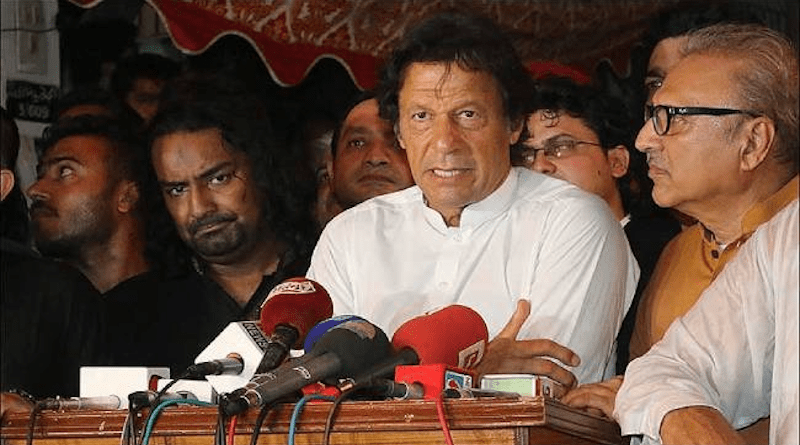
 Pakistan's Imran Khan. Photo Credit: Imran Khan's Twitter account

Can Pakistan Ever Be Free From Clutches Of Military – OpEd

By 

In an article in the respected British journal, The Economist Pakistan’s ousted Prime Minister Imran Khan has expressed doubt about the fairness of the forthcoming General Elections scheduled to be held in January 2024. In his words, Imran Khan is now in jail on charges of exposing state secrets by reading out in the Pakistan National Assembly a secret telegram sent by the Pakistani ambassador to Washington which accused the US government of conspiring with the Pakistani military authority to oust Imran Khan from his post as Prime Minister.

The allegation was naturally dismissed by the US government. Imran Khan wrote “Whether elections happen or not, how I and my party have been targeted since a farcical vote of no confidence in April 2022 has made one thing clear: the establishment—the army, security agencies, and the civil bureaucracy—is not prepared to provide any playing field at all, let alone a level one, for PTI. It was, after all, the establishment that engineered our removal from government under pressure from America, which was becoming agitated with my push for an independent foreign policy and my refusal to provide bases for its armed forces”.

Imran Khan, added “Because of what the cipher message said, I believe that the American official’s message was to the effect of pulling the plug on Imran Khan’s Prime Ministership through a vote of no confidence, or else. Within weeks our government was toppled and I discovered that Pakistan’s Chief of Army Staff, General Qamar Javed Bajwa, had, through the security agencies, been working on our allies and parliamentary backbenchers for several months to move against us… There were two assassination attempts on my life. My party’s leaders, workers, and social media activists, along with supportive journalists, were abducted, incarcerated, tortured, and pressured to leave PTI. Many of them remain locked up, with new charges being thrown at them every time the courts give them bail or set them free. Worse, the current government has gone out of its way to terrorize and intimidate PTI’s female leaders and workers to discourage women from participating in politics…

I remain incarcerated, in solitary confinement, on absurd charges that include treason. Those few of our party’s leaders who remain free and not underground are not allowed to hold even local worker conventions. When PTI workers manage to gather together they face brutal police action. In this scenario, even if elections were held they would be a disaster and a farce since PTI is being denied its basic right to campaign. Such a joke of an election would only lead to further political instability….Despite all this, PTI remains popular, with 66% support in a Pattan-Coalition 38 poll held in December; my personal approval rating is even higher. Now the election commission, desperate to deny the party the right to contest elections, is indulging in all manner of unlawful tricks. The courts seem to be losing credibility daily. 

Meanwhile, a former prime minister with a corruption conviction, Nawaz Sharif, has returned from Britain, where he was living as an absconder of Pakistani justice. In November a Pakistani court overturned the conviction. I believe that Sharif has struck a deal with the establishment whereby it will support his acquittal and throw its weight behind him in the upcoming elections” Imran Khan adds that I remain incarcerated, in solitary confinement, on absurd charges that include treason. Those few of our party’s leaders who remain free and not underground are not allowed to hold even local worker conventions. When PTI workers manage to gather together they face brutal police action. In this scenario, even if elections were held they would be a disaster and a farce since PTI is being denied its basic right to campaign. Such a joke of an election would only lead to further political instability.” If convicted Imran Khan faces a jail sentence of fourteen years. 

Since Major General Iskander Mirza became President of Pakistan the army either directly or indirectly has been ruling the country. A Pakistani analyst wrote in October 2021 before the ouster of Imran Khan from the post of Prime Minister was the blue-eyed boy of the Pakistani army. Once again, in a repetition of the same pattern that has dogged Pakistani politics since the country’s inception, the military and civilian government have become embroiled in a tense and highly publicized tussle for power. Imran Khan—who became Prime Minister in an election allegedly rigged in his favor by the army—had refused to sign off on the appointment of Lt. Gen. Nadeem Anjum as the country’s top spymaster.

As a result, Islamabad has become the setting of a constitutional crisis that has enervated the state and left crucial military departments without leadership and direction. At the center of this conflict is Faiz Hameed the outgoing current director general of Inter-Services Intelligence (ISI), who has been blamed in various quarters for rigging the 2018 election. From General Ayub Khan’s ten years of so-called prosperity during which the country was completely under the control of the army to General Yahya Khan’s ignominious defeat at the hands of Lt. Gen Jagjit Singh Arora was a period of shame for the Pakistan Army. After campaigning on autonomy for East Pakistan, Sheikh Mujibur Rahman’s Awami League won almost every seat in the National Assembly that had been allotted to the east wing of then Pakistan. Logically he now was the paramount leader in East Pakistan, and, because his party had won a majority of the 300 contested seats in the National Assembly, Bangabandhu Shiekh Mujib was entitled to form the national government.

However, Bhutto—whose Pakistan Peoples Party had won a commanding majority in West Pakistan—and the military establishment refused a government where the country’s future might be unilaterally decided by the East. Arguing that Mujib did not have a single seat in the western provinces and that he, Bhutto, was the only serious representative from the west wing, Bhutto insisted on using another formula to organize the civilian government. Bangabandhu Sheikh Mujib having been elected on the promise of pursuing autonomy in East Pakistan, was unwilling to compromise on his six-point program for the East to enjoy increased self-governance. Bhutto and his associates, meanwhile, saw the program as an end to federation altogether. Bhutto convinced Yahya Khan to postpone the convening of the National Assembly as the two sides worked to find a solution, and Yahya Khan did so on March 1, 1971. Bangabandhu Sheikh Mujib declared that the people of Bengal had once again been betrayed by the power in West Pakistan. In the dead of night, the Pakistan Army launched one of the worst genocides in the history of the world on unarmed and unaware Bengalis which finally led to the birth of Bangladesh as an independent country.

Unfortunately, the US sided with Pakistan in the debate in the UN Security Council and noted that its alliances with Pakistan did not commit Americans to take sides in a civil war, even one internationalized by the Indian “invasion” of East Pakistan. It was clear that India had effectively and irreversibly dismembered Pakistan and that the Muslim country would now take a different form from the one created by Mohammed Ali Jinnah and the Muslim League. Zulfiqar Ali Bhutto the leading politician in what remained of Pakistan, assumed the presidency. 

Bhutto was placed under house arrest, and, on July 5, 1977, Gen. Mohammed Zia ul Huq, Bhutto’s personal choice to head the Pakistan army, took the reins of government. Bhutto’s subsequent arrest on charges that he ordered the assassination of a political rival, and Zia’s insistence that he be tried for this alleged crime, brought an end to the Bhutto era and ushered in the Zia ul-Haq regime. Found guilty and sentenced to death, Bhutto was hanged on April 4, 1979. His regime ended on August 17, 1988, when he was killed when his aircraft blew up in mid-air.  The cause of the crash, which also took the life of the U.S. ambassador to Pakistan and several top-ranking Pakistani generals, has never been fully determined. He was succeeded by Zulfiqar Ali Bhutto’s daughter Benazir Bhutto. She had another stint as Prime Minister.

National elections were held again in October 1993. In a close contest, the PPP won a plurality—though not a majority—of seats in the National Assembly; Nawaz Sharif’s new Pakistan Muslim League (N) was a somewhat distant second. Benazir Bhutto’s assassination while campaigning for the third term ended her career. After the resignation of Parvez Asif Ali Zardari was elected President as neither the PML-N nor the PML-Q candidate won enough support to pose a challenge to Zardari, the PPP’s candidate.  

The latest twist in Pakistani politics was the return of Nawaz Sharif whose earlier criminal offences were withdrawn by the court. In between was the killing of Osama Bin Laden the leader of the al-Qaeda network. The assault, carried out by a small team transported by helicopter, was launched after U.S. intelligence located bin Laden living in a walled compound in Abbottabad, a medium-sized city near Islamabad. Bin Laden’s presence in Abbottabad threatened to add new tension to the often-troubled security alliance between the United States and Pakistan. Pakistani officials had often denied claims that bin Laden was hiding out in Pakistan, possibly abetted by Islamic militants in the remote and rugged areas on the Afghan border. After bin Laden’s death, the news that he had lived in a large compound in an affluent area near the Pakistan Military Academy, one of the country’s most prestigious military institutes, raised questions about how his presence could have escaped the notice of Pakistan’s security forces. This in brief is the history of the army’s rule in Pakistan which does not appear to be curtailed in the foreseeable future. (For this part of the history of the Pakistani army and civilian relationship I am indebted to Encyclopedia. Britannica)

Sources say that Imran Khan was fearful of being voted out when the country scheduled to go to the polls in 2023, and he was adamant that Hameed should not be replaced, even though he has been posted to command a corps in Peshawar. According to an analyst, this was because Imran Khan did not believe he could win without the support of ISI, which was guaranteed for as long as Hameed remained in his post. In digging in his heels over this appointment, Imran Khan had placed himself in direct conflict with General Qamar Javed Bajwa, the long-presiding chief of Pakistan’s army, who authorized the replacement of Hameed with Anjum. An erstwhile ally of Imran Khan, Bajwa now has to suffer the ignominy of being defied by a Prime Minister whom he not only helped install but also protected at great cost to the army’s reputation. 

The two main parties—the PPP and the PML-N—both held long-standing grudges with the establishment and could no longer be trusted to do its bidding. Both had been deposed in military coups; both had had their leaders persecuted by the state and, at various times in history, both had campaigned on anti-military platforms. It was in this environment that the army began to promote the candidacy of Imran Khan, with whom it believed it could cultivate a different sort of relationship. Political Scientist Maliha Lodi opined that it all speaks to the noisy nature of politics in Pakistan that there are competing power centers and even when it looks like the whole thing has been stitched up. Everything is being run from General Headquarters and there is more fluidity in the system. 


Is it Conceivable for Russia to Use Nuclear Weapons?

The Kremlin should not retain its monopoly on public discussion of nuclear use, and nuclear threats must be responded to rather than with panic. Russia should be challenged directly over its own toxic and irresponsible domestic and international nuclear statements.

by Kazi Anwarul Masud

INTRODUCTION

One would like to answer in the negative given the fact that such a move would not only end mankind as we know it but would also mean the end of Russia itself. There is no reason to believe that the world regardless of the number of nuclear weapons they possess would let a madman survive. Yet Vladimir Putin’s remarks, are often misrepresented by learned people whose writings are printed in respected magazines e. g. Foreign Affairs and other publications as well, perhaps on the ground that freedom of expression is guaranteed by democracies throughout the world. I found it interesting to read an article by Peter  Schroeder (The Real Russian Nuclear Threat. The West Is Worried About the Wrong Escalation Risks in the December 20, 2023 issue.)

A U.S. nuclear test in the Nevada desert in 1953 Foto: National Nuclear Security Administration

US POLICY ON RUSSIAN USE OF NUCLEAR WEAPONS

 The writer quoted at length US President Joe Biden in the following words: “I worry about Putin using tactical nuclear weapons,” U.S. President Joe Biden said in June. The risk, he continued, is “real.” However, officials do not appear to believe that the war in Ukraine could lead Russia to use its nuclear arsenal against a NATO state, however furious it is at the West for supporting Ukraine. That is a mistake. U.S. officials have it backwards. It is quite unlikely that Russian President Vladimir Putin will use a nuclear weapon on the battlefield in Ukraine, but he may move toward using one against NATO. Unlike the West, Putin may not fear a nuclear standoff: he is well versed in Russia’s nuclear arsenal and the tenets of nuclear deterrence, and possibly sees himself as uniquely suited to navigating a nuclear crisis.

RUSSIAN PRESIDENT ON USE OF NUCLEAR WEAPONS

Vladimir  Putin has been remarkably consistent that Russia is willing to use nuclear weapons against NATO to defend its interests in Ukraine.” Peter Schroeder added that even eight years ago, in a television interview done a year after Russia invaded Crimea, Russian President Vladimir Putin declared that he had been ready to place Russian nuclear forces on alert to prevent Western forces from interfering in Moscow’s takeover of the peninsula.

Russian nuclear weapons use is not imminent. But if Putin does escalate the war, for instance by attacking NATO with conventional weapons, he will likely move very swiftly, so as not to give the United States a chance to manoeuvre away from a crisis. Washington will struggle to deter a Kremlin so emboldened.

INVASION OF UKRAINE AND RUSSIAN NUCLEAR POLICY

Ukraine is too central to the Kremlin’s ambitions—and too secondary to the United States—for Putin to believe any American threats. Ultimately, Vladimir Putin will expect the United States to back down before fighting a nuclear conflict over land so far from home.

Do people believe that such an eventuality can happen in a world that has become so complex and so interdependent with phrases like ‘de-risking” and “ de-globalization” and many other phrases being taught in schools from primary levels?

RUSSIAN SUSPENSION OF NEW START TREATY

In his long article Peter Schroeder wrote that in February 2023, Russia suspended participation in the New START treaty, which regulated how many nuclear weapons Moscow and Washington could have. In March, the Kremlin announced that it would move some of its nuclear weapons into Belarus. In October of that year, Vladimir Putin suggested that Russia might restart nuclear testing.

All the while, Russian government officials have threatened to launch a nuclear attack, as former President Dmitriy Medvedev did in July when he said Russia could “use nuclear weapons” to conclude the Ukraine war in a few days. U.S. officials, of course, have paid attention to these threats, but they have not been convinced by them. They imagined that Moscow may use small so-called tactical nuclear weapons on the battlefield, but not large so-called strategic ones against NATO states.

THE US IS HOPEFUL THAT RUSSIA WILL NOT USE NUCLEAR WEAPONS

According to National Security Adviser, Jake Sullivan  U.S. experts in recent days thought that there was little fear that Russia would use strategic nuclear weapons in Ukraine or against the West, but some remained concerned that Russia could use tactical weapons. Putin, their thinking went might use these weapons to help Russian forces halt a Ukrainian attack that appeared on the verge of taking back Crimea or inflicting a significant defeat that threatened to push Russian forces out of eastern Ukraine. However, the growing complacency among U.S. officials is based on a misunderstanding of Putin’s rhetoric and the dynamics that keep Moscow from using nuclear weapons.

When Putin invokes his arsenal, he is not trying to warn that Russia could use tactical nuclear weapons in Ukraine. Rather, his rhetoric is designed to threaten NATO itself. It is a blinking red light, a warning to American decision-makers that Moscow is willing to create a nuclear confrontation with Washington if needed to win in Ukraine. So long as Putin remains optimistic about Russia’s odds, he is unlikely to rock the boat in Ukraine. Tactical nuclear weapons would do little to help Russia break the stalemate. Ukrainian forces are well entrenched along a frontline that extends for roughly 600 miles, so even dozens of tactical weapons would not be enough to let Russia push through. Even if they were, Russia does not have the manoeuvrable reserve forces needed to exploit any opening created by these weapons.

CHATHAM HOUSE WEIGHS IN ON RUSSIAN NUCLEAR POLICY

Peter Schroeder’s thesis was countered by Valeria Akimenko, Senior Research Analyst, Conflict Studies Research Centre of Chatham House explaining the myth of the use of Russian nuclear weapons and wrote that the circumstances under which Russia might use nuclear weapons have been the subject of lengthy and heated debate. This is in part because of mixed messages from Russia itself. Published nuclear doctrine describes a very limited set of circumstances predicting a nuclear response by Russia. But this is at odds with consistent public rhetoric from President Vladimir Putin down through the entire information apparatus of the Russian state, which has frequently made both implicit and explicit Russia’s nuclear rhetoric being incessant and emphasised readiness to use these weapons.

But it aims to extract the maximum possible practical value from their mere possession, with or without actual intent to use. The impact of these threats builds on an intensive and highly effective program by Russia’s extended network of influencers abroad promising almost inevitable escalation to nuclear war if Russia’s plans are opposed. While the constant Russian nuclear refrain suggests a greater willingness to consider nuclear use in real life, in turn, based on Russia’s demonstrated greater willingness to inflict mass destruction and mass casualties in pursuit of its aims, the rationale behind these threats is to increase Russia’s operational latitude without actually having to go to war, by undermining Western will to resist.

This campaign has been effective in creating an impression that Russia has an exceptionally low threshold for nuclear use and that a wide range of circumstances or ‘provocations’ could cause that threshold to be crossed.

RUSSIAN MILITARY DOCTRINE PROVIDES FIRST USE OF NUCLEAR WEAPONS IN CONVENTIONAL WAR

Russian nuclear doctrine provides for nuclear first use in a conventional war when the country’s ‘very existence’ is at risk. But this has not prevented a wide range of risks in any war, even one started by Russia, being described as existential. It is argued that there need not even be a war. International sanctions and even “aggressive” statements by Russia’s “enemies” have repeatedly proved sufficient to trigger renewed nuclear threats.

Western political leaders have themselves confirmed that Russia has succeeded in shaping their behaviour through nuclear intimidation. A wide range of experienced analysts outside Russia hold the opinion that  Russia’s nuclear weapons would only actually be used in extremis. This view holds that Russia’s nuclear arms are a political, defensive deterrent, and thus unlikely to be employed. It further suggests that advances in Russia’s conventional capabilities have made it less likely to need to resort to the use of nuclear weapons. The debate is further complicated by the layering of Russia’s nuclear capabilities, from non-strategic to strategic weapons.

The contributions of Russian commentators on the nuclear policy should be treated with skepticism, but in many cases, they too have played down the likelihood of nuclear use. The arms control specialist Nikolai Sokov holds that Russia’s nuclear doctrine is defensive and that it reserves nuclear use ‘exclusively for situations when Russia is attacked’, albeit in a broader range of circumstances than the widely recognized criterion of an attack ‘which threatens the existence of the state itself’.

LIMITED NUCLEAR WAR IS “ALIEN” TO RUSSIAN STRATEGY

Meanwhile, the former Russian military intelligence officer and Carnegie Moscow analyst Dmitri Trenin has argued that the notion of a limited nuclear war has always been ‘alien’ to Russian strategy.

Informed analysts outside Russia have also noted a trend for the threshold for Russian nuclear use to become higher, not lower, as Moscow’s conventional military capabilities have improved from their nadir in the 2000s. Kristin Ven Bruusgaard observed that ‘Russia today is less, not more likely to use nuclear weapons than it was 10 or 15 years ago’. Olga Oliker has also argued there is little evidence Russia has lowered its threshold for nuclear use. 

Disagreements over the precise threshold for Russia to use nuclear weapons risk obscuring the key point that that threshold is far lower than for Western nuclear powers. The moral dimension of nuclear use is also far less of a constraint for Russia than for democracies, as is also the case with other actions in Russia’s conduct of war that cause revulsion abroad – most recently highlighted in Ukraine. Russia also continues to upgrade its nuclear command and control systems, regarded as a vital second-strike and warfighting capability.

Moreover, while Russia’s nuclear doctrine posits its nuclear weapons as ‘exclusively’ a deterrent, it also sets out specific criteria for their employment. Each of these criteria allows for nuclear first use in circumstances that no Western leader ‘would even consider’.

RUSSIA SHIFTS TO POLICY OF FIRST USE OF NUCLEAR WEAPONS

Russia’s shifting first-use posture in the late 1990s and into the 2000s – a pivot from ‘no first use’ to ‘first use if necessary’ to ‘assured first use if Russia’s survival is at stake’ – demonstrates its reliance on a nuclear arsenal for both deterrent and warfighting purposes.

The risks of miscalculation, meanwhile, have been strongly emphasized by Russia in its campaign of intimidation but do nevertheless exist.

However, while all of these factors demonstrate that Russia’s attitude to nuclear use is significantly different from that of a NATO nuclear power, this attitude does not set preconditions for reckless, pointless or suicidal nuclear attacks in response to marginal threats.

While Russia’s attitude to nuclear use is significantly different from that of a NATO nuclear power, this attitude does not set preconditions for reckless, pointless or suicidal nuclear attacks in response to marginal threats.

As noted above, the most direct and obvious success of Russia’s nuclear threats is in constraining Western support for Ukraine. But Russia capitalizes far more broadly on the perception that it must not be impeded, offended or, most of all, defeated. This means there are few credible options for responding in the event of Russian use of non-strategic nuclear weapons (NSNWs), which in turn enhances their intimidatory power. In other words, the threat of massive US retaliation alone is inadequate if Western nuclear deterrence is to remain credible.

CHATHAM HOUSE ADVISES RESTRAINT TO THE WEST IN DEALING WITH RUSSIAN NUCLEAR THREATS

Valeryia Akimenko concludes by saying that good policy means responding soberly to Russian nuclear threats, while at the same time ensuring that any actual nuclear use cannot go unanswered. Russia has weaponized nuclear rhetoric to great effect, evident in the near-panic that ensues every time President Putin mentions the possibility of nuclear use. The international community should recognize that this is a routine element of Russian state communications and should take a long view in assessing such propaganda rather than reacting to each new occasion when it is employed. Consistent long-term policy is called for instead.

To close the deterrence gap, NATO must re-examine and re-emphasize its nuclear deterrent in such a way as to address the threat, however remote, of low-yield nuclear weapons being employed for limited military objectives and localized effect. It must better calibrate its capabilities to the developments in Russia’s arsenal, and address the gaps in NATO’s escalatory ladder that have formed as a result. Conventional and nuclear, defensive and offensive, symmetrical and asymmetrical military countermeasures must be demonstratively available for use for maximum effect in deterring any consideration of nuclear use by Russia. The gulf in non-strategic nuclear capability demands policy adjustment, beyond the step already taken to fit several low-yield warheads to strategic submarine-launched ballistic missiles. Cheaper and more credible delivery platforms, distinguishable from those designed for a strategic nuclear strike, are essential.

This is not to argue for a full-on nuclear arms race. Rather, it is essential to signal resolve, which is often lacking, as well as to demonstrate potential, which at the moment is also absent. Defensive action against the use of NSNWs, such as the hardening of high-value targets, must be considered. A coordinated division of labour is necessary both within NATO and more broadly. NATO’s non-nuclear member states and other like-minded non-nuclear nations must also contribute towards advanced conventional deterrent capabilities, including missile defence and a full range of stand-off fires.

The Kremlin should not retain its monopoly on public discussion of nuclear use, and nuclear threats must be responded to rather than with panic. Russia should be challenged directly over its own toxic and irresponsible domestic and international nuclear statements. Above all, situations that would warrant a limited nuclear response by Western nuclear powers, such as Russian use of NSNWs or other weapons of mass destruction, should be discussed publicly to reduce Russia’s confidence in Western self-deterrence. All of these measures would render Russia’s nuclear threats even less realistic, and hence a less effective tool for intimidation.( Publication date: 23 August 2022).

CONCLUSION

Given the above information on Russian nuclear weapons and her policy on the use of nuclear weapons we the people of the world would like to be hopeful for the continued prosperity of mankind. The rise of China, albeit a wrinkle in global politics, is expected to contribute to the development of mankind. One hopes that the “limitless friendship” between Russia and China will not be able to stand in the way of the progress of democratic people regardless of the opposition by the Sino-Russian entente. Many developing countries would indeed be attracted by China’s Bridges and Road (BRI) initiative aimed at developing the infrastructures of these countries that have the need but not the resources. China’s BRI initiative is attractive to developing countries because China does not impose any restrictions on the loans given to these countries. But BRI projects have been publicly criticized by the Americans in particular dubbing the initiative as Debt Trap. Such accusations, however, do not touch Russia or its policy on nuclear weapons. 

Sunday, January 7, 2024

Is China setting up Debt Traps in Developing Countries?

By Kazi Anwarul Masud
Date : 05 Jan , 2024

In December 2019 Deborah Brautigham of John University in New York in the US wrote an interesting paper A Critical Look at Chinese Debt Trap Diplomacy: The Rise of a Meme. The paper delves into depth of the idea which US Vice President Mike Pence publicly warned the developing countries to be aware of the Chinese strategic plan of her aspiration to become a rising superpower that will write the rules to be abided by the rest of the world.

China is a rogue donor about its finances, is a new colonialist, and a predatory and pernicious lender that snares vulnerable states in a debt trap by leveraging its loans to have its way with weak victim.

Additionally, Deborah Brautigham wrote of the warning to African leaders by Hillary Clinton, then Secretary of State on a visit in 2011 to Africa to warn Africans against ‘the new colonialism’; and at the 2014 US–Africa summit, President Barack Obama’s paternalistic advice to African leaders that they ‘make sure that if China is putting in roads and bridges, that they’re hiring African workers”. This US claim that China does not employ African workers, has been proved to be unfounded by scholars such as Barry Sautman (Sautman & Yan, 2015).

Is China a Rogue Donor to the Needy Countries?

The result is a situation where for over a decade Western politicians and pundits have warned that China is a rogue donor about its finances, is a new colonialist, and a predatory and pernicious lender that snares vulnerable states in a debt trap by leveraging its loans to have its way with weak victim. It is debatable how far these warnings by the Western countries are worthwhile given the fact that the Chinese loans given to developing countries are mainly used for financing the infrastructural development of the recipient countries for which these countries have the need but not the resources. Given this background, it is difficult to ignore Western concerns about China’s intentions.

Can We Ignore the Sri Lankan Example?

In the case of Sri Lanka, it has to be noted that China Merchants Port Holdings will take charge of all commercial and administrative management operations at Hambantota Port under the $1.5 billion deal, giving it a 70 percent stake, with Sri Lanka Holding Company owning the remaining 30 percent.

Sri Lankans appear to be happy with the deal as they feel that the agreement will be beneficial for Sri Lanka’s 20 million people, injecting new vitality into the strategic cooperative partnership in various fields. It is expected that it will boost Sri Lanka’s foreign exchange reserves by encouraging Chinese investors to establish cement, iron industries, and various refineries in and around Hambantota.

South China Sea where the Chinese are fortifying islands and creating new ‘facts on the ground’ claiming large swaths of the area to be part of China.

Since 2014, India has raised repeated concerns over the deal, fearing the Chinese-built port would provide a naval advantage on its doorstep. Some Indian media even criticized the project as China’s “debt-trap diplomacy” given the debt-ridden nature of the Sri Lankan economy.

Some Sri Lankan analysts believe that the Chinese presence is important to keep the island nation free from Indian and Western influence. Most Sri Lankans believe China has no ulterior motive in the country or the region.

Western Concern about Chinese Engagements Abroad cannot be Ignored

Deborah Brautigham did mention that the West had reasons for concern about new developments in Chinese engagements overseas. An example is the South China Sea where the Chinese are fortifying islands and creating new ‘facts on the ground’ claiming large swaths of the area to be part of China. She added that the heightened concern about Chinese overseas engagements which has a concrete foundation that in July 2017 the Chinese opened their first overseas military (support) base in Djibouti, even though establishing an overseas base is something that China repeatedly said it would never do.

Djibouti occupies a strategic location on the Bab-el-Mandeb Strait that separates the Horn of Africa from Yemen and the Arabian Peninsula. The Chinese facility lies on the major Gulf of Aden–Suez Canal maritime shipping route and is located only 7 kilometers from the US special operations Camp Lemonnier used to prosecute the ‘War on Terror’.

Conclusion

In the Sri Lankan case, the debt-diplomacy meme asserts that China inveigled Sri Lanka to ‘cough up a port’. However, Indian concerns about the potential military uses of Hambantota spilled over into US government concerns about China’s port investments in the small African country of Djibouti. Senior officials in the US administration charged in December 2018 that Djibouti might incite ambitions in China that may be viewed as potentially risky.

In the case of Sri Lanka, it was proposed that in the construction of Hambantota Port China’s Exim Bank would offer billions of dollars for the running and construction of the port on the condition that the Chinese Banks would own seventy percent of the equity while the Sri Lankans would own thirty percent. Consequently, one could give credence to Western criticism that China has forced Sri Lanka to cede a part of its territory on which Sri Lanka would effectively have no sovereignty.