Sunday, December 10, 2023

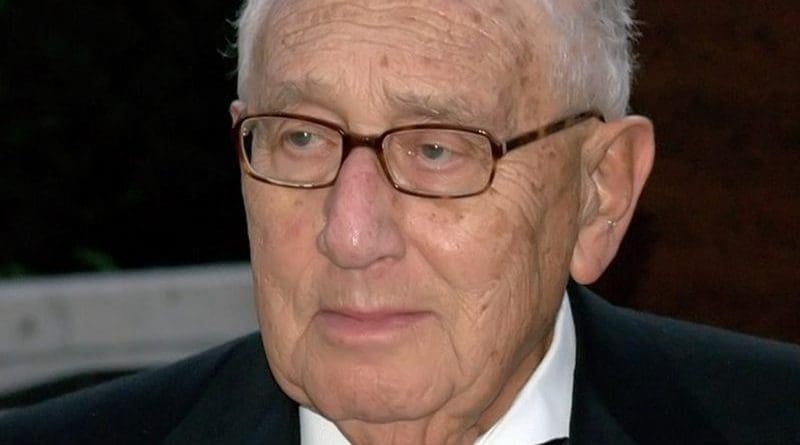
 Henry Kissinger. Photo by David Shankbone, Wikipedia Commons.

The Legacy Of Henry Kissinger – OpEd

By 

Bengalis of all generations would remember with a shiver the insufferable genocide perpetrated by the Pakistani military junta on unarmed people of then East Pakistan and with gratitude to Ishaan Tharoor of Washington Post for his article titled Keeping Dhaka Ghosts Alive (24 September 2023) for reminding the present generation of the shock and disbelief that my generation had seen and suffered. 

Amazingly, writes Jessica T Mathews in Foreign Affairs article (Profiles in Power-The World according to Henry Kissinger-January/February 2023) that Kissinger raised the  bar still higher, and even  posited  that a “global war over Bangladesh” was “possible.” Few would dispute that Nixon and Kissinger were juggling critical U.S. relations with both China and the Soviet Union or that the opening of relations with China held far greater strategic value in 1971 than did autonomy for East Pakistan. But serious questions remain. Did pursuing that opening requires the stance Washington took? When policy in a democracy requires secrecy because of widespread opposition, how often does it produce a beneficial result in the long run? Do illegal acts—in this case, arms transfers—by the government lower the threshold for bad behavior, leading others, in and out of government, to break the law? Is there a better balance to be found than obtained here between a realist concern for the national interest and a decent respect for human life, including brown, non-Christian life?

Such questions raised by Jessica Mathews could be found in Henry Kissinger’s life as a realist. One could also borrow from Harvard luminary Joseph Nye Jr’s opinion, “On the negative side of his ledger is the overthrow of the Allende government in Chile; the backing of Pakistan’s massive brutality against Bangladeshis and Bengalis in the early ’70s — some people would add East Timor, where he supported the government. But the biggest of all is Vietnam and the bombing of Cambodia, which led to Pol Pot coming in with a genocidal regime. And then, the way that war ended, which is more controversial. Some people thought they ended it well. My view is that they could have ended sooner with far less loss of lives, both American and Vietnamese.” 

The main context of this article though is the death of Henry Kissinger who passed away at the ripe age of 100. The British paper The Economist which had a long conversation with Henry Kissinger before his death has written that nobody alive has more experience in international affairs, first as a scholar of 19th-century diplomacy, later as America’s national security adviser and secretary of state, and for the past 46 years as a consultant and emissary to monarchs, presidents, and prime ministers. 

Referring to US-China tensions, Henry Kissinger expressed his worries. “Both sides have convinced themselves that the other represents a strategic danger,” he says. “We are on the path to great-power confrontation.”  Henry Kissinger added that his alarm is caused by China’s and America’s intensifying competition for technological and economic pre-eminence. Even as Russia tumbles into China’s orbit and war overshadows Europe’s eastern flank, he feared that AI was about to supercharge the Sino-American rivalry. Around the world, the balance of power and the technological basis of warfare are shifting so fast and in so many ways that countries lack any settled principle on which they can establish order. If they cannot find one, they may resort to force. 

“We’re in the classic pre-World War I situation,” he said, “where neither side has much margin of political concession and in which any disturbance of the equilibrium can lead to catastrophic consequences.”  The Economist in its long write up added that in his view, the fate of humanity depends on whether America and China can get along. He believed the rapid progress of AI, in particular, leaves them only five-to-ten years to find a way. Despite a reputation for being conciliatory towards the government in Beijing, he acknowledged that many Chinese thinkers believe America is on a downward slope and that, “therefore, as a result of a historic evolution, they will eventually supplant us.” 

He believed that China’s leadership resents Western policymakers’ talk of a global rules-based order, when what they really mean is America’s rules and America’s order. China’s rulers are insulted by what they see as the condescending bargain offered by the West, of granting China privileges if it behaves (they surely think the privileges should be theirs by right, as a rising power). Indeed, some in China suspect that America will never treat it as an equal and that it’s foolish to imagine it might. However, Henry Kissinger also warned against misinterpreting China’s ambitions. In Washington, “They say China wants world domination…The answer is that they [in China] want to be powerful,” he said. “They’re not heading for world domination in a Hitlerian sense,”  “That is not how they think or have ever thought of world order.” In Nazi Germany war was inevitable because Adolf Hitler needed it, but China is different. He had met many Chinese leaders, starting with Mao Tse Tung . He did not doubt their ideological commitment, but this has always been welded onto a keen sense of their country’s interests and capabilities. 

Henry Kissinger saw the Chinese system as more Confucian than Marxist. That teaches Chinese leaders to attain the maximum strength of which their country is capable and to seek to be respected for their accomplishments. Chinese leaders want to be recognized as the international system’s final judges of their interests. “If they achieved superiority that can genuinely be used, would they drive it to the point of imposing Chinese culture?” he asks. “I don’t know. My instinct is No…[But] I believe it is in our capacity to prevent that situation from arising by a combination of diplomacy and force.” One natural American response to the challenge of China’s ambition is to probe it, as a way to identify how to sustain the equilibrium between the two powers. Another is to establish a permanent dialogue between China and America. China “is trying to play a global role. We have to assess at each point if the conceptions of a strategic role are compatible.” If they are not, then the question of force will arise.

Fareed Zakaria of the Washington Post in an article on Henry Kissinger (November 30, 2023. Henry  Kissinger  The Titan of  Realism) quoted an obituary  in the New York Times by David E. Sanger summarizing Henry  Kissinger in the following words  “ considered the most powerful secretary of state in the post-World War II era,” as a “scholar-turned-diplomat who engineered the United States’ opening to China, negotiated its exit from Vietnam, and used cunning, ambition and intellect to remake American power relationships with the Soviet Union at the height of the Cold War, sometimes trampling on democratic values to do so.” On that trampling of democratic values, Gary J. Bass writes for The Atlantic that Kissinger steered the US into some of the policies for which it is most criticized globally. Bass writes: “Yet for all the praise of Kissinger’s insights into global affairs and his role in establishing relations with Communist China, his policies are better remembered for his callousness toward the most helpless people in the world. How many of his eulogists will grapple with his full record in Vietnam, Cambodia, Laos, Bangladesh, Chile, Argentina, East Timor, Cyprus, and elsewhere?”

Harvard luminary Joseph Nye Jr. (Judging Henry Kissinger. Did the Ends Justify the Means? By Joseph S. Nye, Jr. November 30, 2023) he justified the genocide in Bangladesh by quoting his own words In the war of secession of Bangladesh from Pakistan, Kissinger and Nixon were criticized for not condemning Pakistani President Yahya Khan for his repression and bloodshed in Bangladesh, which resulted in the deaths of at least 300,000 Bengalis and sent a flood of refugees into India. Kissinger argued that his silence was needed to secure Yahya’s help in establishing ties with China. But he has admitted that Nixon’s dislike of Indian Prime Minister Indira Gandhi, which Kissinger abetted, was also a factor Unquote. Equally Joseph Nye Jr. asks how does Kissinger measures up on these criteria of moralism versus realism. In Joseph Nye’s words quote   He certainly had great successes: the opening of China, establishing détente with the Soviet Union, and managing crises in the Middle East, all of which made the world safer.

In China, for instance, Kissinger and Nixon had the vision and temerity to guide world politics away from Cold War bipolarity and reintegrate Beijing into the international system. They had to ignore the ugly nature of Mao Zedong’s totalitarian regime. Similarly, in managing détente and arms control with Moscow, Kissinger had to accept the legitimacy of another totalitarian regime and go slower than many Americans wanted in pushing the Kremlin to allow Jewish emigration. Nonetheless, his position helped lower the risk of nuclear war and create the conditions in which the Soviet Union itself gradually eroded. Here, again, the moral gains far outweighed the costs. And although he took risks by raising the alert level of U.S. nuclear forces to DEFCON 3 during the Yom Kippur War in the Middle East, Kissinger’s judgment turned out to be right. Ultimately, he managed to reduce tensions Unquote. In short, it is too early to pass judgment on the success and failure of a person like Henry Kissinger. The present article is only a drop in the ocean of books, articles, and research papers to come in the future unveiling the complex character of Henry Kissinger who lived a life that very few individuals can aspire to live. 


British “Civilizing Mission” In India

Colonial rule in India was framed as an act that was beneficial to the people of India, rather than a process of political and economic dominance by a small minority of foreigners.

by Kazi Anwarul Masud

Ages back I had written an article that was published by the late lamented Subramanium Sundaram in the magazine of SAAG( South Asian Analysis Group) in which I had tried to portray the so-called superiority of the British Raj ( who had then ruled India) with a few supporters called Mcaulay’s children because otherwise it would have been impossible for the British to impose their so-called superiority over the vast Indian subcontinent. I had written that During the period of European colonial rule in India, Europeans in India typically regarded many aspects of Indian culture with disdain and supported colonial rule as a beneficial “civilizing mission”.

Royal treatment to the British people were given by their Indian servants during the British Raj.

WAS COLONIAL RULE FRAMED FOR THE BENEFIT OF THE INDIANS?

Colonial rule in India was framed as an act that was beneficial to the people of India, rather than a process of political and economic dominance by a small minority of foreigners. Under colonial rule, many practices were outlawed, such as the practice of forcing widows to immolate themselves (known as sati) with acts being deemed idolatrous being discouraged by Evangelical missionaries, the latter of which has been claimed by some scholars to have played a large role in the developments of the modern definition of Hinduism. These claims base their assumptions on the lack of a unified Hindu identity prior to the period of colonial rule, and modern Hinduism’s unprecedented outward focus on a monotheistic Vedanta worldview. These developments have been read as the result of colonial views which discouraged aspects of Indian religions that differed significantly from Christianity. It has been noted that the prominence of the Bhagavad Gita as a primary religious text in Hindu discourse was a historical response to European criticisms of Indian culture. Europeans found that the Gita had more in common with their own Christian Bible, leading to the denouncement of Hindu practices more distantly related to monotheistic worldviews; with some historians claiming that Indians began to characterize their faith as the equivalent of Christianity in belief (especially in terms of monotheism) and structure (in terms of providing an equivalent primary sacred text).     

DEVELOPMENT OF HINDU NATIONALISM

  Hindu nationalism developed in the 19th century as an internalization of European ideological prominence; with local Indian elites aiming to make themselves and Indian society modern by “emulating the West”.   This led to the emergence of what some have termed ‘neo-Hinduism’:   consisting of reformist rhetoric transforming Hindu tradition from above, disguised as a revivalist call to return to the traditional practices of the faith.   This reflects the same arguments made by Christian missionaries, who argued that the more superstitious elements of Hindu practice were responsible for corrupting the potential rational philosophy of the faith (i.e. the more Christian-like sentiments).   Moving the definitions of Hindu practice away from more overt idol worshiping, reemphasizing the concept of Brahman as a monotheistic divinity, and focusing more on the figure of Krishna in Vaishnavism due to his role as a messianic type figure (more in line with European beliefs) which makes him a suitable alternative to the Christian figure of Jesus Christ.

RUDYARD KIPLING’S “THE WHITE MAN’S BURDEN”

 Some critics have claimed that writer Rudyard Kipling’s portrayals of Indian characters in his works supported the view that colonized people were incapable of living without the help of Europeans, describing these portrayals as racist. In his famous poem “The White Man’s Burden”, Kipling directly argues for this point by romanticizing the “civilizing mission” in non-Western countries. Jaway Syed has claimed that Kipling’s poems idolize Western culture as entirely rational and civilized while treating non-white cultures as ‘childlike’ and ‘demonic’. Similar sentiments have been interpreted in Kipling’s other works, such as his characterization of the Second Boer War as a “white man’s war” along with his presentation of ‘whiteness’ as a morally and culturally superior trait of the West. His portrayal of Indians in his Jungle Book stories has also been criticized by Jane Hotchkiss as an example of the chauvinistic infantilization of colonized peoples in popular culture. Some historians claim that Kipling’s works have contributed to the development of a colonial mentality in the ways that the colonized people in these fictional narratives are made submissive to and dependent on their white rulers.

BIRTH OF “MACAULAY’S CHILDREN”

  Individuals of Indian descent who adopt European culture have sometimes been labeled as “Macaulay’s Children”. The term is usually used in a derogatory fashion, connoting disloyalty to India. It derives from 19th-century historian, politician, and colonial administrator Thomas Macaulay, who instituted the system of Macaulayism, replacing Indian languages and dialects with English as the official medium of instruction in Indian educational institutions. The consequences of this educational policy can still be felt in contemporary India, where the use of English, as opposed to Hindi, still carries with it a level of superiority.   Nationalist politicians have campaigned and pushed forward policy changes to promote the official usage of Hindi in education and media over English, which was protested against in the south of India as the imposition of Hindi upon non-Hindi speakers.                  

AMERICA COLONIZES PHILIPPINES

 The Americans were the last country to colonize the Philippines (1898–1946) and nationalists claim that it continues to act as a neo-colony of the US despite its formal independence in 1946  In the Philippines colonial mentality is most evident in the preference for Filipino mestizos (primarily those of mixed native Filipino and white ancestry, but also mixed indigenous Filipinos and Chinese, and other ethnic groups) in the entertainment industry and mass media, in which they have received extensive exposure despite constituting a small fraction of the population. The Cádiz Constitution of 1812 automatically gave Spanish citizenship to all Filipinos regardless of race. The census of 1870 stated that at least one-third of the population of Luzon had partial Hispanic ancestry (from varying points of origin and ranging from Latin America to Spain).      The combined number of all types of white mestizos or Eurasians is 3.6%, according to a genetic study by Stanford University. This is contradicted by another genetic study done by California University which stated that Filipinos possess moderate amounts of European admixture.       

JOSEPH CONRAD’S HEART OF DARKNESS

     Joseph Conrad’s Heart of Darkness depicts        Marlow’s story taking place in the Belgian Congo, the most notorious European colony in Africa because of the Belgian colonizers’ immense greed and brutal treatment of the native people. In its depiction of the monstrous wastefulness and casual cruelty of the colonial agents toward the African natives, Heart of Darkness reveals the utter hypocrisy of the entire colonial effort. In Europe, colonization of Africa was justified because not only would it bring wealth to Europe, but it would also civilize and educate the “savage” African natives. Heart of Darkness shows that in practice the European colonizers used the high ideals of colonization as a cover to allow them to viciously rip whatever wealth they could from Africa.    

WHITE COLONIZER’S DAMAGE TO BLACK NATIVES

 Unlike most novels that focus on the evils of colonialism, Heart of Darkness pays more attention to the damage that colonization does to the souls of white colonizers than it does to the physical death and devastation unleashed on the black natives. Though this focus on the white colonizers makes the novella somewhat unbalanced, it does allow Heart of Darkness to extend its criticism of colonialism all the way back to its corrupt source, the “civilization” of Europe.          

BIRTH OF AMERICAN IMPERIALISM

       “American imperialism” is a term that refers to the economic, military, and cultural influence of the United States internationally.      Learning Objectives      Define American imperialism            The late nineteenth century was known as the “Age of Imperialism,” a time when the United States and other major world powers rapidly expanded their territorial possessions.      American imperialism is partly based on American exceptionalism, the idea that the United States is different from other countries because of its specific world mission to spread liberty and democracy.      One of the most notable instances of American imperialism was the annexation of Hawaii in 1898, which allowed the United States to gain possession and control of all ports, buildings, harbors, military equipment, and public property that had belonged to the Government of the Hawaiian Islands.      Some groups, such as the American Anti-Imperialist League, opposed imperialism on the grounds that it conflicted with the American ideal of Republicans and the “consent of the governed.”     

AMERICAN EXCEPTIONALISM AND SOCIAL DARWINISM

Darwinism is an ideology that seeks to apply biological concepts of Darwinism or evolutionary theory to sociology and politics, often under the assumption that conflict between societal groups leads to social progress, as superior groups surpass inferior ones.      American Exceptionalism: A belief, central to American political culture since the Revolution, that Americans have a unique mission among nations to spread freedom and democracy.      The American Anti-Imperialist League: An organization established in the United States on June 15, 1898, to battle the American annexation of the Philippines as an insular area.      American Imperialism: A term that refers to the economic, military, and cultural influence of the United States on other countries.      Expansion and Power      “American imperialism” is a term that refers to the economic, military, and cultural influence of the United States on other countries. First popularized during the presidency of James K. Polk, the concept of an “American Empire” was made a reality throughout the latter half of the 1800s. During this time, industrialization caused American businessmen to seek new international markets in which to sell their goods. In addition, the increasing influence of social Darwinism led to the belief that the United States was inherently responsible for bringing concepts such as industry, democracy, and Christianity to less developed “savage” societies. The combination of these attitudes and other factors led the United States toward imperialism.                  

ALEXIS DE TOCQUEVILLE AND AMERICAN IMPERIALISM

“Ten Thousand Miles from Tip to Tip,” refers to the extension of U.S. domination (symbolized by a bald eagle) from Puerto Rico to the Philippines. The cartoon contrasts the 1898 representation with that of the United States in 1798.      American imperialism is partly rooted in American exceptionalism, the idea that the United States is different from other countries due to its specific world mission to spread liberty and democracy. This theory often is traced back to the words of 1800s French observer Alexis de Tocqueville, who concluded that the United States was a unique nation, “proceeding along a path to which no limit can be perceived.”      Pinpointing the actual beginning of American imperialism is difficult. Some historians suggest that it began with the writing of the Constitution; historian Donald W. Meinig argues that the imperial behavior of the United States dates back to at least the Louisiana Purchase. He describes this event as an “aggressive encroachment of one people upon the territory of another, resulting in the subjugation of that people to alien rule.” Here, he is referring to the U.S. policies toward Native Americans, which he said were, “designed to remold them into a people more appropriately conformed to imperial desires.”

Kazi Anwarul Masud is a retired Bangladeshi diplomat. During his tenure, he worked in several countries as the ambassador of Bangladesh including Thailand, Vietnam, South Korea and Germany

Monday, December 4, 2023


Joe Biden’s Year Long Record of Foreign Policy

Successive US Presidents including Barack Obama believed that awarding China with economic support and its inclusion in the World Trade Organization would help China to enter a rule-based world and ultimately towards democracy.

  
7 mins read
 
Joseph Robinette Biden Jr. 46th and current president of the United States [ Photo: Alex Majoli / Magnum]

JOE BIDEN’S CHINA POLICY

A year has passed since President JOE Biden’s accession to the Presidency of the USA. In his inaugural address, he promised to be President for all Americans, those who stood by him and those who did not. The US may not be as rich as it was when after the Second World War yet the US became the global hegemon and its writ was accepted by the entire world. Sea waves no longer ruled the world as Britain and indeed the entire Europe wrecked by Adolph Hitler’s incessant attacks had to submit to the American wealth for resurrection from poverty to prosperity. Emergence of NATO and the European Union, all countries practicing democracy, came to the rescue of American suzerainty.  In the meantime, while challenge to the US came from an unknown part of the world, now believed by most Americans as an existential threat to US security. Though successive US Presidents including Barack Obama believed that awarding China with economic support and its inclusion in the World Trade Organization would help China to enter a rule-based world and ultimately towards democracy. This hope was shattered with the complete rule of the Chinese Communist Party over the entire population where dissent from the dictates of the CCP would send the person concerned to the “re-education center” where an estimated one million people are presently being lodged. Donald Trump with his America First slogan took a strict policy towards China which President Joe Biden is continuing.

ALTERNATE VIEWS OF DONALD TRUMP’S POLICY

  Now that Donald Trump has finally gone the damning of his administration by Francis Fukuyama (Rotten to the Core), Stephen Walt( Hell of Good Intentions: America’s Foreign Policy Elites), John Mearsheimer’s ( The Great Delusion: Liberal Dreams and International Realities) and many others have not only joined the force for the deliberate slide of American international standing, but many like NYT’s Jennifer Rubin’s eulogy of January 21st, 2021 (Joe Biden delivers one of the best inaugural addresses in memory) hopes for a better America more inclusive like a middle-class foreign policy bringing a new democracy still reluctant to join forces with the US fearing that the country may not again elect an authoritarian President more at home with Capitol burning mob reminiscent of Hitler’s burning of Bundestag than democracies more at home with peaceful transfer of power.

FUKUYAMA’S EXHORTATION OF THE UNIVERSAL DECLARATION OF HUMAN RIGHTS

 Fukuyama exhorted the world to look at the Universal Declaration of Human Rights based on the principle of universal human dignity, “without distinction of any kind, such as race, color, sex, language, religion, political or other opinion, national or social origin, property, birth, or other status” as the lodestar.  Thomas Carothers and Andrew O! Donahue( of Carnegie Endowment of International Peace) have described political polarization in South and South East Asia as with entrenched political divides and limiting liberalization of taking faltering steps toward democracy.

INDIA’S FALTERING STEPS FROM CONSTITUTIONAL LEGALITY

 It is surprising that the largest democracy in the world—India—has been bracketed in the group of taking ‘faltering steps” if one were to, constitutional legality aside, India since liberation from British rule in 1947 has been practicing unbroken democratic rule. The recent constitutional changes regarding the status of Kashmir and the persecution of a minority have blighted the Image India had created for decades. This polarization based on religious differences, one hopes, would not only be confined within definable geographical areas but also would be temporary in a country that houses people of different ethnic, religious, and identities thus avoiding polarization that India can ill afford.   Carothers and O! Donohue observed utilizing “ a common definition of severe polarization developed by Jennifer McCoy and Murat Somer. In their path-breaking recent work, these scholars define severe or “pernicious” polarization as “a process whereby the normal multiplicity of differences in the society increasingly align[s] along a single dimension, cross-cutting differences become reinforcing, and people increasingly perceive and describe politics and society in terms of ‘us’ versus ‘them”.  

HINDU-MUSLIM DIVIDE IN INDIA

The authors added the comments by Niranjan Sahoo that the divide between secular and Hindu nationalist visions of Indian identity forms the crux of polarization. Although the country’s political tensions have been simmering since the 1980s, the Hindu right’s landslide electoral victories in 2014 and 2019 brought polarization to a boil. In the current context of toxic partisanship, attacks on independent institutions have increased, violence against minority communities has flared up, and the electoral success of Hindu nationalist parties has rendered the opposition reluctant to defend pluralism and minority rights. In a panel discussion (Constitution, Democracy, and Citizenship – Circa 2020)  Niranjan Sahoo expressed his opinion on the need to protect and safeguard the Constitution which remained the mother of not just Indian democracy but also seen as the bible to understand the workings of democracy worldwide. He explained how CAA and NRC have become a serious threat to the citizen and the idea of citizenship. He argued, “The citizenship idea will not wither away or be deleted from Constitution but the very notion of its day-to-day affairs of the Republic is witnessing a sort of systematic erosion. And it is not largely through the constitutional changes but through the politics on the street. Sahoo appealed for the need for more collective action and mobilization as happened in the case of farmer’s agitation and anti-CAA protests. These unprecedented ideological transformations and unprecedented mobilization can challenge the majoritarian state not just in terms of ideas but also in terms of politics on the streets.  

REACTION IN INDIA’S IMMEDIATE NEIGHBORS

 As the Indians themselves are critical of the Central government’s policies so it is natural for the immediate neighbors to be alert as developments in India affect their internal and external policies. Some of the Indian neighbors are more affected than others. Bangladesh is the most prominent among them. Muslim population is estimated to be 165 million with a density of 1265 per sq kilometer. The Hindu population is estimated to be 13 million or about 9% of the total population. It used to be 30% in 1947. The partition of India and Pakistan was the major reason for the exodus of Hindus from then East Pakistan. It is surmised that the representation of Hindus in government service and in law enforcement agencies is more than in proportion to the Hindu population in Bangladesh.

INDO-BANGLADESH RELATIONS

Besides the imposition of the Citizenship Amendment Act in Assam and the cross-border killing of Bangladeshi citizens by BSF is increasingly becoming an issue of concern to Bangladesh authorities. Yet relations between the two neighbors are and have to be as friendly as possible. India has promised to provide COVID vaccine to Bangladesh at the same time as is provided to Indian nationals. Inter-country relations are determined by several factors of which geographical proximity is an important factor. India and Bangladesh share a common border of 4096 km running through five Indian states, West Bengal, Assam, Meghalaya, Tripura, and Mizoram. India’s relations with Bangladesh are traditionally, cultural, social, and economic. There is much that brings them together shared history and common heritage linguistic and cultural ties, and passion for music, literature, and the arts. India shares not only a common history of struggle for freedom and liberation but also enduring feelings of both fraternal as well as familial ties (Javid Ahmad Mir, Research Scholar at School of Social Sciences, Devi Ahlya Viswavidalya, Indore, India).

INDIA’S HELP IN THE BANGLADESH WAR OF LIBERATION

Many opine that Indian help to Bangladesh in 1971 was more dictated by her resolve to dismember Pakistan than to see an immediate neighbor in distress. Hosting about a million refugees from then East Pakistan had put immense pressure on India. If Bangabandhu   Sheikh Mujibur Rahman was the Father of Bangladesh in whose name millions of Bangladeshis fought and won the war of independence then the undeterred resolve and untiring efforts of then Indian Prime Minister Indira Gandhi brought the war of independence to fruition. But for Henry Kissinger’s Machiavellian policy of creating a front with China Indian forces were within striking distance of capturing Lahore the second most important city of Pakistan. BBC termed a report by Anthony Mascarehas, then a Pakistani journalist on genocide committed on unarmed Bengalis as a first-hand report exposing to the world yet unaware of the extent of brutality committed in the “civilized” society of the twentieth century. Similarly, Christopher Hitchens in his book Trial of Henry Kissinger named Bangladesh as one of those countries indicting Henry Kissinger for authorizing in  “Indochina, Bangladesh, Chile, Cyprus, East Timor, and in the plight of the Iraqi Kurds, “including conspiracy to commit murder, kidnap, and torture. “With the precision and tenacity of a prosecutor, Hitchens offers an unrepentant portrait of a felonious diplomat who “maintained that laws were like cobwebs,” and implores governments around the world, including our own, to bring him swiftly to justice”.  Many books and articles have been written on genocide in Bangladesh and should continue to be written so that the world jumping from crisis to crisis does not forget those who laid down their lives for freedom. No less important, perhaps more in many cases, is the economic relations between neighbors.

BANGLADESH’S DEPENDENCE ON INDIA

Bangladesh being hemmed on three sides by Indian land-related trade is a logical option. Besides India’s economy being one of the largest in the world and growing fast ( less than that of China due to its democratic way of decision-making compared to Xi Jiping’s dictatorial way) the opportunity for discussion before decisions is taken is favorable to India’s neighbors used to since the British left Indian subcontinent. In May last year, Britain proposed the formation of D10—which would include existing G 7 and include India, South Korea, and Australia to create a wall of democracies against external threats from China and other non-democracies admitting at the same time fractures within democracies caused mainly during the Trump years.

JOE BIDEN’S ATTEMPTS TO CORRECT DONALD TRUPM’S EXCESSES IN FOREIGN POLICY

As Hal Brands (John Hopkins School of Advanced International Studies) pointed out “Most important, Trump’s recognition that the great gamble of post–Cold War foreign policy—the effort to pacify China through integration and, eventually, liberalization—had failed freed the Pentagon and other agencies to begin crafting a more competitive approach. It took an illiberal president to identify the distortions and illusions that had accumulated within the liberal order—Last Chance for American Internationalism). Trump has already made history by becoming the first President of the US to be impeached twice for his foolhardy domestic and foreign policies. Whether Joe Biden’s Presidency would be able to fully weather the fallout of Trump’s legacy remains to be seen. For South Asia India’s domestic and foreign policies would remain to have an immediate impact.  Bangladesh in particular as the only Muslim-majority country in India’s vicinity would need to remain alert.


USA’s Dilemma: Balancing Relations with Muslim World and Israel

The end of the Cold War witnessed a sea change. Having shed its pretensions to superpower status, Moscow saw its influence in the Middle East dissipate.

  
5 mins read
 
Prime Minister Benjamin Netanyahu (L) greets US President Joe Biden upon his arrival at Tel Aviv's Ben Gurion Airport on October 18, 2023. (Brendan SMIALOWSKI / AFP)

Joe Biden was Vice President in Barack Obama’s administration from 2009 to 2017. In May 2013 Joe Biden in a speech a speech to a Jewish group said that the Jewish influence “behind” American culture is “immense.” Praising a Jewish audience, he spoke of the prominent roles Jews had played in transforming American attitudes toward civil rights, feminism, and gay rights. He said quote   You make up 11 percent of the seats in the United States Congress. You make up one-third of all Nobel laureates. So many notions that are embraced by this nation that particularly emanate from over 5,000 years of Jewish history, tradition, and culture: independence, individualism, fairness, decency, justice, and charity unquote. Biden added that Think behind of all that, I bet you 85 percent of those changes, whether it’s in Hollywood or social media are a consequence of Jewish leaders in the industry. The influence is immense, the influence is immense. And, I might add, it is all to the good,” he said. Jews have also been key to the evolution of American jurisprudence. “You literally can’t. You can’t talk about the recognition of … rights in the Constitution without looking at these incredible jurists that we’ve had.” “Jewish heritage has shaped who we are – all of us, us, me – as much or more than any other factor in the last 223 years.

JOHN MEARSHEIMER AND STEPHEN WALT ON ISRAELI LOBBY

And that’s a fact,” he said. If I may add a long dissertation from WIKIPEDIA which says that John Mearsheimer and Stephen Walt state in their controversial bestseller, The Israel Lobby and U.S. Foreign Policy, that the tone of the right-leaning component of the Israel lobby results from the influence of the leaders of the two top lobby groups: AIPAC and the Conference of Presidents of Major American Jewish Organizations. They go on to list, as right-leaning think tanks associated with the lobby, the three important analysis groups. Added were other similar lobbies, such as the NRA (NRA) and the AARP.A number of commentators have asserted that the Israel lobby has undue or pervasive influence over U.S. foreign policy in the Middle East.     Mearsheimer and Walt state that “pro-Israel figures have established a commanding presence at the American Enterprise Institute, , the Center for Security Policy, , the Foreign Research Institute, The Heritage Foundation,  the Hudson Institute, the Institute of Foreign Policy Analysis,  and the Jewish Institute for National Security Affairs (JINSA). These think tanks are all decidedly pro-Israel.  In 2002, the Brookings Institution was founded the, named after Haim Saban, an Israeli-American media proprietor, who donated $13 million toward its establishment. Saban has stated of himself, “I’m a one-issue guy, and my issue is Israel”.  

JINSA’S CLOSE  TIES WITH GEORGE W BUSH’S ADMINISTRATION

 JINSA had close ties to the administration of George W Bush in that it “draws from the most conservative hawks in the U.S. establishment for its board of directors” including Vice-President Richard Cheney and some important Bush administration appointees. Analyst Jason Vest wrote that both(the Jewish Institute for National Security Affairs- JINSA) and the Center for Security Policy think they are “underwritten by far-right American Zionists” and that they both “effectively hold there is no difference between US and Israeli national security interests, and that the only way to assure continued safety and prosperity for both countries is through hegemony in the Middle East – a hegemony achieved with the traditional cold war recipe of feints, force, clientism and covert action.” 

GEORGE SCHULTZ REFUTES THE ISRAELI LOBBY’ INFLUENCE

However former Secretary of State George Schultz stated that “the notion that U.S. policy on Israel and the Middle East is the result of the Israeli lobby’s influence is simply wrong.”  That is not to say that AIPAC and others have no influence. Nor did the US  shy away from one because ‘the lobby’ opposed it. That is not to say that AIPAC and others have no influence. Friendly relations between Israel and the U.S. have been and continue to be a tenet of both American and Israeli foreign policy. Israel receives bipartisan support in the U.S. Congress. The Israeli Foreign Ministry states that U.S. and Israel share common “economic, political, strategic, and diplomatic concerns” and that the countries exchange “intelligence and military information” and cooperate in an effort to halt international terrorism and illegal drug trade. Furthermore, a majority of American citizens view Israel favorably. In 2011, the Washington Institute for Near East Policy (a think tank founded by “a small group of visionary Americans committed to advancing U.S. interests in the Middle East”) argued that the U.S.-Israel relationship is “A Strategic Asset for the United States   One analyst asked: Would Saudi Arabia’s policies toward the United States be markedly different in practice if Washington entered into a sustained crisis with Israel over the Palestine issue during which the bilateral relationship between the United States and Israel went into steep, systemic decline? In that instance, would Riyadh lower the price of oil? Would it stop hedging its regional bets concerning U.S. attempts to coerce Iran into freezing its nuclear weapons program? Would it regard U.S. policy toward Afghanistan any less critically? Would it view American democracy promotion in the Middle East more favorably? Would it be more inclined to reform its internal governmental processes to be more in line with U.S. preferences? Many more questions may be raised defying a clear-cut answer.

IT IS NOW A MULTIPOLAR WORLD

The US today already lives in a multi-polar world. It has to depend on NATO, the EUROPEAN UNION, and other Western countries for support and for demonstrating to the world that Sino-Russian “limitless” friendship notwithstanding the benefits derived since the Yalta Conference, albeit with beneficial changes when needed, would continue despite Russian aggression of Ukraine.   These are difficult questions to answer. British newspaper The Guardian ( 03-11-2023) which in print wrote Russia is no longer a superpower surmised Russian benefit from the present global crisis. The Guardian wrote that what the Soviets really wanted was a comprehensive peace settlement through a Soviet-American agreement, where the US “delivered” Israel, while the Soviet Union “delivered” the Arabs. Only there was a small problem: neither Israel nor the Arabs were cooperating. The Yom Kippur War left the Soviet leader, Leonid Brezhnev, deeply dissatisfied with his Arab friends. Brezhnev was very angry and was reported as saying. “We’ve been offering them a reasonable way all these years. But no, they wanted to have a fight.”

EGYPT-ISRAEL AND CAMP DAVID ACCORDS

In the aftermath, Egypt’s President, Anwar Sadat, pursued rapprochement with the US and then with Israel, a policy that led to the signing of the Camp David Accords in 1978 and the return of Sinai to Egypt. The Soviets fumed at what to them looked like a break in the united Arab front; they worried, in particular, about the unresolved Palestinian question. The 1970s were the high point for Moscow’s standing in the Middle East. Its influence there was largely a function of the Soviet ability to furnish a wide-ranging clientele with military aid. Its advocacy on behalf of the Palestinians (including consistent support for Yasser Arafat) helped sustain the Soviet Union’s reputation in the region, even if it was tarnished by the Soviet invasion of Afghanistan in December 1979. The end of the Cold War witnessed a sea change. Having shed its pretensions to superpower status, Moscow saw its influence in the Middle East dissipate. Yet today, unlike in the late 1960s and the early 1970s, Russia is not a superpower that can project force across the region and sustain a wide-ranging clientele through military and economic aid.  There is one immediately tangible way a war in the Middle East would benefit Vladimir Putin: by potentially raising the price of oil. So far, the impact has been limited, but the world may not have yet seen the worst of it.