Saturday, May 4, 2024

Print

China-Russia “Limitless” Freindship

By Kazi Anwarul Masud
Issue:  Net Edition    | Date : 27 Apr , 2024

Alexander Gubaev on China-Russia Limitless Friendship

Alexander Gubaev, an expert on Russian affairs, not only termed the China -Russia  alliance “unholy” but he also cast doubt –‘Why the West Won’t Be Able to Drive a Wedge Between Russia and China’ ( April 2024). China and Russia are more firmly aligned now than at any time since the 1950s. The tightening of this alignment between Russia and China is one of the most important geopolitical outcomes of Putin’s war against Ukraine. The conscious efforts of Xi Jinping and Vladimir Putin drive much of this reorientation, but it is also the byproduct of the deepening schism between the West and both countries. Western officials cannot wish this axis away.  Instead, the West should be prepared for an extended period of simultaneous confrontation with two immense nuclear-armed powers.  In a joint statement issued on February 4, 2022, Putin and Xi described ties between their two countries as a “partnership without limits.” That phrase won a lot of attention in the West, especially after Putin invaded Ukraine just 20 days later.

History of China-Russia Partnership

Yet the deepening partnership was not born in February 2022. Following the bitter estrangement of the Sino-Soviet split that spanned the 1960s to the 1980s, China and Russia have become closer for several pragmatic reasons. Both sides wanted to make the territorial conflict between them a thing of the past, and by 2006, their 2,615-mile border had finally been fully delimited. Economic complementarity also drove them together.   And as Russia grew increasingly authoritarian with Putin in charge since 2000, Beijing and Moscow teamed up at the UN Security Council, using their power as permanent members to push back against many of the positions and norms advocated by Western countries, including the use of sanctions against authoritarian regimes and U.S.-led pressure campaigns in regional hot spots such as Syria. China and Russia have also long shared a distrust of the United States, seeing Washington as an ideology-driven global hegemon that wants to prevent Beijing and Moscow from taking their rightful places in leading the world order and, even worse, that aims to topple their regimes.

Russia-China growing freindship and Ukraine War

Russia and China’s growing closeness is one of the most important outcomes of the war in Ukraine.  Since Xi’s state visit to Russia in March 2023, Russian Prime Minister Mikhail Mishustin and senior members of his team have traveled to China several times.  Throughout 2023, many senior Russian officials and CEOs of the largest state-owned and private companies shuttled to and from China. Senior Chinese leaders—especially those from the military and security sectors—have also made trips to Russia. Russian Foreign Minister Sergei Lavrov visited Beijing for talks with his Chinese counterpart Wang Yi. It is notable that this traffic is mostly one-sided—senior Russian officials and business leaders are going to China much more frequently than their Chinese counterparts going the other way, a clear indication of Russia’s desperate need for China. The one exception is the military-security domain, where the visits of high-ranking officials have tended to be symmetrical and reciprocal.

Independent opinion polls suggest Russians View China Positively

The overall warming of attitudes to China is reflected in opinion polls, too, including recent data produced by the joint efforts of the Carnegie Endowment and the Levada Center, the independent Russian polling organization. At the end of 2023, 85 percent of Russians viewed China positively, where as only six percent had a negative opinion of the country.

How Russia assesses relationship with Foreign Powers

The Kremlin now assesses every relationship with a foreign power through a lens of three essential considerations: whether this relationship can help Russia directly on the battlefield in Ukraine, whether it can help sustain the Russian economy and circumvent sanctions, and whether it can help Moscow push back against the West and punish the United States and its allies for supporting Kyiv. Russia’s relationship with China emphatically checks all three boxes. Beijing is not providing direct lethal aid to Moscow in Russian invasion of Ukraine but China’s indirect support for the Russian war effort is indispensable. On the economic front, Putin’s war chest relies heavily on revenue from Chinese purchases of Russian exports. The clearance of payments in the Chinese yuan keeps the Russian financial system afloat, and imports of cars, electronics, and other consumer goods keep shops well stocked and ordinary Russians quiet. More telling, however, is Russia’s decision to firmly align with China in its geopolitical contest with the United States.

Moscow and Beijing do not want formal Military Alliance

Moscow and Beijing do not want to sign a formal military alliance, as senior officials on both sides have reiterated multiple times. Neither wants to have a legal obligation to fight for the other and be dragged into an unnecessary conflict. Still, two large nuclear powers that are on friendly terms standing back-to-back on the giant Eurasian landmass is a major headache for Washington. With the collapse of global nuclear arms control regimes and China’s rapid nuclear buildup, U.S. strategists will face tough choices about resource allocation: The United States will need to develop a strategic nuclear force that can at the same time deter two partnered rivals with vast nuclear arsenals.

China-Russia consider US as the Prime Enemy

A de facto nonaggression pact between China and Russia, and the countries’ shared perception of the United States as an enemy, could lead to increased coordination between the European and Asian theaters, further stretching U.S. resources and attention.  Putin’s anti-Western rhetoric that defines his invasion of Ukraine both as a rebellion against U.S. hegemony and “neocolonial practices” and as a bid to build a “more just multipolar world order” fails to convince the countries of the diverse global South (a group Putin grandiosely claims to represent), many of which look askance at Russia’s blatant disregard for Ukraine’s sovereignty and international law. The problem for the West is that many countries perceive its leader, the United States, to be just as cynical as Russia, thanks to Washington’s checkered legacy of interventionism and selective respect for international law.

Russia wants to replace its reliance on the West

Russia is on its way to replacing near total reliance on the West with reliance on China; it stayed afloat and has been able to wage an expansive war against a large country backed by NATO. Other countries wary of dependence on the West now see how Beijing can be a ready source of technology and payment settlement mechanisms, as well as a giant market for commodities producers. This is the most significant contribution of the Chinese-Russian alignment to the remaking of the global order. Moscow and Beijing may never sign a formal alliance, but the evolution of their relationship in the years ahead will increasingly affect the world and challenge the West. To come to terms with this development, Western policymakers should abandon the idea that they can drive a wedge between Beijing and Moscow.

US attempts to Dilute China-Russia Freindship

Under Trump, the National Security Council entertained the idea of a “reverse Kissinger” approach of engaging Russia, the weaker partner, but to no avail. Whereas former Secretary of State Henry Kissinger courted communist China during the Cold War by offering Beijing a normalization of ties with the United States, U.S. officials cannot extend a deal of that sort to either Moscow or Beijing at this point. Any hopes of peeling them away from each other are nothing more than wishful thinking. Certainly, the Sino-Russian relationship is not without its strains, and existing tensions may be exacerbated as China grows more confident and is tempted to start bossing around the Russians in a more heavy-handed way—something that no ruler in Moscow would take lightly. For now, however, Beijing and Moscow have demonstrated a remarkable ability to manage their differences.

Conclusion

If the China-Russia tandem is here to stay, Western leaders must build a long-term strategy that will help maintain peace by accounting for all the ramifications of having to compete with China and Russia simultaneously. For a start, the West will need to find the right balance between deterrence and reassurance with Moscow and Beijing to avoid dangerous escalatory situations that could arise from accidents, misperceptions, and miscommunication. Western governments should consider the second-order effects of the coercive economic measures they have applied to Russia and China and how retaliatory countermeasures further erode the fabric of globalization. And while they should not tolerate Russian and Chinese disinformation and attempts to subvert the functioning of international institutions, Western countries should seek to make some of these institutions, such as the United Nations and its related agencies, functional again even with Beijing and Moscow on board. When considering how to protect European and Asian security, rein in climate change, govern new disruptive technologies such as artificial intelligence, and address the challenges facing global financial architecture, Western policymakers must now reckon with the reality of an increasingly resolute Sino-Russian axis.


With Navatny Dead Does Putin Have Any Red Lines?

Putin’s ruthlessness at home and his aggression abroad are difficult to fathom on his next move and how he intends to wrap up the Pandora's Box.

  
5 mins read
 
Yulia Navalnaya, widow of Alexei Navalny

VLADIMIR PUTIN’S “RED LINE” TO WESTERN POWERS

In April 2021 Russian President Vladimir Putin sternly warned the West against encroaching further on Russia’s security interests, saying Moscow’s response will be “quick and tough” and make the culprits feel bitterly sorry for their actions. The warning came during Putin’s annual state-of-the-nation address amid a massive Russian military buildup near Ukraine, where cease-fire violations in the seven-year conflict between Russia-backed separatists and Ukrainian forces have escalated in recent weeks. The United States and its allies have urged the Kremlin to pull the troops back. “I hope that no one dares to cross the red line concerning Russia, and we will determine where it is in each specific case,” Putin said. “Those who organize any provocations threatening our core security interests will regret their deeds more than they regretted anything for a long time.”

MOSCOW REJECTS WESTERN CONCERN REGARDING UKRAINE

Moscow has rejected Ukrainian and Western concerns about the troop buildup, saying it doesn’t threaten anyone and Russia is free to deploy its forces on its territory. But the Kremlin also has warned Ukraine against trying to use force to retake control of the rebel-held east, saying Russia could be forced to intervene to protect civilians in the region. “We really don’t want to burn the bridges,” Putin said. “But if some mistake our good intentions for indifference or weakness and intend to burn or even blow up those bridges themselves, Russia’s response will be asymmetrical, quick, and tough.”As Alexey Navalny’s health is deteriorating, Magnitsky campaigner Bill Browder says countries who are hesitant to levy sanctions on Russian oligarchs and put pressure on President Putin, are “cowards”. As Putin spoke, a wave of protests started rolling across Russia in support of imprisoned opposition leader Alexei Navalny, and a human rights group said nearly 1,500 people were arrested. Thousands marched in central Moscow, where police blocked off a square next to the Kremlin. Police in St. Petersburg blocked off Palace Square, outside the Hermitage museum, and protesters instead massed along Nevsky Prospekt. The politician, who is Putin’s most persistent critic and was poisoned with a chemical nerve agent last year, started a hunger strike three weeks ago to protest what he said was inadequate medical treatment and officials’ refusal to allow his doctor to visit him. His supporters called the rallies as his health reportedly is in severe decline. Weapons development.

PUTIN DECLARES RUSSIA’S INTENTION TO MODERNIZE ITS NUCLEAR ARSENALS

In his speech, Putin pointed to Russia’s moves to modernize its nuclear arsenals and said the military would continue to procure a growing number of state-of-the-art hypersonic missiles and other new weapons. He added that the development of the nuclear-armed Poseidon underwater drone and the Burevestnik nuclear-powered cruise missile is continuing successfully. In an apparent reference to the U.S. and its allies, the Russian leader denounced those who impose “unlawful, politically motivated economic sanctions and crude attempts to enforce its will on others.” He said Russia has shown restraint and often refrained from responding to “openly boorish” actions by others. The U.S. ordered 10 Russian diplomats expelled, targeted dozens of companies and individuals, and imposed new curbs on Russia’s ability to borrow money. Russia retaliated by ordering 10 U.S. diplomats to leave, blacklisting eight current and former U.S. officials, and tightening requirements for U.S. Embassy operations. “Russia has its interests, which we will defend in line with the international law,” Putin said during Wednesday’s address. “If somebody refuses to understand this obvious thing, is reluctant to conduct a dialogue and chooses a selfish and arrogant tone, Russia will always find a way to defend its position.”

PUTIN CHASTISES THE WEST FOR TAKING DEFIANT STANCE TOWARDS RUSSIA

 In an emotional outburst, Putin chastised the West for taking a defiant stance toward Russia. In an apparent reference to the U.S. allies, he compared them to Tabaqui, a cowardly golden jackal kowtowing to Shere Khan, the tiger in Rudyard Kipling’s The Jungle Book. “They howl to please their lord,” he said. Russia this week engaged in a tense tug-of-war with the Czech Republic following Prague’s move to expel 18 Russian diplomats over a massive Czech ammunition depot explosion in 2014. Moscow has dismissed the Czech accusations and retaliated by expelling 20 Czech diplomats. Putin also harshly criticized the West for failing to condemn what he described as a botched coup attempt and a failed plot to assassinate Belarus’s president, Alexander Lukashenko, allegedly involving a blockade of the country’s capital, power cuts, and cyberattacks. “The practice of organizing coups and planning political assassinations of top officials goes over the top and crosses all boundaries,” Putin said, drawing parallels to plots against Venezuelan President Nicolas Maduro and the popular protests that led to the ouster of Ukraine’s former Russia-friendly president, Viktor Yanukovych, in 2014. Russia responded to Yanukovych’s ouster by annexing Ukraine’s Crimean Peninsula and throwing its support to the separatists in the country’s east. Fighting there has since killed more than 14,000 people and devastated the industrial heartland.

IS THERE ANY RATIONALE FOR PUTIN’S “RED LINE” NOW WITH NO OPPOSITION?

On February this year and opposition leader Navalny dead, does Putin have any red lines? There is alarm about the Kremlin’s recklessness but, after two years of war, sanctions are struggling and faith in Ukraine’s ability to defeat Russia is ebbing • Katherine Butler If the death of Alexei Navalny was a shocking message from Vladimir Putin to the already cowed Russian opposition, it has dramatically refocused Europe’s attention on the war in Ukraine and the threat Putin represents beyond Russia’s borders. Outrage is matched by a new sense of alarm. Not only does Putin appear unassailable in a Russia where the space for dissent has shrunk to nothing. But Navalny’s treatment suggests that Putin has no red lines as he seeks to win in Ukraine – which he now regards as a war with the West. Navalny’s widow, Yulia, took her husband’s struggle directly to Europe’s leaders and the global defense community in Munich and Brussels. Her moral authority probably influenced the tone of a joint EU statement pinning Navalny’s death on Putin.

EU SANCTIONS AGAINST RUSSIA CONTINUES   

Beyond accusing him of “slow murder” and summoning Russia’s diplomats, however, Europe has little obvious leverage. Germany has proposed new EU sanctions. But 12 rounds of EU sanctions have already been imposed since the invasion of Ukraine in February 2022 and a 13th round was approved recently. The UK is including bosses of the Arctic penal colony where Navalny died in its sanctions package. Critics say such measures have proved symbolic and easy to dodge: efforts to make Russia an international pariah have had limited success. Could a sense of Western panic about Ukraine’s defeat in the wake of Navalny’s death translate into more urgency – and unity – about arming Ukraine? Russia made its biggest battlefield gain since May last weekend with the fall of the city of Avdiivka. Ukraine blames its allies’ failure to supply it with enough ammunition and weapons to halt Russia’s progress. Putin by contrast has turned Russia into a “Kalashnikov economy”. Relentless propaganda ensures he controls the war message within Russia. A new 10-year bilateral security pact with Ukraine underlines the shift in Berlin’s direction.

WESTRN COALITION SPLIT ON SUPPORT FOR UKRAINE

Yet, Olaf Scholz’s coalition is split over sending Taurus long-range cruise missiles, which could allow Ukraine to strike behind Russia’s lines. Germany and France are also not seeing eye to eye on how to manage support for Ukraine. French officials told Patrick Wintour that poor coordination and incompatibility were bigger problems than the “billions” spent on weapons. Worryingly for those who believe that arming Ukraine is the best hope of stopping Putin, there has been a significant shift in European public sentiment about the war.

CONCLUSION

According to exclusive new survey data, barely 10% now believe Ukraine can defeat Russia militarily. A “compromise settlement” is seen as the conflict’s most likely outcome. A year ago, most people said Ukraine must regain all its territory.  Sheer fatigue, low morale, and trepidation is the present situation in Ukraine. More than 6.4 million Ukrainians fled the country in search of safety and 3.4 million are internally displaced. There was little love lost between Alexei Navalny and Ukraine, where his failure to condemn the annexation of Crimea drew anger. But an analyst argued for Guardian opinion that the Russian opposition’s greatest hope could lie in Ukraine. Putin’s ruthlessness at home and his aggression abroad are difficult to fathom on his next move and how he intends to wrap up the Pandoras Box.

Friday, April 26, 2024

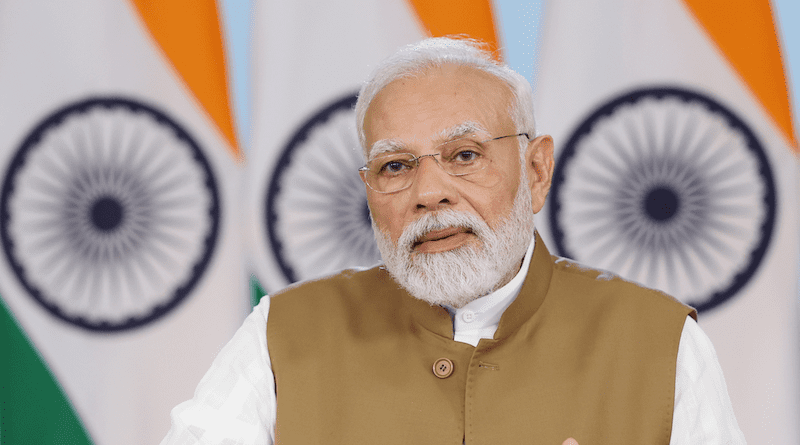
 India's Prime Minister Narendra Modi. Photo Credit: India PM Office

India: Can Narendra Modi Repeat His Past Election Victories This Time Too? – OpEd

By 

India is poised to become populous nation in 2023, with an estimated population of 1.428 billion people (17.8% of the global population).  By the end of April 2023 India’s population is expected to be 1,425,775,850 slightly higher than China’s population of 1.4 billion in 2022. UNFPA estimates India’s population at 1.4286 billion by mid-2023 surpassing China’s population. India’s population growth is driven by fertility levels, and together, China and India account for more than one-third of the world’s total population.

It’s important to note that these figures are estimates, and population dynamics can change over time due to various factors such as birth rates, mortality rates, and migration patterns.  The crossover between India and China reminds us of the importance of long-term planning and addressing the needs of different age groups. As India continues to grow, ensuring the well-being and development of its population remains a critical priority. This sub-continent is holding its election, projected by the famous British newspaper The Guardian, as a certain victory for current Prime Minister Narendra Modi despite world wide condemnation of his regime for the persecution of the minority Muslim community, in particular by the Muslim majority areas of the world. In a write up Michael Kugelmen in South Asia Brief in Foreign Affairs reported on the most recent events relating to elections in India. 

India’s national election begins on 19th April and runs for six weeks, through June 1. At first glance, the vote may seem similar to two others in South Asia this year. Just as in Bangladesh in January and Pakistan in February, an incumbent government is favored to win, and the election is playing out against a backdrop of sidelined opposition leaders and growing crackdowns on dissent. 

However, India’s election and its broader political environment stand in contrast to political trends across the region—mainly because of the striking popularity and longevity of Indian Prime Minister Narendra Modi and the ruling Bharatiya Janata Party (BJP). A recent survey put Modi’s public approval rating at 75 percent, a remarkably high figure for a head of government in office for nearly a decade. Many factors account for this popularity: Modi’s personality, his leadership model, his achievements, his ideology, and India’s weak political opposition. The main electoral uncertainty is not if Modi and the BJP will win, it’s by how much. Many of Modi’s critics say that India’s electoral playing field is unequal, but that isn’t quite accurate. They point out that India’s government has arrested opposition leaders on politically motivated charges and increased its influence over the country’s election commission, damaging opponents’ prospects. 

But the BJP enjoys overwhelming support, and the national political opposition does not. Even if the Indian state weren’t targeting opposition parties, such is the strength of the BJP that the opposition’s chances of electoral success might not improve that much. Away from national politics, the calculus is a bit different. The BJP has lost a few recent state and local elections to either the main opposition Indian National Congress or smaller regional parties. But these parties can’t hold a candle to the BJP’s countrywide clout. Then there is the longevity factor. In South Asia, few elected leaders or parties have held power as long as Modi and the BJP. Nepal has had 13 governments since 2008. Pakistan has seen a series of weak coalition governments since the end of its formal military rule the same year. Sri Lankan President Ranil Wickremesinghe took office in 2022, after his predecessor resigned amid anti-government protests. Only Bangladesh’s prime minister, Sheikh Hasina, has held office longer than Modi—since 2009—and she has benefited from polls that election observers have deemed not free or fair.  

 Both Modi’s popularity and the fact that India’s opposition hasn’t been able to put forward a strong, charismatic leader that can counter him suggest that the prime minister will face little threat to his political survival as long as he stays in office. Some reckoning for the BJP may not be that far off, even assuming the party wins this year. Whether Modi opts to try for a fourth term in 2029 remains uncertain. If not, the BJP will face major questions, chief among them the issue of his successor. The appeal of Hindu nationalism would help the BJP’s cause, but it would need to make headway on long-standing issues that could make it vulnerable, from widespread unemployment to the challenge posed by China. For now, Modi occupies a special status as one of South Asia’s most popular and longest-tenured leaders, with little intrigue attached to an election that is likely to bring him another huge public mandate. It’s a far cry from the volatility that has characterized polls and politics elsewhere in the region in recent years.

Rohan Mukherjee of London Assistant Professor of London School of Economics and Political Science in his article title A Hindu Nationalist Foreign Policy wrote that under Narendra Modi India Is Becoming More Assertive (dated April 4, 2024) and that he   is not the first Indian leader with global ambitions. The country’s first prime minister, Jawaharlal Nehru, also sought a leading role for India and worked energetically from the 1940s to the 1960s to promote a distinct brand of foreign policy—nonalignment with both the Soviet Union and the United States—through international institutions. But while Pandit Nehru’s efforts resonated with only a narrow domestic elite; the wider populace was too beset by poverty to care about intangibles such as international recognition. India today, by contrast, is a rising power whose population is primed for leaders to manipulate national aspirations for domestic and international gains. Narendra Modi has also successfully used a more confident and assertive society and diaspora to bolster his party’s political fortunes and to improve India’s global standing. 

It is, in some respects, surprising that Narendra Modi could capitalize so effectively on foreign issues. The prime minister had minimal diplomatic experience when he took office, in 2014. Yet this lack of familiarity enabled him to craft a new way of interacting with the world, one that turned diplomacy into performance art for the masses. As a populist leader accustomed to bypassing traditional institutions, appealing directly to his supporters, and tightly controlling information, Narendra Modi (and his government) used the media and large rallies to great effect. The party is constantly reaching out to people everywhere, trying to gain supporters. Even with the disruption of the COVID-19 pandemic, Narendra Modi has undertaken more international visits in his two terms as prime minister than his predecessor, Manmohan Singh, did in his two. 

The growing importance of India cannot, of course, be credited entirely to Modi or his government’s initiatives (or those of past prime ministers). The country has been helped, albeit indirectly, by China. As Beijing has become a persistent threat to its neighbors in Asia and to the West, India’s stock has risen. The United States, in particular, is wooing India in an effort to constrain China’s ambitions. As long as New Delhi can help countries compete with Beijing, India will have plenty of international partners, giving it considerable room for maneuver in its external relations. But China’s story is also a cautionary tale. As Beijing arrived as a world player, it abandoned its strategy of building friendly ties with other countries based on mutual economic gain. Instead, driven by popular and elite nationalism, it began strongly asserting claims to contested territory, acting recklessly in its own region, and demanding deference from others—alienating its neighbors and virtually every major power except Russia. This path is particularly fraught because rising nationalism exacerbates routine conflicts of interest. A society and polity that take offense at even minor slights will quickly encounter pushback from other states, in turn intensifying domestic anxieties and feelings of wounded pride, leading to a vicious cycle of provocation. U.S. House Speaker Nancy Pelosi’s 2022 visit to Taiwan provides a case in point. Beijing described the visit as a provocation and warned the United States not to “play with fire.” Pelosi, unbowed, went anyway. China then began conducting military exercises around Taiwan, further raising the stakes in the strait. Ironically, when the dust settled, Chinese nationalists accused their government of making empty threats and not doing enough to stand up to the United States. India is still early in its trajectory as a rising power. But there are signs it may fall into a similar trap. 

According to U.S. intelligence officials, New Delhi assassinated a Sikh Canadian national—officially designated a terrorist by the Indian government—on Canadian soil in 2023. Ottawa condemned the attack and demanded an explanation from New Delhi. Instead of seeking a way to defuse this crisis, it took umbrage at Canada for harboring Sikh separatists and pledged to protect India’s security (while also denying the allegations). New Delhi also moved to expel Canadian diplomats and suspend new visas for Canadians wishing to visit India. Later in the year, U.S. officials accused New Delhi of plotting to assassinate a Sikh American, sparking another dispute. When foreign policy itself becomes nationalist, it gives rise to self-defeating risks. These episodes command worldwide attention. India has come to realize that rise of China and eternal enmity of Pakistan gives little scope to India but to strengthen relations with the US.  

Conclusion

As a rising power, India is still far from that level of global game of pull and increasing the countries’ influence in global affairs.  A nationalist diplomacy backed by an increasingly confident and assertive public will also make such issues difficult to resolve by limiting the scope for compromise. Voters, for example, may turn against a government that—having set high expectations—falters in protecting expansive versions of the country’s interests and honor. National pride may know no bounds, but foreign policy must operate in a highly constrained environment. India’s political leadership will therefore have to work carefully to ensure that its nationalist diplomacy does not undermine national objectives. It may be relevant here to mention Indian Foreign Minister Dr Jaya Shankar’s reference to Goldilocks’ Principle relating to Western attitude of keeping India limited   within bounds so that India’s proclivity to curve an independent course of its own may not affect Western policies. In any case India’s friends and partners will have to adjust to India’s assertive demeanor—in part, by making room for the country as it ascends in the international order.


Can Narendra Modi Repeat His Election Victory This Time Too?

As a rising power, India is still far from that level of global game of pull and increasing the countries’ influence in global affairs.

  
7 mins read
 
An elderly woman shows her ink-marked index finger after casting her vote at a polling station during the first phase of India's general elections in Nagaon district of India's northeastern state of Assam, April 19, 2024. (Str/Xinhua)

THE MOST POPULOUS NATION ON EARTH IS HAVING ELECTIONS IN APRIL 2024

India is poised to become populous nation in 2023, with an estimated population of 1.428 billion people (17.8% of the global population).  By the end of April 2023 India’s population is expected to be 1’425’775,850 slightly higher than China’s population of 1.4 billion in 2022. UNFPA estimates India’s population at 1.4286 billion by mid-2023 surpassing China’s population. India’s population growth is driven by fertility levels, and together, China and India account for more than one-third of the world’s total population. It’s important to note that these figures are estimates, and population dynamics can change over time due to various factors such as birth rates, mortality rates, and migration patterns.  The crossover between India and China reminds us of the importance of long-term planning and addressing the needs of different age groups. As India continues to grow, ensuring the well-being and development of its population remains a critical priority. This sub-continent is holding its election, projected by the famous British newspaper The Guardian, as a certain victory for current Prime Minister Narendra Modi despite world wide condemnation of his regime for the persecution of the minority Muslim community, in particular by the Muslim majority areas of the world. In a write up Michael Kugelmen in South Asia Brief in Foreign Affairs reported on the most recent events relating to elections in India.  India’s national election begins on 19th April and runs for six weeks, through June 1. At first glance, the vote may seem similar to two others in South Asia this year. Just as in Bangladesh in January and Pakistan in February, an incumbent government is favored to win, and the election is playing out against a backdrop of sidelined opposition leaders and growing crackdowns on dissent.

POPULARITY OF NARENDRA MODI AND HIS POLITICAL PARTY

However, India’s election and its broader political environment stand in contrast to political trends across the region—mainly because of the striking popularity and longevity of Indian Prime Minister Narendra Modi and the ruling Bharatiya Janata Party (BJP). A recent survey put Modi’s public approval rating at 75 percent, a remarkably high figure for a head of government in office for nearly a decade. Many factors account for this popularity: Modi’s personality, his leadership model, his achievements, his ideology, and India’s weak political opposition. The main electoral uncertainty is not if Modi and the BJP will win, it’s by how much. Many of Modi’s critics say that India’s electoral playing field is unequal, but that isn’t quite accurate. They point out that India’s government has arrested opposition leaders on politically motivated charges and increased its influence over the country’s election commission, damaging opponents’ prospects.

WEAK OPPOSITION PARTIES ARE NO MATCH FOR BJP

But the BJP enjoys overwhelming support, and the national political opposition does not. Even if the Indian state weren’t targeting opposition parties, such is the strength of the BJP that the opposition’s chances of electoral success might not improve that much. Away from national politics, the calculus is a bit different. The BJP has lost a few recent state and local elections to either the main opposition Indian National Congress or smaller regional parties. But these parties can’t hold a candle to the BJP’s countrywide clout. Then there is the longevity factor. In South Asia, few elected leaders or parties have held power as long as Modi and the BJP. Nepal has had 13 governments since 2008. Pakistan has seen a series of weak coalition governments since the end of its formal military rule the same year. Sri Lankan President Ranil Wickremesinghe took office in 2022, after his predecessor resigned amid anti-government protests. Only Bangladesh’s prime minister, Sheikh Hasina, has held office longer than Modi—since 2009—and she has benefited from polls that election observers have deemed not free or fair. 

APPEAL OF HINDU NATIONALISM IS HELPING NARENDRA MODI

 Both Modi’s popularity and the fact that India’s opposition hasn’t been able to put forward a strong, charismatic leader that can counter him suggest that the prime minister will face little threat to his political survival as long as he stays in office. Some reckoning for the BJP may not be that far off, even assuming the party wins this year. Whether Modi opts to try for a fourth term in 2029 remains uncertain. If not, the BJP will face major questions, chief among them the issue of his successor. The appeal of Hindu nationalism would help the BJP’s cause, but it would need to make headway on long-standing issues that could make it vulnerable, from widespread unemployment to the challenge posed by China. For now, Modi occupies a special status as one of South Asia’s most popular and longest-tenured leaders, with little intrigue attached to an election that is likely to bring him another huge public mandate. It’s a far cry from the volatility that has characterized polls and politics elsewhere in the region in recent years.

UNDER NARENDRA MODI INDIA IS BECOMING MORE ASSERTIVE

Rohan Mukherjee of London Assistant Professor of London School of Economics and Political Science in his article title A Hindu Nationalist Foreign Policy wrote that under Narendra Modi India Is Becoming More Assertive (dated April 4, 2024) and that he   is not the first Indian leader with global ambitions. The country’s first prime minister, Jawaharlal Nehru, also sought a leading role for India and worked energetically from the 1940s to the 1960s to promote a distinct brand of foreign policy—nonalignment with both the Soviet Union and the United States—through international institutions. But while Pandit Nehru’s efforts resonated with only a narrow domestic elite; the wider populace was too beset by poverty to care about intangibles such as international recognition. India today, by contrast, is a rising power whose population is primed for leaders to manipulate national aspirations for domestic and international gains. Narendra Modi has also successfully used a more confident and assertive society and diaspora to bolster his party’s political fortunes and to improve India’s global standing.

NARENDRA MODI’S SURPRISING GRASP OF FOREIGN POLICY ISSUES

It is, in some respects, surprising that Narendra Modi could capitalize so effectively on foreign issues. The prime minister had minimal diplomatic experience when he took office, in 2014. Yet this lack of familiarity enabled him to craft a new way of interacting with the world, one that turned diplomacy into performance art for the masses. As a populist leader accustomed to bypassing traditional institutions, appealing directly to his supporters, and tightly controlling information, Narendra Modi (and his government) used the media and large rallies to great effect. The party is constantly reaching out to people everywhere, trying to gain supporters. Even with the disruption of the COVID-19 pandemic, Narendra Modi has undertaken more international visits in his two terms as prime minister than his predecessor, Manmohan Singh, did in his two.

CHINA’S MUSCULAR ACTIVITIES AND INDO-US RELATIONS

The growing importance of India cannot, of course, be credited entirely to Modi or his government’s initiatives (or those of past prime ministers). The country has been helped, albeit indirectly, by China. As Beijing has become a persistent threat to its neighbors in Asia and to the West, India’s stock has risen. The United States, in particular, is wooing India in an effort to constrain China’s ambitions. As long as New Delhi can help countries compete with Beijing, India will have plenty of international partners, giving it considerable room for maneuver in its external relations. But China’s story is also a cautionary tale. As Beijing arrived as a world player, it abandoned its strategy of building friendly ties with other countries based on mutual economic gain. Instead, driven by popular and elite nationalism, it began strongly asserting claims to contested territory, acting recklessly in its own region, and demanding deference from others—alienating its neighbors and virtually every major power except Russia. This path is particularly fraught because rising nationalism exacerbates routine conflicts of interest. A society and polity that take offense at even minor slights will quickly encounter pushback from other states, in turn intensifying domestic anxieties and feelings of wounded pride, leading to a vicious cycle of provocation. U.S. House Speaker Nancy Pelosi’s 2022 visit to Taiwan provides a case in point. Beijing described the visit as a provocation and warned the United States not to “play with fire.” Pelosi, unbowed, went anyway. China then began conducting military exercises around Taiwan, further raising the stakes in the strait. Ironically, when the dust settled, Chinese nationalists accused their government of making empty threats and not doing enough to stand up to the United States. India is still early in its trajectory as a rising power. But there are signs it may fall into a similar trap.

WESTERN CRITICISM OF INDIAN INVOLVEMENT IN THE ASSASSINATION OF A SIKH CANADIAN NATIONAL

According to U.S. intelligence officials, New Delhi assassinated a Sikh Canadian national—officially designated a terrorist by the Indian government—on Canadian soil in 2023. Ottawa condemned the attack and demanded an explanation from New Delhi. Instead of seeking a way to defuse this crisis, it took umbrage at Canada for harboring Sikh separatists and pledged to protect India’s security (while also denying the allegations). New Delhi also moved to expel Canadian diplomats and suspend new visas for Canadians wishing to visit India. Later in the year, U.S. officials accused New Delhi of plotting to assassinate a Sikh American, sparking another dispute. When foreign policy itself becomes nationalist, it gives rise to self-defeating risks. These episodes command worldwide attention. India has come to realize that rise of China and eternal enmity of Pakistan gives little scope to India but to strengthen relations with the US.  

CONCLUSION

As a rising power, India is still far from that level of global game of pull and increasing the countries’ influence in global affairs.  A nationalist diplomacy backed by an increasingly confident and assertive public will also make such issues difficult to resolve by limiting the scope for compromise. Voters, for example, may turn against a government that—having set high expectations—falters in protecting expansive versions of the country’s interests and honor. National pride may know no bounds, but foreign policy must operate in a highly constrained environment. India’s political leadership will therefore have to work carefully to ensure that its nationalist diplomacy does not undermine national objectives. It may be relevant here to mention Indian Foreign Minister Dr Jaya Shankar’s reference to Goldilocks’ Principle relating to Western attitude of keeping India limited   within bounds so that India’s proclivity to curve an independent course of its own may not affect Western policies. In any case India’s friends and partners will have to adjust to India’s assertive demeanor—in part, by making room for the country as it ascends in the international order